
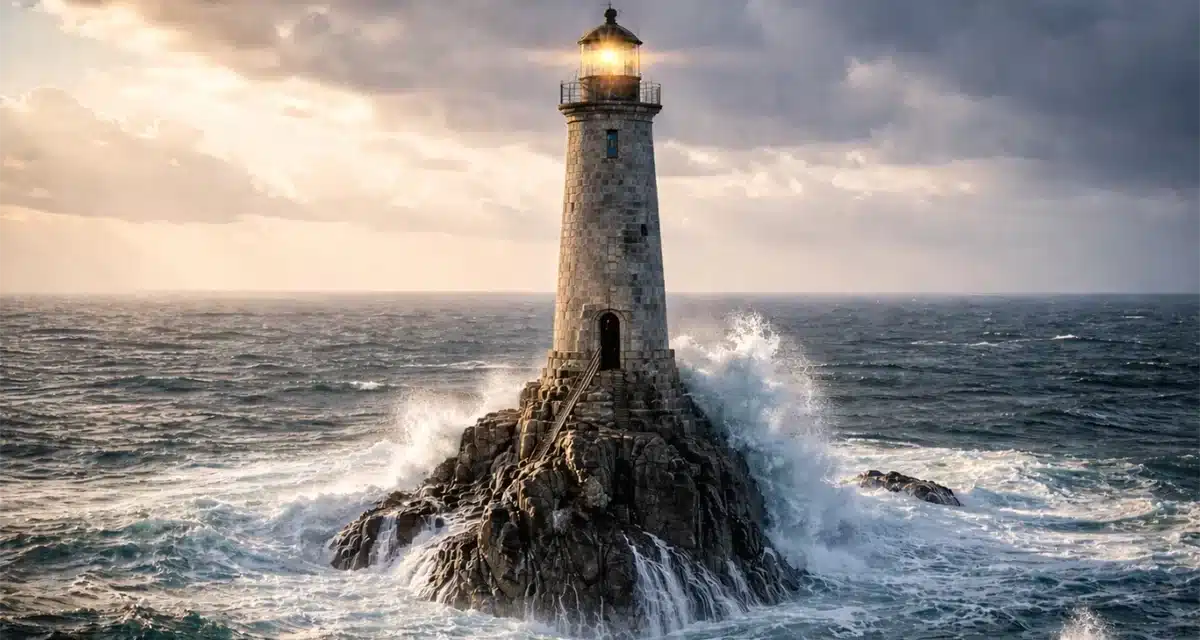
Bishop Rock Lighthouse sits on a single granite outcrop at the western edge of the Isles of Scilly, where the Atlantic offers no protection and very little margin for error.
There is no island, no surrounding land, and no gradual approach. The structure rises directly out of the sea, anchored to a rock so small that early engineers questioned whether a lighthouse could survive there at all.
It is one of the most isolated lighthouses ever built—and one of the most instructive examples of how engineering adapts when the environment refuses compromise.
Table of Contents
Where Bishop Rock Is—and Why It Matters
Bishop Rock lies at the far southwestern tip of the Isles of Scilly, off the coast of Cornwall, England.
It marks a critical navigation point where the Atlantic shipping lanes narrow as vessels approach the English Channel.
For centuries, this stretch of water was dangerous even for experienced crews.
Hidden rocks, unpredictable weather, and heavy traffic made shipwrecks common.
One of the most devastating was the loss of Admiral Sir Cloudesley Shovell’s fleet in 1707, when multiple ships ran aground in the area with the loss of nearly 2,000 lives.
That disaster forced the British Admiralty to reconsider coastal navigation aids in earnest. Bishop Rock, long known and feared by sailors, became an obvious candidate for a lighthouse—despite the near-impossibility of building one there.
The First Attempt: A Lighthouse That Did Not Last
The first Bishop Rock lighthouse was completed in 1847, and it failed almost immediately.
Designed by engineer James Walker, the structure was an iron pillar tower mounted directly into the rock.

Before it could even be fully commissioned, a powerful storm destroyed it entirely.
This failure made something clear: Bishop Rock could not support lightweight construction. Any successful lighthouse would need to be massive, rigid, and inseparable from the rock itself.
The Second Lighthouse: Stone, Weight, and Permanence
Construction of the second lighthouse began in 1851 under the direction of engineer James Walker and later Sir James Douglass.
This time, the design relied on interlocking granite blocks, each shaped to lock into the next.
Every stone was cut with precision and assembled vertically, creating a structure that behaved as a single unit rather than a stacked tower.
Key challenges included:
- Landing workers and materials on a rock constantly battered by waves
- Securing foundations during brief calm weather windows
- Designing a structure tall enough to remain visible above storm seas
The lighthouse was completed in 1858 and stood 35 meters tall. It survived—but the sea still reached higher than anticipated.
Reinforcement and the Lighthouse We See Today
By the late 19th century, it became clear the original stone tower needed reinforcement.
Storms regularly sent waves over the lantern, and erosion remained a concern.
Between 1883 and 1887, the lighthouse was encased in additional granite, widening its base and increasing its height.
This work produced the structure seen today: broader, heavier, and better able to resist the Atlantic.
After reinforcement:
- The tower stood approximately 49 meters tall
- The base diameter increased significantly
- The lantern was raised further above wave impact
This version of Bishop Rock Lighthouse has endured ever since.
Entering from the Side: A Design Choice Forced by Reality
One of the most striking aspects of Bishop Rock Lighthouse is the entrance door, located partway up the side of the tower rather than at the base.
This was not an aesthetic choice. It was survival-driven engineering.
A ground-level entrance would be unusable. Waves regularly engulf the base of the structure, even in relatively calm seas.
A door at sea level would be destroyed quickly—or worse, allow water inside.
Instead:
- The entrance is elevated well above typical wave height
- Access was historically achieved by rope, ladder, or crane
- Supplies and keepers were lifted directly into the tower
This side-entry design is common among extreme offshore lighthouses but feels especially dramatic at Bishop Rock because there is no surrounding platform or breakwater. The door opens directly over open water.
It underscores a basic reality: this lighthouse was never meant to be approached casually.
Life Inside the Lighthouse
For much of its history, Bishop Rock Lighthouse was manned by keepers who lived in complete isolation.
Rotations were long, weather could delay relief for weeks, and conditions inside the tower were severe.
Living quarters were compact and utilitarian.
Every element served a function. There was no wasted space, and no room for comfort beyond what was strictly necessary.
Daily life involved:
- Maintaining the light and optics
- Monitoring weather and sea conditions
- Performing constant maintenance on metal and stone
- Managing supplies carefully due to infrequent deliveries
Storms could shake the entire structure. Waves struck the tower with enough force to send vibrations through the granite.
The lighthouse was automated in 1992, ending permanent human occupation.
The Light Itself
Bishop Rock’s light has always been essential rather than symbolic.
Its position marks the westernmost point of England and serves as a final warning before ships enter narrower, busier waters.
Over time, the lighthouse transitioned through several lighting technologies:
- Oil lamps
- Incandescent mantles
- Electric lighting
The optic system was designed for maximum range, prioritizing reliability over complexity.
Today, the light remains operational and automated, monitored remotely by Trinity House.
Why Bishop Rock Endures as an Engineering Case Study
Bishop Rock Lighthouse is often cited not because it is beautiful, but because it is uncompromising.
It represents what happens when design responds entirely to environment rather than convenience.
There is no decorative excess. Every decision—materials, shape, entrance location—exists because alternatives failed or were impossible.
It demonstrates several principles clearly:
- Weight can be an advantage
- Rigidity matters in dynamic environments
- Access must be designed around worst-case conditions
- Maintenance needs dictate internal layout
This is not architecture attempting to impress. It is engineering attempting to survive.
Bishop Rock Today
Today, Bishop Rock Lighthouse remains active and largely unchanged in function.
It no longer houses keepers, but it still performs the role it was built for: warning ships away from a rock that offers no forgiveness.
It stands alone, exposed, and intact—more than a century and a half after its construction.
Its continued operation is not accidental. It is the result of lessons learned through failure, adaptation, and restraint.
Bishop Rock Lighthouse exists because the sea demanded it—not because humans wanted it. That distinction explains everything about how it looks, how it functions, and why it continues to stand where almost nothing else could.
Bishop Rock Lighthouse Q&A
Where is Bishop Rock Lighthouse located?
It is located on Bishop Rock at the western edge of the Isles of Scilly, off the coast of Cornwall, England.
Why was the first lighthouse destroyed?
The original iron structure was too light and was destroyed by a storm before it could be fully commissioned.
Why is the entrance door on the side?
A ground-level door would be destroyed by waves. The elevated side entrance keeps water out and allows safer access.
Was the lighthouse always automated?
No. It was manned by keepers until automation in 1992.
How did keepers enter the lighthouse?
They were lifted by rope, ladder, or crane directly to the elevated entrance.
Is the lighthouse still active?
Yes. It remains operational and is monitored remotely.
What makes Bishop Rock unique?
Its extreme isolation, minimal rock foundation, and side-entry design make it one of the most demanding lighthouse builds in history.