
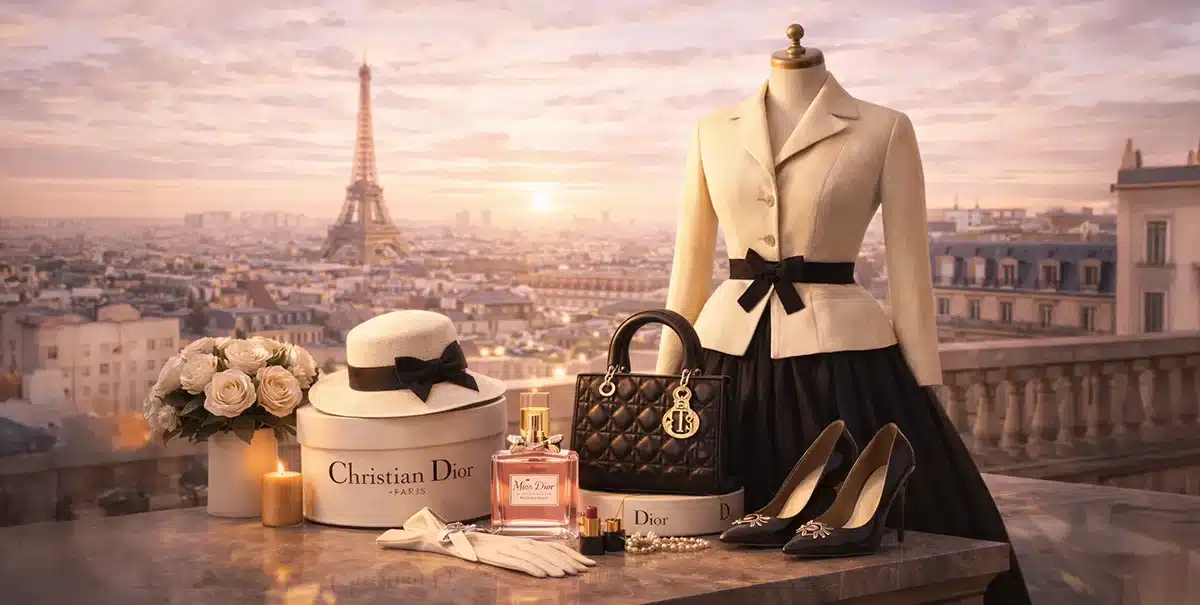
Christian Dior reoriented women’s fashion at a moment of historical rupture.
His influence did not arise from gradual evolution. It arrived as deliberate correction.
The New Look reorganized silhouette, consumption, and authority in the years following global conflict, establishing a post-war fashion order that prioritized structure, visibility, and controlled femininity.
The change was immediate and systemic.
Table of Contents
Fashion Conditions After World War II
Post-war fashion operated under scarcity, regulation, and social recalibration.
During and immediately after World War II, clothing reflected necessity.
Fabric rationing, labor disruption, and economic limitation shaped garments that emphasized utility over expression. Silhouettes narrowed.
Ornament disappeared. Standardization replaced variation.
These conditions produced functional coherence but limited aesthetic range.
Clothing addressed survival and reconstruction rather than display. The body appeared contained and pragmatic. Fashion deferred to circumstance.
Once restrictions lifted, the system required redefinition.
The Introduction of the New Look
The New Look reasserted fashion authority through volume, contrast, and visual discipline.
Dior’s 1947 collection presented a sharp departure from wartime restraint. Rounded shoulders, defined waists, and full skirts demanded material, labor, and presence.
The silhouette displaced recent norms rather than adapting them.
This intervention mattered structurally.
It restored fashion as aspirational system rather than utilitarian response. The body became focal point again. Excess returned as signifier.
The look reset expectations.
Structural features of the New Look
The silhouette functioned through specific construction choices introduced deliberately.
These included:
- Emphasized waists through shaping and internal structure
- Full skirts requiring substantial fabric
- Soft shoulders replacing military severity
- Controlled proportions directing attention to form
Each feature reinforced authority through contrast with recent deprivation.
Authority Through Silhouette
The New Look established control by defining a single dominant form.
Rather than offering variation, Dior’s approach imposed coherence.
Acceptance followed repetition and institutional validation.
Media coverage amplified the form. Buyers aligned. Imitation spread.
This consolidation restored Paris as fashion reference point.
Influence flowed outward from a recognizable center. Variation existed, but within defined parameters.
Silhouette served governance function.
Consumption and Economic Signaling
The New Look normalized renewed consumption as cultural signal.
Material abundance itself became message. Fabric usage communicated recovery.
Labor-intensive construction validated expense.
Fashion reentered economic circulation as driver rather than accessory.
This model reconnected fashion to industrial output and consumer aspiration. The garment signaled participation in post-war renewal.
Luxury regained legitimacy through structure.
Gender, Form, and Contested Freedom
The New Look reintroduced constraint alongside visual expansion.
While often framed as celebratory, the silhouette limited movement and required maintenance.
Corsetry returned in subtler forms. The body became shaped object once again.
This tension defined the era.
Liberation through abundance coexisted with physical restriction. Fashion asserted order during social reconstruction.
Freedom and control advanced together.
Institutionalization of Post-War Fashion
Dior’s model established a repeatable system rather than singular moment.
The house structured seasonal collections, licensing, and international presence.
Brand identity persisted beyond the founder. Organizational continuity supported influence.
Key institutional outcomes included:
- Centralization of Paris fashion authority
- Codified seasonal change
- Integration of fashion with media cycles
- Expansion of luxury markets internationally
The reset proved durable because it was organized.
Long-Term Structural Impact
The New Look set the framework for modern fashion cycles.
Later reactions operated against Dior’s silhouette.
Minimalism, youth movements, and functional dress gained meaning through contrast.
The reset provided reference point for decades.
Fashion regained the ability to impose direction rather than respond to condition. Authority returned through form.
The system held.
Christian Dior Q&A
What was the New Look?
A post-war silhouette emphasizing volume, structure, and contrast with wartime austerity.
Why was it introduced so abruptly?
Fashion required a visible reset after prolonged restriction and material scarcity.
Did the New Look increase freedom in dress?
Visually, yes. Physically, it reintroduced constraint through structured shaping.
How did the New Look affect consumption?
It legitimized renewed spending by associating material abundance with recovery.
Why was the New Look influential beyond Paris?
Media repetition and institutional validation accelerated global adoption.
What defines Christian Dior’s lasting significance?
The establishment of a post-war fashion order grounded in structure, authority, and organized change.