
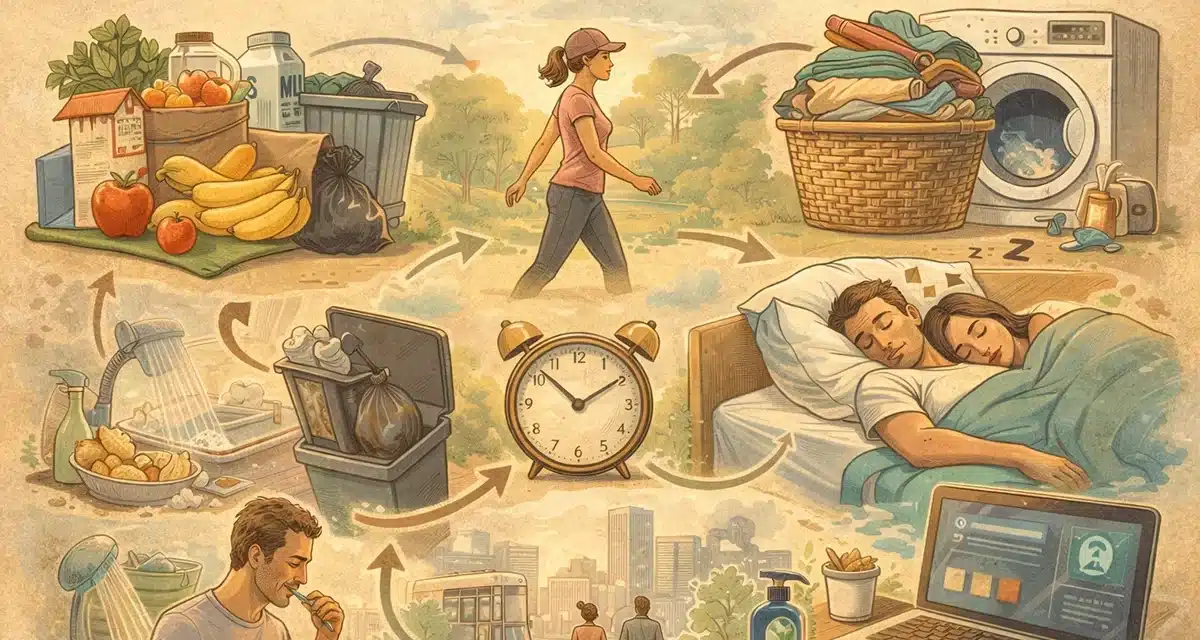
Many people interpret daily obligations as evidence that something went wrong.
Errands repeat. Hygiene never ends. Work cycles reset every morning.
The expectation, often unspoken, is that life should eventually graduate beyond upkeep.
That expectation is false.
Ongoing maintenance is not a flaw in living. It is a measurable indicator that life is still functioning.
Table of Contents
Why Effort Never Disappears
All living systems require continuous input to remain stable.
This is not motivational theory.
It is basic biology and systems behavior.
Human bodies require:
- Regular caloric intake
- Continuous hydration
- Repeated sleep cycles
- Movement to maintain muscle and joint function
- Waste removal to prevent breakdown
Human environments require:
- Cleaning to limit pathogen growth
- Repair to counter material decay
- Organization to reduce cognitive load
None of these systems reach a terminal “done” state.
A permanent completion condition only exists when the system stops operating entirely.
No upkeep would indicate one outcome only: system failure.
The Source of “There’s Always Something to Do” Stress
The stress reaction many people experience is not caused by tasks themselves.
It comes from an inaccurate mental model.
The mind treats maintenance as temporary, expecting eventual relief. When relief never arrives, the mismatch creates frustration, anxiety, and a sense of being trapped.
The error is not in the workload.
It is in expecting an endpoint that does not exist.
Once maintenance is recognized as continuous rather than transitional, the emotional response changes.
Repetition stops signaling inadequacy and starts signaling continuity.
Maintenance Confirms Continuation
Each recurring task corresponds directly to a sign of ongoing life.
Trash exists because consumption occurred.
Laundry exists because the body was active.
Sleep is needed because the brain is still processing.
Planning matters because future time still exists.
These are not constraints imposed by society or productivity culture.
They are baseline conditions of remaining alive.
When viewed correctly, the presence of routine is not evidence of limitation. It is confirmation of continuation.
Intentional Living Is Clearance, Not More Effort
Intentional living does not mean adding meaning or maximizing fulfillment. It means removing interference.
Tasks are handled so they stop occupying attention.
Work is completed so time can be used freely.
Basic care is done consistently to prevent future disruption.
The objective is not optimization.
It is reduction of friction.
This allows time to be spent on simple shared activities without distraction—walking, eating, moving through the city, being present with another person.
No event needs to justify that time. The time exists because the system is still running.
A Grounding Principle
Use this rule when routine feels heavy:
If nothing required care, nothing would still exist.
Daily effort is not a sign of failure to arrive somewhere better.
It is the condition that allows life to keep going at all.
Maintenance is not the thing interrupting life.
Maintenance is the thing confirming it.
Daily Life Maintenance Q&A
Why do daily tasks feel so mentally heavy if they are normal?
Because the mind often expects maintenance to be temporary.
When the brain anticipates an endpoint that never arrives, repeated effort gets misinterpreted as failure or confinement rather than continuity.
Is disliking routine a sign that something is wrong?
No. Discomfort usually signals a mismatch between expectations and reality, not a problem with the routine itself.
Expecting life to move beyond upkeep creates unnecessary stress.
Does enjoying maintenance mean settling or giving up ambition?
No.
Maintenance is a baseline requirement, not a ceiling. Goals sit on top of stable systems. When basics are handled consistently, cognitive and emotional capacity increases.
Why does completing small tasks reduce anxiety?
Because unfinished maintenance creates background cognitive load.
Closing loops restores a sense of order and confirms that systems are functioning.
What is the practical takeaway to remember day to day?
If nothing needed care, nothing would still exist.
Repetition is not stagnation. It is proof of continuation.
How does this mindset change daily living?
It shifts effort from something to escape into something to orient around.
Tasks stop feeling like interruptions and start feeling like confirmation that time, body, and relationships are still active.