
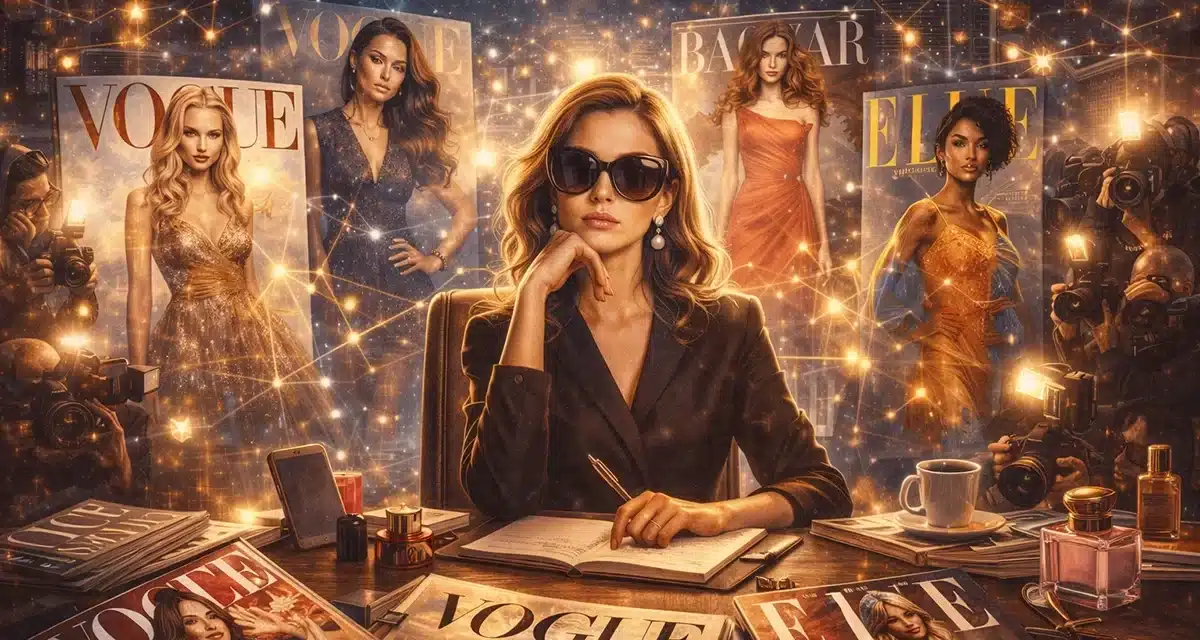
Fashion media has never functioned as neutral documentation of style.
From the early twentieth century onward, magazines and their editors operated as gatekeepers who determined which designers, bodies, ideas, and aesthetics entered public legitimacy.
Before social media and direct-to-consumer branding, fashion media served as the primary infrastructure through which taste was manufactured, hierarchies were enforced, and cultural authority was distributed.
Table of Contents
Fashion Media as an Institutional System
Fashion magazines historically operated as institutions with agenda-setting power rather than passive reporting outlets.
Major publications did not merely reflect trends.
They filtered, curated, and legitimized them. Placement within elite magazines signaled seriousness, market viability, and cultural relevance.
These publications occupied a structural position between designers, advertisers, retailers, and consumers.
Their authority derived from scarcity.
Limited pages, long lead times, and controlled access created an environment where inclusion conferred legitimacy.
Fashion media’s power was institutional before it was personal.
Magazines as Cultural Infrastructure
Fashion magazines functioned as infrastructure connecting design, capital, and consumption.
Publications such as Vogue and Harper’s Bazaar standardized visual language, seasonal rhythm, and aspirational identity across global markets.
They shaped:
- Seasonal calendars and trend cycles
- Hierarchies of designers and fashion houses
- Norms of beauty, class, and acceptability
By repeating certain silhouettes, bodies, and narratives, magazines stabilized fashion meaning over time.
The Economics of Editorial Real Estate
Editorial space was limited, expensive, and intertwined with advertising relationships.
Coverage decisions balanced aesthetic judgment with commercial necessity.
This structure created an implicit exchange system.
Designers gained exposure.
Advertisers gained proximity to authority. Readers absorbed curated aspiration.
Editors as Cultural Gatekeepers
Editors concentrated interpretive authority within a small number of decision-makers.
Editors-in-chief did not merely select garments or models.
They established worldview. Their aesthetic preferences shaped entire markets.
Editors such as Anna Wintour exemplified this role.
Through sustained tenure, editors created continuity of taste that outlasted individual trends.
Gatekeeping occurred through repetition.
Designers consistently featured became synonymous with quality.
Those excluded struggled for legitimacy regardless of innovation.
Editorial judgment functioned as cultural arbitration.
Taste-Making and the Construction of Legitimacy
Fashion media created legitimacy through narrative, not consensus.
Trends did not emerge democratically.
They were introduced, emphasized, and reinforced through repeated editorial framing. Language, imagery, and context guided interpretation.
A garment photographed in isolation conveyed little.
A garment contextualized within editorials, profiles, and runway narratives acquired meaning.
Legitimacy was constructed through association:
- With established designers
- With approved models and photographers
- With narratives of progress or relevance
Taste was assembled rather than discovered.
Representation, Exclusion, and Power
Fashion media historically enforced narrow standards of visibility and inclusion.
Editorial decisions shaped who could appear aspirational. Bodies, ethnicities, genders, and aesthetics outside dominant norms were minimized or framed as novelty.
This exclusion was structural rather than incidental.
Editors responded to advertisers, circulation expectations, and established readerships.
Change occurred slowly and selectively.
Inclusion was often aestheticized rather than normalized.
Media power shaped cultural boundaries long before public discourse caught up.
Advertising, Dependency, and Structural Compromise
Fashion media’s authority was inseparable from advertiser dependency.
Magazines relied on luxury brands and retailers for revenue.
This created unavoidable tension between editorial independence and financial survival.
Critical coverage was rare.
Negative assessment threatened advertising relationships.
Silence functioned as both approval and disapproval.
Editorial judgment therefore operated within constrained limits. Power was real, but not absolute.
Gatekeeping coexisted with compromise.
Globalization of Fashion Media
Fashion media expanded globally while maintaining centralized authority.
International editions extended reach without fully decentralizing power.
Editorial direction flowed outward from cultural centers to regional markets.
Local adaptations existed, but core narratives remained consistent.
Designers validated in Paris or Milan gained legitimacy elsewhere.
Global fashion media exported taste alongside products. Cultural globalization followed editorial hierarchy.
Digital Disruption and the Erosion of Central Control
Digital platforms fractured fashion media’s monopoly on visibility.
Blogs, social media, and influencers introduced alternative pathways to attention.
Designers could bypass editors. Audiences could access variety without mediation.
This fragmentation weakened gatekeeping but did not eliminate power. It redistributed it.
Editors retained influence within elite institutions.
New platforms introduced parallel hierarchies rather than flattening the field.
Authority became plural rather than singular.
Editors in the Contemporary Landscape
Editorial power now operates through curation rather than exclusion alone.
Modern editors manage relevance in an information-saturated environment. Their role shifted from controlling access to framing meaning.
They contextualize rather than dictate.
Their authority derives from interpretation and synthesis.
Legacy power persists, but its mechanics have evolved.
Fashion Media and Cultural Memory
Fashion media serves as an archive of cultural aspiration.
Editorial content documents shifting values, anxieties, and ideals over time. What was included, excluded, praised, or ignored provides historical insight.
Magazines record not only what people wore, but what they were encouraged to want.
As such, fashion media functions as cultural memory shaped by power rather than objectivity.
The Enduring Role of Gatekeepers
Gatekeeping did not disappear; it adapted.
Algorithms now coexist with editors. Visibility is influenced by data as well as taste.
Yet the core function remains unchanged.
Someone decides what matters.
Fashion media continues to mediate between creativity, capital, and culture.
Fashion Media Q&A
Did fashion magazines create trends or reflect them?
They primarily shaped and legitimized trends rather than neutrally reflecting them.
Why did editors hold so much power?
Scarcity of exposure and centralized control of distribution concentrated authority.
Has social media eliminated fashion gatekeepers?
No. It diversified gatekeeping rather than removing it.
Are magazines still influential today?
Yes, particularly within luxury and institutional fashion contexts.
Why is fashion media important historically?
It reveals how taste, power, and representation were organized and enforced.