
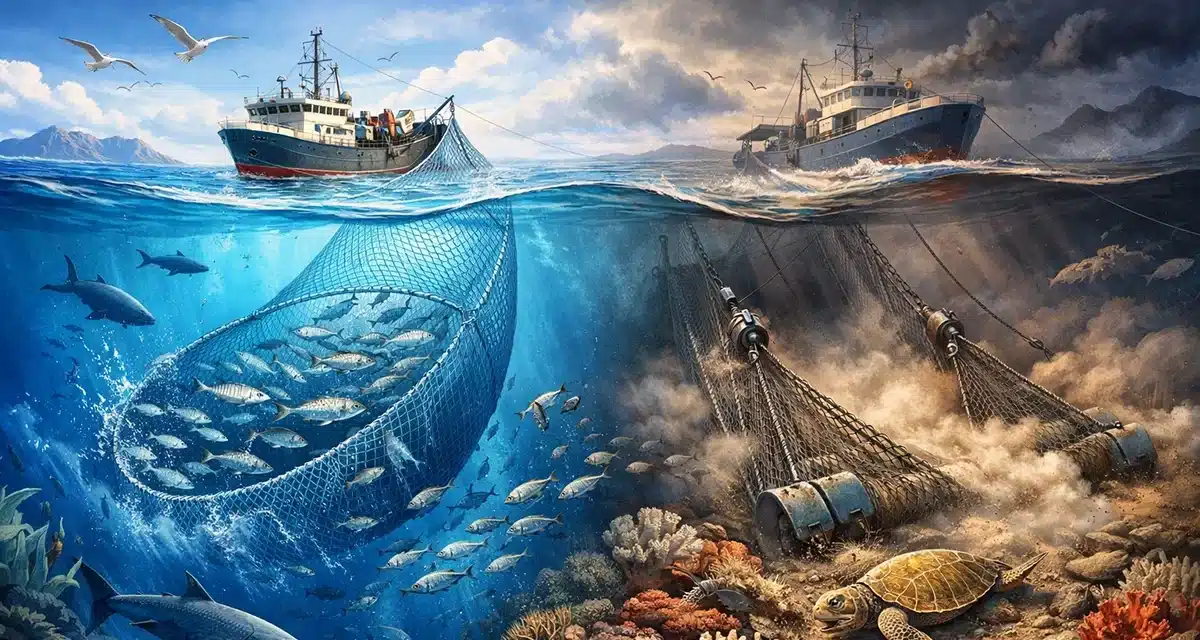
Fish trawling is a commercial fishing method that uses large nets dragged through the water column or along the seafloor to capture target species at scale.
Trawling developed as a response to industrial demand for seafood. Unlike hook-and-line or small-scale net fishing, trawling is mechanized and vessel-dependent. Large boats deploy funnel-shaped nets that remain open due to weighted gear or metal “otter boards” that hold the net horizontally apart.
Two primary forms dominate commercial practice: pelagic trawling and bottom trawling.
Pelagic trawling targets species such as mackerel, herring, and pollock that swim midwater.
Bottom trawling drags gear directly along the seabed to capture species such as cod, flounder, and shrimp.
The distinction matters.
Pelagic trawling typically has lower seabed impact. Bottom trawling interacts directly with benthic habitats. Public debate often fails to differentiate between these practices, even though their ecological footprints vary significantly.
Trawling is legal in many countries and regulated under national and international frameworks.
Quotas, gear restrictions, seasonal closures, and marine protected areas seek to balance economic interests with conservation objectives.
Table of Contents
How Bottom Trawling Affects Marine Ecosystems
Bottom trawling physically disturbs seabed habitats and can alter benthic ecosystems in measurable ways.
The seafloor is not barren. It contains corals, sponges, shellfish beds, and sediment communities that support broader food webs. When heavy nets move across these areas, physical disruption occurs. Sediment is resuspended into the water column.
Fragile structures may be crushed or displaced.
Scientific studies document several environmental effects associated with bottom trawling:
- Direct damage to benthic habitats such as cold-water coral reefs
- Reduction in structural complexity of seabed ecosystems
- Mortality of non-target invertebrates
- Sediment plumes that can affect nearby organisms
- Altered nutrient cycling in disturbed sediments
These effects vary by region, substrate type, and frequency of trawling.
Sandy seabeds often recover faster than rocky or coral-dominated systems. Some high-trawling areas show long-term habitat simplification. Others demonstrate partial recovery when fishing pressure declines.
At the same time, not all bottom trawling occurs in ecologically sensitive zones.
Many fleets operate on historically fished grounds where habitats have already been altered over decades. This does not eliminate environmental concern, but it introduces context.
Bycatch and Species Composition
Bycatch refers to non-target species unintentionally captured during trawling operations.
Trawl nets are designed to capture large volumes efficiently. As a result, species swimming within the net’s path may be caught even if they are not commercially valuable.
Bycatch can include juvenile fish, marine mammals, sea turtles, and other organisms.
Modern fisheries management has implemented multiple mitigation strategies:
- Turtle excluder devices in shrimp trawls
- Bycatch reduction devices that allow smaller fish to escape
- Real-time area closures when protected species are present
- Observer programs and electronic monitoring systems
Data from regulated fisheries show declining bycatch rates in several regions following enforcement of gear modifications.
Nonetheless, bycatch remains an ongoing concern, particularly in developing fisheries with weaker oversight.
It is important to distinguish between regulated industrial fisheries and illegal, unreported, and unregulated fishing. Environmental harm is frequently higher in poorly managed systems.
Carbon Emissions and Climate Implications
Bottom trawling may contribute to carbon release by disturbing sediment layers that store organic material.
Recent scientific discussions have examined whether seabed disturbance releases stored carbon into the water column. Sediments contain organic carbon accumulated over long periods.
When trawling disrupts these sediments, some carbon may be released as carbon dioxide.
Estimates of these emissions vary widely. Some researchers argue that trawling’s sediment disturbance has climate implications comparable to industrial emissions in certain regions.
Others caution that models require refinement and that long-term sequestration dynamics remain uncertain.
The broader fishing industry also contributes to emissions through vessel fuel consumption.
Trawl vessels are energy-intensive.
Fuel efficiency improvements and alternative propulsion technologies are under development, though transition remains gradual.
Climate analysis must account for nuance. Seafood production generally emits less greenhouse gas per gram of protein than land-based livestock such as beef.
Comparisons between protein systems are complex and depend on species, region, and fishing method.
Economic and Food Security Considerations
Trawling supplies a significant portion of the global seafood market and supports coastal economies worldwide.
Millions of people depend directly or indirectly on commercial fishing. In regions with limited agricultural capacity, marine protein is a central source of nutrition.
Trawl fisheries contribute to global food supply chains, particularly for whitefish, shrimp, and processed seafood products.
Economic impacts include:
- Employment for vessel crews and processing workers
- Revenue for coastal ports and logistics sectors
- Export income for fishing nations
- Affordable protein for consumers
Policy decisions regarding trawling restrictions affect livelihoods.
Abrupt bans can disrupt communities that rely on fishing income. As a result, many governments adopt phased restrictions, habitat protections, or partial closures rather than full prohibitions.
Environmental protection and economic continuity are often presented as opposing goals. In practice, sustainable fisheries management seeks to maintain both.
Regulation and Scientific Management
Modern trawl fisheries in many developed countries operate under science-based management frameworks.
Management systems typically include stock assessments, annual catch limits, and monitoring programs.
When assessments show declining stocks, regulators reduce quotas or close fisheries temporarily.
Examples of management tools include:
- Total allowable catch limits
- Individual transferable quotas
- Vessel monitoring systems
- Seasonal spawning closures
- Marine protected areas
Recovery of certain overfished stocks in North America and parts of Europe demonstrates that regulation can stabilize fisheries.
However, enforcement capacity varies globally. Regions without robust monitoring infrastructure face greater ecological risk.
International coordination presents additional complexity.
Migratory species cross national boundaries. Agreements between governments play a role in preventing overexploitation.
Technological Innovations and Mitigation Efforts
Gear modifications and emerging technologies aim to reduce trawling’s environmental footprint.
Engineers and marine scientists have introduced lighter gear designs that reduce seabed contact.
Raised footropes and semi-pelagic trawls limit direct bottom disturbance in some fisheries.
Selective mesh sizes allow smaller organisms to escape.
Research continues into:
- Precision sonar mapping to avoid sensitive habitats
- Real-time data sharing between vessels
- Lower-drag net materials
- Alternative harvest methods for high-value species
While improvements are measurable, trade-offs persist. More selective gear may reduce catch volume. Operational costs may increase.
Adoption depends on economic feasibility and regulatory requirements.
Environmental outcomes improve most consistently where innovation is paired with enforcement and transparent data reporting.
Public Debate and Ethical Framing
Public concern about trawling reflects legitimate environmental questions, but broad generalizations can obscure important distinctions.
Images of damaged coral reefs or discarded bycatch are powerful. They shape perception. At the same time, trawling differs by region, target species, and governance structure.
Equating all trawling globally with worst-case scenarios oversimplifies the issue.
Environmental organizations often advocate for expanded seabed protections.
Fishing associations emphasize employment, food production, and progress in mitigation technology.
Respect for both environmental science and fishing livelihoods strengthens policy dialogue. The debate benefits from measurable data rather than rhetorical framing.
The central challenge is not whether trawling has environmental impact. It does. The question is how to balance ecological preservation with human needs under enforceable regulatory systems.
Fish Trawling Q&A
Does all fish trawling destroy the seafloor?
No.
Pelagic trawling occurs midwater and does not contact the seabed. Bottom trawling interacts directly with seafloor habitats and can cause disturbance, though impacts vary by habitat type and frequency of trawling.
Is trawling worse than other fishing methods?
Impact depends on method, species, and management.
Bottom trawling has higher habitat disturbance compared to hook-and-line fishing. At the same time, well-managed trawl fisheries can maintain stable fish populations under regulated quotas.
Can damaged seabed ecosystems recover?
Some habitats recover over time, particularly soft sediments.
Recovery is slower in complex systems such as cold-water coral areas. Protection measures often focus on these sensitive habitats.
Does trawling contribute to climate change?
Trawling vessels consume fuel, producing emissions.
Disturbance of carbon-rich sediments may release additional carbon, though estimates vary and research continues to refine these models.
Why is trawling still allowed in many countries?
Governments balance environmental considerations with economic and food security needs.
In regions with regulatory oversight, trawling operates under quota systems, habitat protections, and monitoring programs intended to limit ecological harm.