Giorgio Armani is widely credited with redefining modern tailoring by dismantling the rigid conventions of postwar European menswear and translating that philosophy into both men’s and women’s fashion.
His work reshaped how power, authority, and professionalism are visually communicated through clothing.
Rather than relying on spectacle or ornament, Armani’s influence rests on restraint, proportion, and construction.
The designer’s legacy is built on how garments function on the body, how they signal confidence, and how they adapt to social change without theatrical excess.
Table of Contents
The Origins of Armani’s Design Philosophy
Armani’s approach emerged from a rejection of traditional tailoring rigidity rather than from decorative ambition.
Before establishing his own label in 1975, Armani worked within the Italian fashion system, gaining technical exposure to garment construction and manufacturing realities.
This background informed his early dissatisfaction with heavily structured jackets, rigid padding, and overt displays of masculinity that dominated mid-twentieth-century menswear.
Armani’s solution was not radical disruption but subtraction.
By removing excess structure, stiff linings, and aggressive silhouettes, he created garments that followed the natural shape of the body while retaining authority.
This philosophy would become foundational across his collections.
The Deconstruction of the Traditional Suit
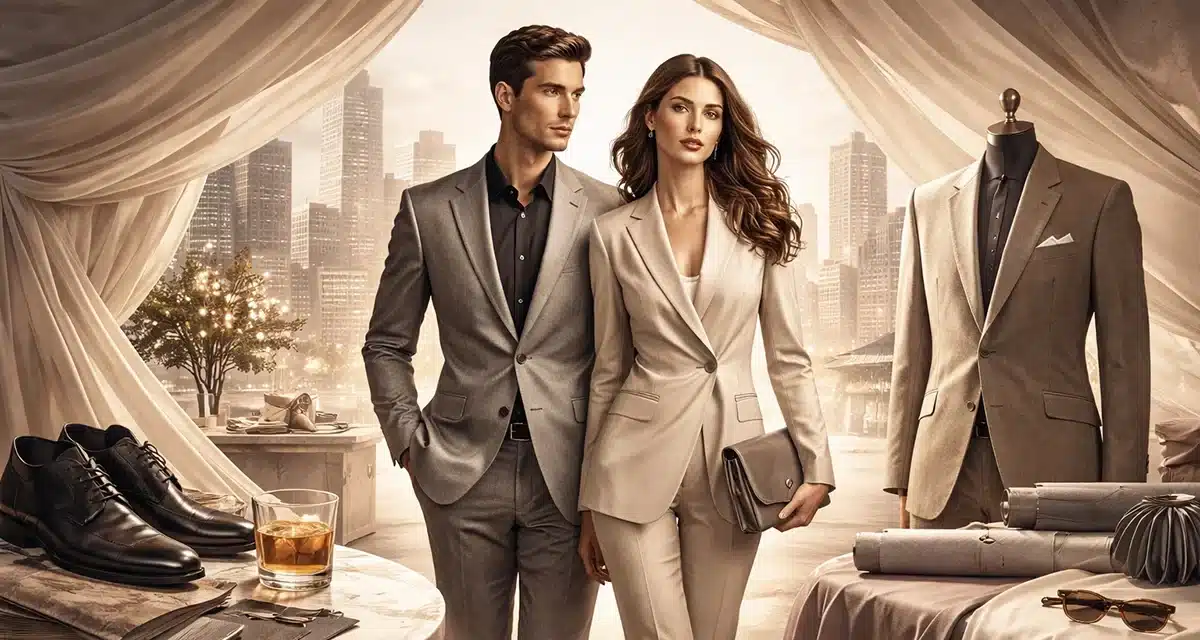
The Armani suit redefined power dressing by softening structure without sacrificing presence.
At a time when suits symbolized hierarchy and institutional control, Armani introduced jackets with relaxed shoulders, lighter canvassing, and fluid drape. These garments conveyed authority through ease rather than force.
The result was a suit that allowed movement, comfort, and understatement.
Power was expressed through confidence and composure instead of rigidity.
This shift aligned with cultural changes in professional environments that increasingly valued adaptability over formality.
Armani’s tailoring altered expectations across industries, from corporate offices to media and politics.
Power Dressing and the Late Twentieth Century Workplace
Armani’s designs became visual shorthand for modern professional authority.
During the late 1970s and 1980s, Armani suits gained prominence in business and finance as workplaces evolved.
The emphasis on streamlined silhouettes and neutral palettes aligned with emerging ideals of controlled ambition and understated competence.
In women’s fashion, Armani adapted his tailoring principles without replicating masculine forms.
His womenswear introduced suits that conveyed authority without exaggeration, avoiding severe shoulders or aggressive styling.
This balance allowed professional attire to evolve without replicating patriarchal visual codes wholesale.
Fabric Innovation and Material Choice
Fabric selection played a central role in achieving Armani’s signature softness.
Rather than relying on traditional heavy wools, Armani favored lighter textiles that enhanced drape and movement.
His material choices emphasized texture, breathability, and visual quiet.
Key fabric characteristics included:
- Reduced stiffness for natural movement
- Matte finishes to avoid visual dominance
- Neutral tones that emphasized form over color
Fabric became structural rather than decorative, reinforcing the philosophy of restraint.
Color, Palette, and Visual Discipline
Armani’s restrained color palette reinforced authority without visual aggression.
Earth tones, greys, navy, beige, and muted neutrals defined much of his work.
These colors reduced distraction and allowed the garment’s construction to take precedence.
Color discipline also contributed to versatility.
Armani garments could move between professional and social settings without stylistic conflict. This adaptability expanded their functional value and commercial longevity.
The visual quietness of Armani’s palette distinguished his work from trend-driven fashion cycles.
Influence on Film and Cultural Identity
Cinema amplified Armani’s association with controlled power and elegance.
Armani’s close relationship with film costume design cemented his brand identity in popular culture. His suits became symbols of authority, sophistication, and emotional restraint on screen.
These appearances reinforced the perception of Armani as the uniform of individuals operating within high-stakes environments.
Film did not create the aesthetic but accelerated its cultural adoption.
The resulting association between Armani and modern authority persists across generations.
Gender, Neutrality, and Modern Silhouettes
Armani blurred gender distinctions through proportion rather than provocation.
By focusing on shape, balance, and comfort, Armani created garments that emphasized human form over gendered exaggeration.
His womenswear avoided ornamental feminization, while his menswear rejected hyper-masculinity.
This approach allowed clothing to function as a tool rather than a statement.
Authority became a matter of posture and presence, not costume.
The result was a subtle contribution to broader shifts in gender presentation within professional environments.
Commercial Structure and Brand Longevity
Armani’s design philosophy supported long-term brand stability.
By prioritizing timeless construction over seasonal novelty, Armani built a brand capable of enduring changes in fashion cycles.
His collections rarely depended on shock or trend adoption.
This consistency allowed the Armani label to expand across markets while retaining a coherent identity.
Products aligned with the same foundational principles, reinforcing trust and recognizability.
Longevity became a byproduct of discipline rather than constant reinvention.
Legacy in Contemporary Fashion
Armani’s influence persists in modern tailoring across luxury and mass markets.
Elements of soft structure, relaxed tailoring, and restrained palettes are now industry standards rather than deviations.
Many contemporary designers operate within parameters Armani normalized decades earlier.
His legacy is not defined by imitation but by normalization.
What once appeared understated now defines modern expectations of professional dress.
The Armani suit remains a reference point for how clothing communicates authority without excess.
Giorgio Armani Q&A
What distinguishes Giorgio Armani’s suits from traditional tailoring?
They use softer construction, lighter materials, and relaxed silhouettes while maintaining authority.
Why are Armani’s designs associated with power?
They signal control and confidence through restraint rather than visual dominance.
Did Armani influence womenswear as well as menswear?
Yes. His tailoring principles reshaped professional womenswear without replicating masculine exaggeration.
Why does Armani favor neutral colors?
Neutral palettes emphasize form, versatility, and longevity over trend-based impact.
Is Armani’s influence still visible today?
Soft tailoring and understated power dressing remain central to contemporary fashion.