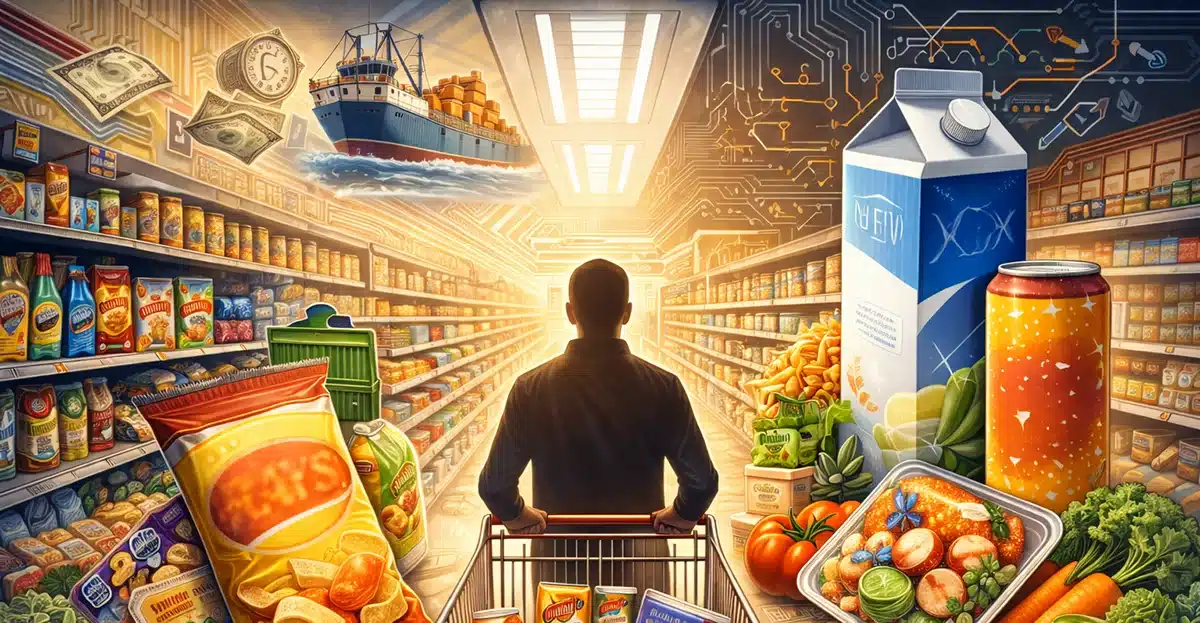
Modern grocery retail is structured around logistics, preservation, and behavioral prompting rather than nutrition or taste.
Most consumers experience grocery stores as neutral spaces for food acquisition.
In practice, these environments operate as carefully engineered marketing systems. Every shelf, package, color, and phrase exists to support scale, shelf stability, and predictable revenue.
Food is the input. Packaging and persuasion are the product.
Understanding this distinction reshapes how food history, pricing, and consumer behavior align.
Table of Contents
The Shift From Food to Infrastructure
Food stopped being the core value driver once preservation and shipping scaled reliably.
Before industrial packaging, food systems revolved around proximity, seasonality, and spoilage. Once canning, bottling, refrigeration, and plastics stabilized supply, the constraint shifted.
The winning advantage became durability rather than freshness.
Shelf-stable goods introduced time into the profit equation. Products that survived weeks or months could be shipped farther, stocked longer, and promoted more aggressively.
This allowed brands to detach value from ingredients and attach it to format.
As a result, food history increasingly tracks infrastructure rather than cuisine.
Railroads, cold storage, containerization, and highway distribution quietly shaped what people eat more than recipes ever did.
Packaging as the Primary Economic Engine
Packaging determines scale, margins, and brand perception far more than ingredients.
Packaging serves several simultaneous functions. It preserves the product, protects it during transport, standardizes shelf placement, and provides visual real estate for persuasion.
Once packaging is solved, marketing becomes repeatable.
Higher prices rarely reflect better food.
They reflect higher packaging costs, design budgets, and promotional overhead.
The ingredient list often becomes secondary.
This explains why simple staples frequently cost less despite offering greater nutritional density. They lack elaborate packaging systems and resist long shelf narratives.
Shipping Efficiency and Shelf Stability
Products that ship cheaply and survive handling dominate retail space.
Grocery economics reward foods that tolerate vibration, stacking, temperature shifts, and time.
Taste can be adjusted later through additives or processing.
Stability cannot be negotiated.
Distribution networks determine what brands survive.
A product that ships efficiently outperforms one that tastes better but spoils faster. Over time, entire categories evolve around transport realities rather than culinary quality.
What appears as consumer preference often reflects invisible logistical constraints.
The Psychology of the Grocery Environment
Retail grocery spaces apply constant low-level behavioral pressure.
Visual interruption drives movement. Color saturation stops the eye. End caps interrupt routines.
Shelf height signals importance. “New,” “limited,” and “seasonal” language inject urgency without substance.
Shoppers are rarely making deliberate choices.
They are responding to stimuli arranged to guide behavior efficiently.
Most carts are filled through peripheral engagement rather than conscious evaluation.
This explains why ingredient-level foods remain quieter and cheaper. They are harder to dramatize visually and resist narrative packaging.
Marketing Without Ambiguity
Retail and nonprofit systems share the same underlying rule: clarity outperforms implication.
Grocery retail trains professionals to think in direct prompts.
Product placement is an instruction. End caps are commands. Pricing is a suggestion framed as inevitability.
Nonprofit fundraising applies the same logic in language.
Successful campaigns do not hint. They ask. Action follows clarity.
This principle scales across categories:
- Buy this
- Donate now
- Register today
- Attend the event
- Make a decision
Marketing that avoids clear asks sacrifices performance under the guise of politeness.
Why Simple Food Reduces Cost
Removing packaging narratives collapses the markup.
Once consumers recognize that most grocery pricing reflects logistics, advertising, and shelf placement, behavior shifts.
Ingredient-level food bypasses much of the system.
These foods:
- Spoil faster and therefore resist heavy marketing
- Ship poorly compared to packaged goods
- Require little branding
- Carry lower embedded advertising costs
The result is a dramatic reduction in food spending without nutritional compromise.
Marketing Literacy as Consumer Defense
Professional marketing awareness changes buying behavior permanently.
Once the mechanics are visible, grocery environments feel loud and coercive rather than helpful.
This response mirrors how experienced marketers interact with advertising generally. Immunity replaces fascination.
Efficiency replaces exploration.
Repetition replaces novelty. Spending shifts away from persuasion and toward utility.
This is not austerity. It is operational clarity applied to daily systems.
The Broader Lesson
Food is one of the earliest and most successful applications of large-scale behavioral marketing.
Understanding grocery systems provides a blueprint for how packaging, logistics, and direct prompting operate in every industry. The lesson extends far beyond food.
Wherever distribution precedes storytelling, marketing becomes reinforcement rather than discovery.
The product that survives is not the best, but the most stable, shippable, and legible.
Once this framework is understood, consumer decisions simplify. Cost drops. Noise fades. Systems become visible for what they are.
Grocery Marketing Q&A
Why do packaged foods cost more than simple ingredients?
Packaged foods include embedded costs for preservation, shipping efficiency, branding, advertising, and retail placement.
Ingredients rarely carry those overhead layers.
Is higher grocery pricing connected to food quality?
In many cases, no.
Higher prices often reflect packaging and marketing systems rather than superior nutrition or sourcing.
Why are grocery stores designed to feel overwhelming?
Retail environments are engineered to influence behavior through constant visual and psychological prompts that increase dwell time and impulse selection.
How does nonprofit marketing connect to grocery retail?
Both rely on direct prompting.
Clear asks produce action. Implication and subtlety reduce performance.
Can understanding marketing mechanics reduce household expenses?
Yes.
Recognizing where persuasion costs are embedded allows consumers to bypass them, particularly in food purchasing.
Are “artisanal” products exempt from this system?
Artisanal branding often replaces industrial scale with storytelling.
While supply chains may be shorter, narrative cost remains a significant pricing driver.