
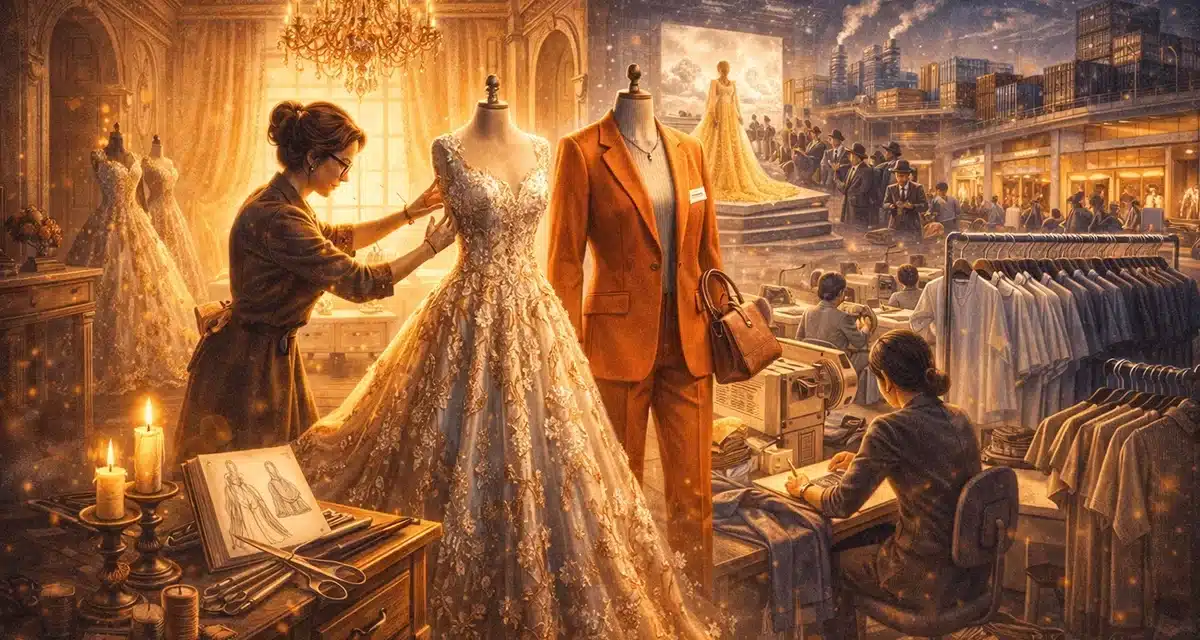
Fashion did not scale through creativity alone.
It scaled through structural transformation—shifting from artisanal production for a narrow elite to standardized manufacturing for global markets.
The divide between haute couture and ready-to-wear marks one of the most important industrial inflection points in modern cultural history.
Table of Contents
What Haute Couture Originally Represented
Haute couture began as a regulated system of bespoke garment production for private clients.
In the late nineteenth and early twentieth centuries, haute couture functioned as a made-to-order craft system centered in Paris.
Garments were designed, fitted, and assembled specifically for individual clients, often requiring multiple fittings and extensive hand labor.
Couture houses operated under strict standards later formalized by bodies such as the Chambre Syndicale de la Haute Couture.
These standards governed craftsmanship, labor requirements, and presentation schedules.
Haute couture was not intended to scale. Exclusivity was its defining economic feature.
Couture as a Business Model
Couture houses relied on prestige rather than volume for economic viability.
Despite their visibility, couture collections were rarely profitable through garment sales alone.
The economic value of couture lay in reputation, not units moved.
Couture supported:
- Elite client relationships
- Cultural authority within fashion capitals
- Brand legitimacy that extended beyond clothing
This prestige enabled secondary revenue streams such as licensing, perfume, accessories, and later diffusion lines.
Couture functioned as symbolic capital first and commercial engine second.
Structural Limits of Haute Couture
Haute couture could not meet the demands of expanding consumer markets.
As the twentieth century progressed, industrialization, urbanization, and the rise of a professional middle class transformed clothing demand.
Consumers wanted designer-authored fashion without bespoke pricing or production timelines.
Couture’s constraints were structural:
- Labor intensity limited output
- Cost restricted access
- Geographic concentration constrained reach
Fashion needed a system that preserved design authorship while enabling scale.
The Emergence of Ready-to-Wear
Ready-to-wear transformed fashion by separating design from individualized production.
Ready-to-wear, or prêt-à-porter, introduced standardized sizing, factory-based manufacturing, and seasonal collections designed for retail distribution.
Designers retained creative control, but garments were produced in volume.
This shift allowed fashion to:
- Reach larger audiences
- Stabilize production schedules
- Integrate with global retail networks
Ready-to-wear did not replace couture immediately. It supplemented it.
Industrialization and Manufacturing Logic
Ready-to-wear aligned fashion with industrial manufacturing principles.
Production moved toward assembly-line processes, cost optimization, and logistical efficiency. Factories replaced ateliers for most garments, and labor was geographically distributed to reduce expense.
Design remained centralized. Manufacturing decentralized.
This separation allowed fashion houses to operate across borders, scale output, and respond to seasonal demand predictably.
Fashion became an industry rather than a collection of workshops.
Branding as the Bridge Between Couture and Scale
Brand identity replaced craftsmanship as the primary carrier of value.
As garments became more standardized, branding preserved differentiation.
Logos, aesthetics, and designer names replaced handwork as signals of worth.
Ready-to-wear leveraged:
- Runway shows to establish authority
- Advertising and editorial placement to shape desire
- Retail environments to control perception
Brand cohesion allowed consumers to buy into an identity rather than a custom garment.
Economic Consequences of Scaling
Scaling shifted profit generation from garments to systems.
As fashion scaled, profitability moved away from individual pieces toward supply chains, licensing, and global distribution.
Margins depended on volume, velocity, and brand leverage.
This shift introduced:
- Greater financialization of fashion houses
- Dependence on global manufacturing networks
- Pressure to increase seasonal output
Fashion’s rhythm accelerated as a result.
Couture’s Role in the Modern Industry
Haute couture persists as a symbolic and strategic function rather than a market solution.
Today, couture represents a small fraction of global fashion revenue. Its importance lies in signaling mastery, heritage, and creative authority.
Couture functions as:
- Brand elevation
- Media spectacle
- Technical experimentation unconstrained by cost
It legitimizes ready-to-wear rather than competing with it.
Ready-to-Wear as the Dominant Global Model
Ready-to-wear defines contemporary fashion consumption.
Most consumers engage with fashion through ready-to-wear systems, whether luxury, mid-market, or mass retail.
Pricing, sizing, and availability are standardized.
This model supports:
- Global trend diffusion
- Rapid production cycles
- Predictable revenue forecasting
Fashion’s reach depends on this infrastructure.
Structural Tension Between Craft and Scale
Couture and ready-to-wear embody opposing industrial logics that coexist uneasily.
Couture prioritizes time, skill, and individuality.
Ready-to-wear prioritizes efficiency, consistency, and accessibility.
The industry maintains both because each serves a different function:
- Couture sustains myth and authority
- Ready-to-wear sustains revenue and relevance
Neither can fully replace the other.
Cultural Impact of Fashion Scaling
Scaling altered how fashion communicates meaning.
As garments became widely accessible, meaning shifted from material to image.
Ownership became less exclusive, but aspiration expanded.
Fashion transitioned from elite craft to mass cultural language.
This transformation defines modern fashion’s power and its contradictions.
Haute Couture vs Ready-to-Wear Q&A
Is haute couture still relevant today?
Yes. It functions as symbolic capital and brand authority rather than mass commerce.
Why did ready-to-wear succeed?
It aligned fashion with industrial production and expanded consumer access.
Does ready-to-wear diminish craftsmanship?
It redistributes craftsmanship rather than eliminating it.
Can couture exist without ready-to-wear?
In the modern industry, couture relies on ready-to-wear for financial sustainability.
Why does the industry maintain both systems?
Because scale requires efficiency, while authority requires exclusivity.