
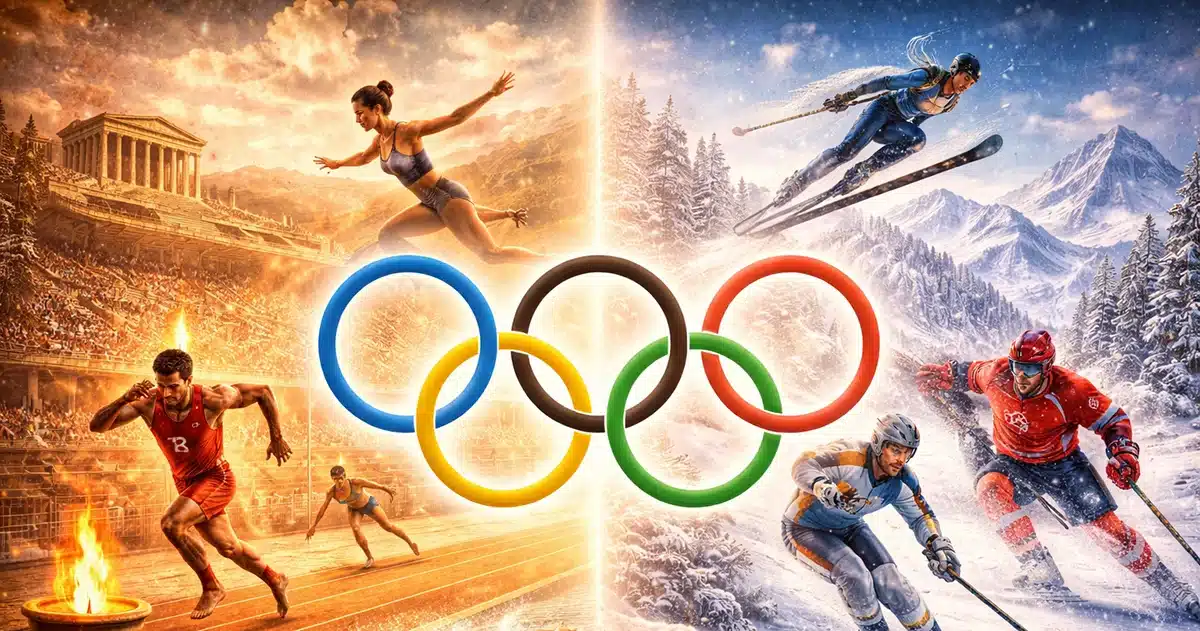
The separation of the Winter Olympics from the Summer Games was not an aesthetic decision but a structural solution to geographic limits, seasonal logistics, and the expanding scale of international sport.
For the first decades of the modern Olympic movement, all recognized Olympic sports—regardless of climate or setting—were treated as parts of a single unified event.
Snow and ice sports existed on the margins, folded awkwardly into summer-focused systems that were never designed to support them.
The eventual split was the result of institutional pressure rather than philosophical disagreement.
As the Olympics grew, winter sports forced the movement to confront questions of environment, scheduling, equity, and governance that could no longer be ignored.
Table of Contents
The Early Olympic Model and Its Limits
The original modern Olympics were conceived around summer athletics rooted in European educational and military traditions.
When the first modern Games were held in 1896, their event roster reflected sports that could be staged outdoors or indoors during warmer months using relatively simple infrastructure.
Track and field, gymnastics, fencing, and swimming fit neatly within this framework.
Winter sports, by contrast, presented complications:
- They required cold climates or artificial ice
- They depended on terrain not available in many host cities
- They relied on equipment and venues that could not be reused seasonally
Rather than addressing these constraints directly, early organizers attempted to absorb winter sports into the Summer Games when possible or to stage them inconsistently.
Early Experiments With Winter Sports
Before a formal split, winter sports appeared sporadically and experimentally within the Olympic program.
Figure skating debuted at the 1908 London Games, held indoors at a time when artificial ice rinks were still rare.
Ice hockey followed in 1920 at the Antwerp Games, staged inside an arena originally designed for other uses.
These inclusions were pragmatic rather than visionary.
They solved short-term participation demands but exposed deeper structural issues.
Winter sports raised persistent questions:
- How could events reliant on cold conditions be fairly staged worldwide?
- Should winter athletes wait four years for marginal inclusion?
- Could host cities realistically support both summer and winter infrastructure?
By the early 1920s, these tensions made ad hoc solutions unsustainable.
The Role of International Sport Federations
Pressure to separate the Games came less from Olympic leadership and more from emerging international federations.
Organizations governing skating, hockey, skiing, and sliding sports sought consistent competition schedules, standardized rules, and visibility equal to summer disciplines.
Being treated as secondary additions undermined their legitimacy and growth.
At the same time, Alpine nations viewed winter sports as expressions of national expertise and terrain-based advantage.
Folding them into summer-centered Games diluted that identity.
This combination of administrative frustration and geographic specialization accelerated calls for a distinct winter event.
The 1924 Turning Point
The formal division of the Olympic calendar began not as a declaration, but as a compromise.
In 1924, the Olympic authorities sanctioned an “International Winter Sports Week” held in Chamonix, France, under Olympic patronage.
While not initially labeled an Olympic Games, it was organized with full international participation, medals, and standardized competition.
The success of Chamonix clarified what earlier experiments had obscured:
- Winter sports thrived when staged in appropriate environments
- Athlete participation and public interest increased
- Logistical strain on summer hosts was eliminated
In 1926, the event was retroactively designated the first Winter Olympic Games.
Why a Split Became Inevitable
Separating the Winter and Summer Olympics solved multiple structural problems simultaneously.
From an institutional perspective, the split allowed:
- Climate-appropriate hosting without artificial constraints
- Equal status for winter disciplines
- Reduced infrastructure overload for host cities
- Expanded global participation from snow-heavy regions
It also aligned with the broader trend of Olympic specialization as the program expanded beyond what a single event could support.
Calendar Separation and Alternating Cycles
The Olympic calendar continued to evolve long after the initial split.
For much of the twentieth century, the Summer and Winter Games were held in the same year, every four years.
This arrangement preserved symbolic unity but strained media coverage and financial planning.
In 1994, the calendar was reorganized so that the Winter and Summer Olympics would alternate every two years.
This change reflected:
- Broadcast economics
- Sponsorship cycles
- Audience attention span
- Logistical sustainability
The alternating model reinforced the Winter Olympics as a standalone institution while preserving shared governance under International Olympic Committee.
Governance and Identity After the Split
Despite separation, the two Games remain structurally linked rather than independent.
They share a charter, ethical framework, and selection process for host cities.
Yet their identities diverged.
The Summer Olympics emphasize volume, scale, and global athletic breadth.
The Winter Olympics emphasize environment, specialization, and technical precision.
This divergence reshaped how nations invest in sport. Countries without access to snow or mountains face higher barriers to winter success, reinforcing geographic inequality alongside athletic excellence.
Why the Split Still Shapes the Olympics Today
The Winter–Summer divide remains essential to understanding modern Olympic structure.
It influences:
- Host city selection criteria
- Infrastructure investment decisions
- Athlete development pipelines
- Media narratives and audience expectations
Climate change has added new urgency.
Artificial snow, rising temperatures, and shifting seasonal patterns now challenge the assumptions that made the split viable in the first place.
The existence of separate Games allows for adaptation—but also exposes fragility.
The Separation as a Structural Success
The Winter Olympics did not emerge as a subsidiary or secondary event.
They emerged as a correction to a structural mismatch between sport and environment.
By separating the Games, the Olympic movement preserved competitive integrity while expanding its global reach.
The split was not a fracture of Olympic identity, but a refinement of it.
Winter Olympics Q&A
When were the Winter Olympics officially separated from the Summer Games?
The Winter Olympics were formally recognized in 1926, following the 1924 Winter Sports Week in Chamonix.
Why were winter sports not originally separated?
Early Olympic organizers attempted to stage all sports together, underestimating the logistical and environmental demands of winter disciplines.
What was the first official Winter Olympic Games?
The 1924 Chamonix Games were later designated as the first Winter Olympics.
Why do the Winter and Summer Games alternate today?
Alternating the Games improves media coverage, financial planning, and logistical sustainability.
Are the Winter and Summer Olympics governed separately?
They are governed under the same Olympic Charter and overseen by the International Olympic Committee, despite operating as distinct events.