
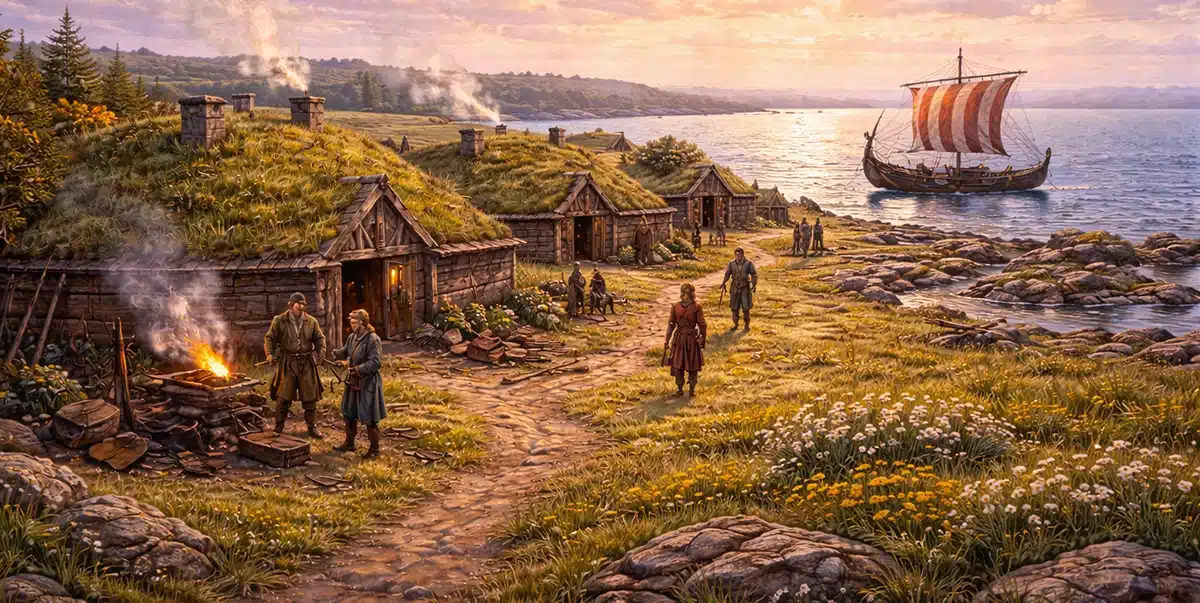
L’Anse aux Meadows National Historic Site is the only confirmed site in North America that provides physical evidence of Norse presence dating to around the year 1000.
Unlike speculative claims of Viking travel elsewhere in the Americas, L’Anse aux Meadows is supported by archaeological excavation, carbon dating, and unmistakable Norse material culture. Its importance lies not in legend, but in verification.
The site sits on the northern tip of Newfoundland, geographically distant from most popular narratives of early North American history.
Yet its implications are direct and measurable: Europeans reached the continent nearly 500 years before Columbus, established a settlement, and then left.
This post examines the site itself, how it was identified, what was found there, and what it does—and does not—tell us about Viking activity in the Americas.
Table of Contents
Geographic Context
L’Anse aux Meadows is located at the northernmost point of Newfoundland, facing the Strait of Belle Isle.
The surrounding landscape consists of coastal grasslands, low hills, and peat bogs. The area is exposed to strong winds and harsh winters, even by North Atlantic standards.
This location was not chosen at random.
It offered:
- Direct access to the North Atlantic
- Nearby timber resources, scarce in Greenland
- Natural harbors for Norse vessels
- Visibility of maritime traffic
For Norse sailors accustomed to Greenland and Iceland, Newfoundland was reachable using known navigation methods.
Discovery of the Site
The site was identified in the early 1960s by Norwegian explorer Helge Ingstad and archaeologist Anne Stine Ingstad.
They were searching for physical evidence of Vinland, the land mentioned in Icelandic sagas describing Norse voyages west of Greenland.
Local residents had long known of unusual grassy mounds in the area, which they believed to be Indigenous or possibly French in origin.
Excavation revealed something else entirely.
Archaeological digs beginning in 1961 uncovered building foundations unmistakably Norse in form and construction.
The Structures
The remains at L’Anse aux Meadows consist of eight buildings, including longhouses and smaller functional structures.
These buildings were constructed using sod walls over timber frames, consistent with Norse architecture used in Iceland and Greenland.
Key structural features included:
- Turf walls up to two meters thick
- Rectangular floor plans
- Central hearths
- Separate spaces for living, working, and storage
The layout closely matches known Norse settlements from the North Atlantic world. There is no ambiguity in the architectural style.
Artifacts and Material Evidence
Excavations yielded Norse artifacts that cannot be attributed to any Indigenous culture of the region.
These finds confirm both European presence and settlement rather than brief landing.
Recovered items included:
- An iron nail consistent with ship repair
- A bronze ring-pin
- A spindle whorl used in textile production
- Evidence of iron smelting
The iron smelting site is especially significant. It indicates on-site production rather than imported material, suggesting a settlement intended for extended use.
Dating the Settlement
Carbon dating places the Norse occupation at approximately 990–1050 CE.
This aligns with saga descriptions of Leif Erikson’s voyages and later expeditions.
Recent research using tree-ring analysis has further refined dating, identifying a specific cutting year of 1021 CE for wood modified by metal tools.
That date currently represents the earliest confirmed European presence in the Americas.
Purpose of the Settlement
L’Anse aux Meadows was likely a seasonal base rather than a permanent colony.
The site shows no evidence of long-term agriculture or large-scale population growth.
Most scholars agree the settlement served as:
- A repair station for ships
- A base for exploration southward
- A source of timber and other raw materials
- A staging area linking Vinland to Greenland
There is no evidence that the site developed into a self-sustaining community.
Vinland and the Sagas
The Icelandic Vinland sagas describe lands west of Greenland rich in resources.
While these texts blend history and storytelling, key elements match known geography.
Descriptions of:
- Forested land
- Wild grapes or berries
- Mild coastal areas
…may correspond to regions south of Newfoundland.
L’Anse aux Meadows itself does not match the more fertile Vinland described in later saga sections.
This suggests the site functioned as a northern outpost, not Vinland proper.
Indigenous Presence and Interaction
The Norse were not alone in the region.
Indigenous peoples, likely ancestors of the Beothuk or related groups, inhabited Newfoundland at the time.
There is limited evidence of direct interaction at L’Anse aux Meadows itself, but the sagas describe encounters with people referred to as Skrælings.
Artifacts indicate potential conflict elsewhere, though not at this specific site.
The Norse presence in North America appears brief, possibly due to:
- Resistance from local populations
- Logistical challenges
- Distance from supply lines
- Limited population size
No evidence suggests sustained coexistence.
Why the Norse Left
The Norse withdrawal from L’Anse aux Meadows was likely deliberate rather than catastrophic.
The settlement was abandoned within a few decades, if not sooner.
Contributing factors include:
- Difficulty maintaining supply routes
- Harsh environmental conditions
- Limited immediate economic return
- Conflict risks with Indigenous peoples
Unlike later European colonization efforts, Norse exploration did not escalate into expansion.
The abandonment left no lasting Norse footprint in North America beyond this site.
Excavation, Preservation, and Interpretation
Following excavation, the site was carefully preserved rather than fully reconstructed.
Today, reconstructed sod buildings nearby help visitors understand scale and layout without altering the original remains.
The site was designated a UNESCO World Heritage Site in 1978.
Preservation priorities include:
- Protecting turf foundations
- Managing erosion
- Limiting structural intrusion
- Maintaining archaeological context
Interpretation focuses on evidence, not mythmaking.
What the Site Proves—and What It Does Not
L’Anse aux Meadows proves that Norse explorers reached North America and established a settlement.
It does not prove sustained colonization, widespread Viking influence, or long-term European presence.
It also does not support:
- Claims of Viking ruins elsewhere without evidence
- Transatlantic diffusion of Indigenous culture
- Early European domination of the continent
The site’s importance lies in its limits as much as its confirmation.
Why L’Anse aux Meadows Matters
The site forces a recalibration of timelines rather than a rewrite of history.
It places Norse exploration firmly within the story of North America without overstating its consequences.
Its value is archaeological, not symbolic.
L’Anse aux Meadows demonstrates:
- The reach of Norse maritime technology
- The reality of pre-Columbian transatlantic contact
- The difference between exploration and colonization
It stands because evidence supports it.
L’Anse aux Meadows is important precisely because it is restrained.
It is a single site, used briefly, and left behind. Its significance comes from what can be proven—not what people wish had happened.
L’Anse aux Meadows Q&A
What is L’Anse aux Meadows?
It is the only confirmed Norse settlement in North America, dated to around 1000 CE.
Who discovered the site?
Helge Ingstad and Anne Stine Ingstad identified the site in the early 1960s.
Were Vikings permanently established there?
No. Evidence suggests a short-term or seasonal settlement rather than a permanent colony.
What kind of buildings were found?
Norse-style turf longhouses and supporting structures used for living and work.
How do we know it was Norse?
Architectural design, ironworking evidence, and distinctive artifacts confirm Norse origin.
Did the Vikings interact with Indigenous peoples?
Possibly, but direct evidence at this site is limited. Sagas describe encounters elsewhere.
Why did the settlement fail?
Logistical difficulty, environmental challenges, and conflict risks likely made continued occupation impractical.