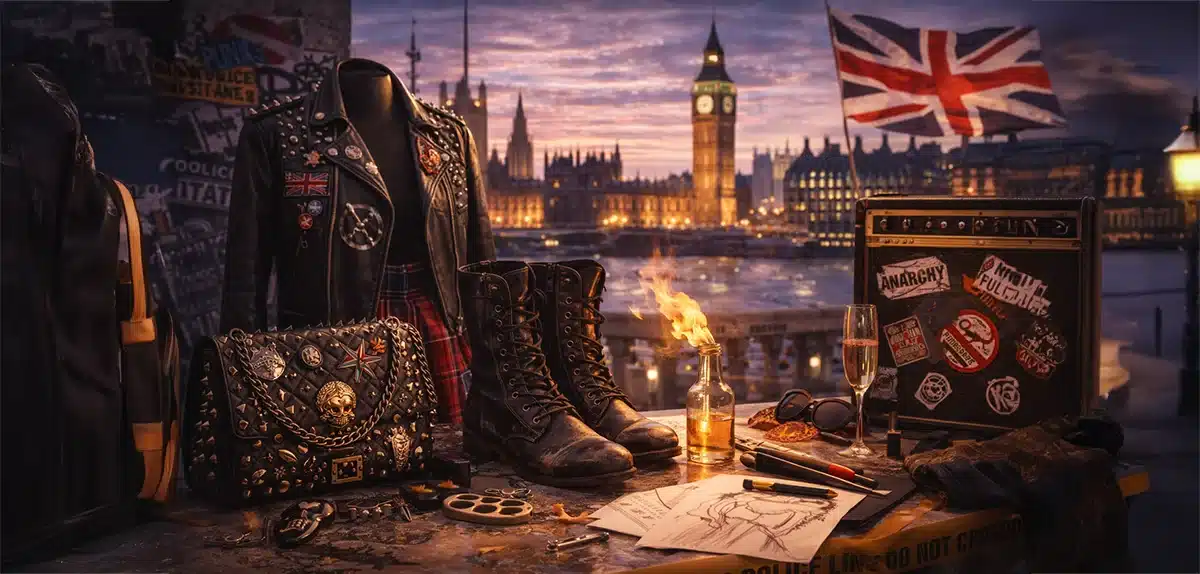
London occupies a distinct position in fashion history by operating outside traditional luxury hierarchies.
Its influence did not emerge from courts, couture houses, or consolidated wealth.
It formed through class tension, youth culture, and resistance to institutional authority.
London fashion developed as reaction rather than inheritance.
Table of Contents
London Fashion Outside Traditional Power
London fashion evolved without the stabilizing presence of aristocratic couture or centralized luxury institutions.
Unlike Paris or Milan, London did not anchor fashion to long-standing elite systems. Its fashion economy emerged within a city shaped by industrial labor, post-war austerity, and recurring class conflict.
Economic instability and limited luxury infrastructure constrained traditional pathways to authority.
These constraints produced a different operating model.
Fashion developed in fragmented neighborhoods, art schools, music venues, and informal retail spaces. Authority did not flow downward from institutions.
It formed horizontally through shared identity and opposition to dominant culture.
Lack of institutional continuity forced innovation through necessity.
Subculture as Structural Driver
Subcultures in London functioned as organized social responses rather than stylistic trends.
British subcultures arose from material conditions. Youth unemployment, housing pressure, racial tension, and political dissatisfaction shaped how communities formed and expressed themselves.
Clothing became visible shorthand for affiliation and refusal.
Subcultural fashion operated through:
- Distinct dress codes tied to music and local identity
- Rejection of mainstream refinement
- Visible signals of belonging and exclusion
- Rapid evolution driven by social change
These systems produced coherence without centralized control.
Rebellion as Economic Constraint
Rebellion in London fashion reflected material limitation rather than aesthetic experimentation alone.
Garments were often improvised, repurposed, or altered due to lack of access to luxury materials. Visibility mattered more than finish. Impact outweighed longevity.
This approach inverted traditional value structures.
Refinement became irrelevant. Authenticity replaced polish.
The point was recognition, not approval.
Rebellion carried economic clarity.
Fashion as Protest Mechanism
Clothing in London frequently operated as public objection rather than personal preference.
Dress communicated opposition to class hierarchy, political authority, and cultural conformity. These messages were not encoded subtly.
They were designed for confrontation.
Fashion served protest by:
- Making dissent publicly legible
- Disrupting expectations of respectability
- Collapsing boundaries between costume and daily wear
Visibility functioned as pressure.
Institutional Resistance and Absorption
London fashion repeatedly faced institutional resistance followed by partial assimilation.
What began as rejection often transitioned into market capture. Subcultural elements were later absorbed, sanitized, and sold through broader fashion systems.
This process diluted original meaning while expanding reach.
The cycle repeated consistently:
- Subculture forms through exclusion
- Visibility increases through media attention
- Commercial systems adopt surface elements
- Original context weakens
Resistance survived briefly. Influence endured structurally.
Education and Informal Authority
London’s fashion schools functioned as alternative power centers rather than conservative institutions.
Educational environments encouraged conceptual disruption over refinement. Designers trained to critique systems as much as produce garments.
Output emphasized idea clarity rather than commercial readiness.
This education model reinforced London’s position as generator rather than validator.
Ideas emerged early. Consolidation occurred elsewhere.
London produced friction.
Ongoing Role in Global Fashion
London continues to supply opposition within a global fashion system oriented toward stability.
While its commercial influence fluctuates, London retains symbolic power as site of resistance.
Subcultural language remains a recurring source for global fashion reinterpretation.
The city operates as pressure valve rather than control hub.
London Fashion Q&A
Why is London fashion associated with rebellion rather than refinement?
Because it developed outside centralized luxury systems and responded to social and economic pressure.
Do London subcultures function as fashion trends?
No. They operate as social structures with dress as visible identifier.
Is protest clothing symbolic or practical?
Primarily symbolic, designed for recognition rather than durability.
Why does London fashion influence global brands?
It generates oppositional ideas that later become commercially adaptable.
Does institutional absorption weaken subcultural fashion?
It reduces contextual meaning while extending visual influence.
What defines London’s lasting contribution to fashion history?
The use of dress as organized resistance within unstable social conditions.