
Blockchains are deterministic systems.
They can only act on information already embedded in their own state. This design preserves consensus and auditability. It also creates a hard boundary. Real-world data exists outside the chain. Prices move, weather changes, events occur, and identities update independently of any ledger.
Oracle networks exist to bridge that boundary.
Without oracles, smart contracts remain closed systems. With oracles, blockchains interact with external reality in a controlled and verifiable way. Every decentralized exchange, lending protocol, synthetic asset, and insurance contract that reacts to off-chain information depends on oracle infrastructure.
Oracle networks are not an accessory. They are required infrastructure.
Table of Contents
What Oracle Networks Are
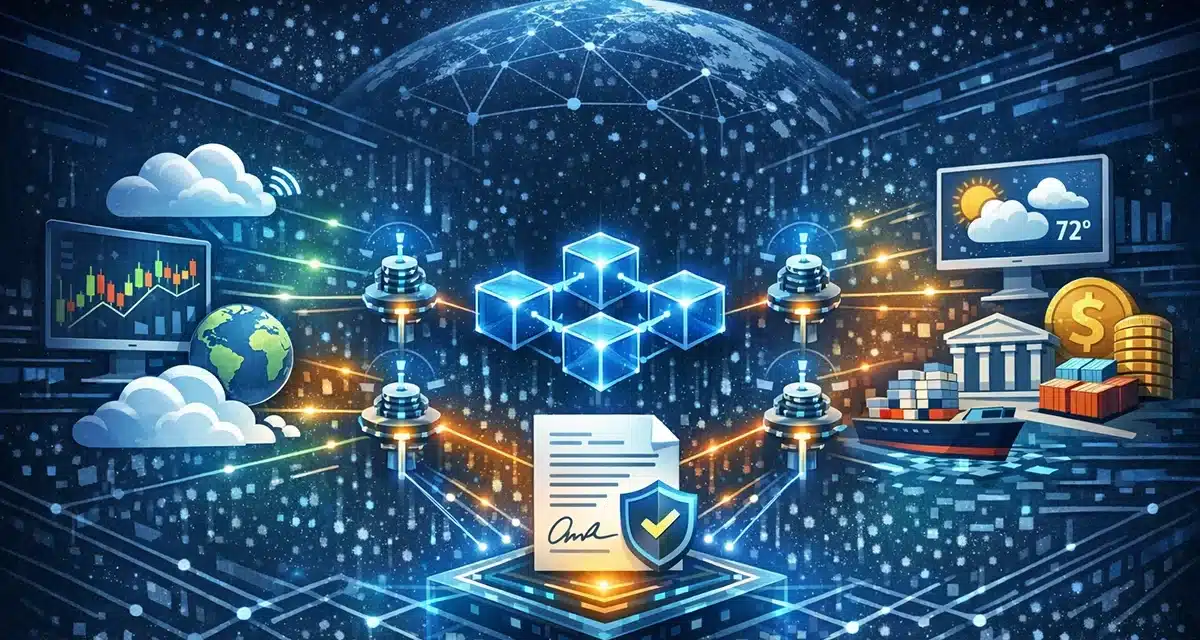
An oracle network is a system that delivers external data to blockchains in a way contracts can safely consume.
An oracle does not create new truths. It transports information from outside the chain into on-chain state. That distinction matters. The oracle becomes part of the trust surface of the application, not part of the ledger itself.
Most modern designs avoid single oracles.
They rely on networks of independent data providers, aggregation layers, and verification logic. This reduces the impact of faulty or malicious inputs.
Oracle networks sit between blockchains and the external world. They translate real-world signals into deterministic inputs that contracts can process.
Why Blockchains Cannot Access External Data Directly
Blockchain nodes execute transactions in isolation.
Each node must reach the same result given the same inputs. Direct API calls would break that property. External sources can change, time out, or respond differently across locations.
Allowing contracts to query the internet would fragment consensus.
The solution is indirect access:
- External data is retrieved off-chain
- Data is validated and aggregated
- Results are written on-chain as state updates
Once data enters the chain, it becomes subject to the same rules as any other state transition. The oracle absorbs the uncertainty so the blockchain does not have to.
Oracle Networks vs Single Oracles
Early smart contract systems used single trusted oracles. This approach failed under scrutiny.
Single oracles introduce multiple risks:
- A single point of failure
- Incentives to manipulate data
- Operational downtime
- Regulatory or legal capture
Oracle networks distribute data provision across independent actors.
Most follow a common pattern:
- Multiple data sources report values
- Independent nodes submit responses
- An aggregation mechanism determines the final value
- Economic incentives reward accurate reporting
- Penalties discourage dishonest behavior
Decentralization shifts trust from a single operator to a system with verifiable rules.
Core Components of Oracle Networks
Oracle networks consist of several coordinated layers.
Data Sources
External inputs such as price feeds, sensor data, APIs, or event results.
Oracle Nodes
Independent operators that retrieve data and submit reports.
Aggregation Layer
Logic that combines multiple reports into a single output.
On-Chain Interface
Smart contracts that expose oracle data to applications.
Incentive Mechanisms
Rewards and penalties tied to reporting accuracy and availability.
Each layer controls a specific risk vector. Removing any one weakens the system.
Types of Oracle Data
Oracle networks supply more than price feeds.
Common categories include:
- Asset prices and exchange rates
- Time and block-related data
- Randomness inputs
- Event outcomes
- Sensor and IoT data
- Identity and credential proofs
- Cross-chain state verification
Price data dominates current usage.
Other categories continue to mature as demand grows.
Push Models vs Pull Models
Oracle networks deliver data using two primary models.
Push-based oracles
Data is updated on a schedule or when thresholds are crossed. Contracts read values from storage.
Pull-based oracles
Contracts request data on demand. Nodes respond with signed data.
Push models favor predictability and lower latency for widely used feeds. Pull models support customization and reduced overhead for niche data.
Hybrid designs combine both approaches.
Trust and Verification in Oracle Systems
Oracle networks do not eliminate trust. They reshape it.
Trust shifts to assumptions about:
- Data source reliability
- Node independence
- Economic incentives
- Cryptographic verification
- Transparency of aggregation logic
Some systems use cryptographic proofs such as signatures or commit-reveal schemes.
Others rely on economic security through staking and slashing.
In practice, trust is layered. Applications decide which oracle assurances are sufficient for their risk profile.
Economic Security and Incentives
Accurate data reporting must be cheaper than manipulation.
Oracle networks use economic alignment:
- Nodes stake collateral
- Honest behavior earns fees
- Faulty behavior risks penalties
- Reputational systems limit long-term abuse
Economic security does not guarantee correctness.
It raises the cost of deviation beyond rational thresholds.
Applications with large value at risk demand correspondingly stronger oracle security.
Oracle Networks as Systemic Infrastructure
Oracle failures propagate.
Incorrect price data can liquidate positions, drain pools, or halt protocols. Several historical incidents resulted from oracle malfunction rather than smart contract bugs.
This makes oracle selection a system-level decision.
Key evaluation factors include:
- Data source diversity
- Update frequency
- Failure recovery mechanisms
- Network decentralization
- Economic incentives
- Audit history
Oracle networks increasingly resemble utilities. They support multiple applications and absorb shared risks.
Leading Oracle Network Architectures
The oracle landscape includes multiple design philosophies.
Chainlink relies on decentralized node operators, aggregation contracts, and economic incentives.
Chainlink dominates price feed usage across major chains.
Other designs focus on:
- Optimistic reporting
- Specialized data verticals
- Cross-chain messaging
- Application-specific oracle sets
No single architecture fits all use cases. Application requirements shape oracle choice.
Limitations of Oracle Networks
Oracle networks introduce latency.
Data must be fetched, processed, and written on-chain. This adds delay compared to native state reads.
They also add cost. Oracle updates consume transaction fees and operational expenses.
Data quality remains a challenge. Garbage inputs produce garbage outputs, even with decentralization.
Oracle networks mitigate risk. They do not erase it.
Oracles and Smart Contract Design
Developers must design contracts around oracle behavior.
Key considerations include:
- Handling stale data
- Limiting oracle dependency scope
- Implementing circuit breakers
- Accounting for update delays
- Avoiding oracle-driven reentrancy risks
Robust contracts assume oracle failure and degrade safely.
The Role of Oracles in Future Blockchain Systems
Oracle networks continue to expand beyond price feeds.
Emerging areas include:
- Verifiable randomness
- Cross-chain interoperability
- Off-chain computation proofs
- Real-world asset settlement
- Identity and compliance signaling
As blockchains interface with traditional systems, oracle complexity increases.
Reliability becomes more critical than raw decentralization metrics.
Infrastructure maturity matters more than novelty.
Why Oracle Networks Are Non-Negotiable
Blockchains cannot remain closed systems.
Any contract that reacts to markets, events, or external conditions requires oracle data.
Removing oracles strips smart contracts of relevance beyond static state machines.
Oracle networks allow blockchains to remain deterministic while interacting with an uncertain world. That balance defines their importance.
Oracle Networks Q&A
What is an oracle network in blockchain?
A system that delivers external data to blockchains so smart contracts can react to real-world conditions.
Why can’t smart contracts fetch data themselves?
Direct external calls would break deterministic execution across nodes.
Are oracle networks decentralized?
Many are decentralized at the node and aggregation level, though decentralization varies by design.
What happens if an oracle fails?
Applications may halt, revert actions, or produce incorrect outcomes depending on contract design.
Are oracle networks replaceable?
No alternative currently enables safe off-chain data access without introducing greater trust risks.
Do all blockchains need oracles?
Any blockchain supporting stateful smart contracts that depend on external information requires oracle mechanisms.
Are oracle networks part of consensus?
No. They feed data into the system but do not participate in block production or validation.