Seattle’s skyline is shaped by a limited number of vertical structures that communicate both scale and civic intent.
Among them, the Space Needle in Seattle, in the State of Washington, occupies a central role as an observation tower, architectural experiment, and long-standing symbol of the city.
Viewing the structure at dusk offers an especially clear framework for understanding its design priorities, spatial effects, and relationship to the surrounding urban environment.
As daylight fades, the Space Needle transitions from a daylight landmark into a lighting and visibility instrument.
This period highlights how the tower mediates between natural geography and the built city below.
Table of Contents
Construction and World’s Fair Origins
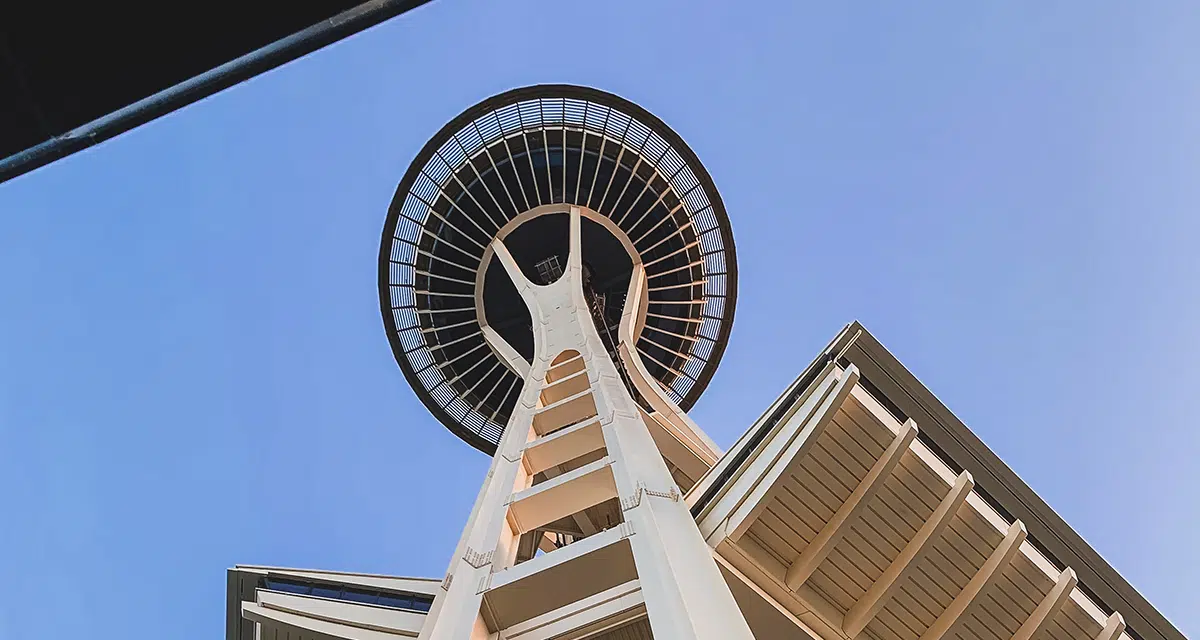
The Space Needle was constructed as a permanent symbol of futurism for the 1962 World’s Fair.
The tower was completed in under fourteen months and opened to the public in April 1962. It was designed to embody confidence in science, engineering, and progress during a period defined by the Space Race and large-scale civic investment.
Standing approximately 605 feet tall, the structure was engineered to withstand strong winds and seismic activity common to the Pacific Northwest.
Key characteristics of the original structure include:
- A narrow reinforced concrete core supporting the entire load
- A widened observation deck positioned near the top for public access
- A silhouette intended to communicate optimism and technological confidence
From its debut, the Space Needle became inseparable from Seattle’s identity.
Its image circulated globally as shorthand for the city itself, reinforcing its role not just as an attraction, but as a civic marker.
Urban Placement and Geographic Context
The tower’s location allows wide-angle observation of Seattle’s urban and natural systems.
Situated near Seattle Center and Broad Street, the Space Needle rises above surrounding mid-rise development and provides uninterrupted sightlines across multiple urban zones. Its elevation enables simultaneous views of downtown density, waterfront infrastructure, and surrounding terrain.
At dusk, the urban grid becomes more legible as lighting shifts. Street corridors, transportation routes, and building massing appear in higher contrast than during midday.
Visible geographic features commonly include:
- Downtown Seattle’s central business district
- Puget Sound and adjacent waterways
- Residential neighborhoods extending north and east
- Mount Rainier on clear days
These combined views illustrate how Seattle is structured around both commerce and geography.
Observation Deck Configuration
Modern viewing areas emphasize exposure, transparency, and uninterrupted sightlines.
The Space Needle’s observation levels are arranged to gradually increase sensory exposure. Movement through the tower transitions visitors from enclosed circulation spaces to highly transparent viewing zones designed to minimize visual obstruction.
Dusk conditions accentuate depth, reflection, and perceived height, intensifying the visual experience without changing physical elevation.
Upper Observation Level
The upper deck prioritizes outward visibility over enclosure.
Angled glass panels replace traditional railings, eliminating horizontal sightline interruptions and extending views outward beyond the deck’s perimeter. Glass seating elements further emphasize scale and exposure.
Design elements include:
- Floor-to-ceiling laminated glass panels
- Outward-tilted barrier geometry
- Minimal framing to reduce visual interruption
This configuration maximizes visibility while increasing perceptual height awareness.
Lower Observation Level
The lower level emphasizes vertical transparency and structural scale.
Sections of reinforced glass flooring allow downward views toward the ground below. These panels are limited in placement to maintain balance between visual impact and comfort.
Primary functions of this level include:
- Reinforcing the tower’s vertical height
- Highlighting structural engineering precision
- Providing contrast to enclosed upper spaces
The lower deck functions as both a viewing platform and a transitional space.
Renovation and Design Modernization
A major renovation in the late 2010s redefined the visitor experience.
Modernization efforts focused on removing physical barriers, increasing transparency, and reinforcing structural systems. Traditional opaque elements were replaced with high-performance glass designed to meet current safety and load requirements.
Key renovation priorities included:
- Maximizing uninterrupted viewing angles
- Updating structural materials and finishes
- Redesigning circulation for higher visitor volume
- Enhancing the sensory impact of height and exposure
These changes preserved the tower’s iconic form while substantially altering how it is experienced internally.
Visitor Access and Amenities
Access systems are designed for high throughput and controlled flow.
Entry typically uses timed ticketing, either through advance purchase or on-site kiosks. High-speed elevators transport visitors to observation levels in under a minute, supporting consistent circulation even during peak hours.
Supporting amenities include:
- Observation-level food and beverage options
- Seating areas oriented toward skyline views
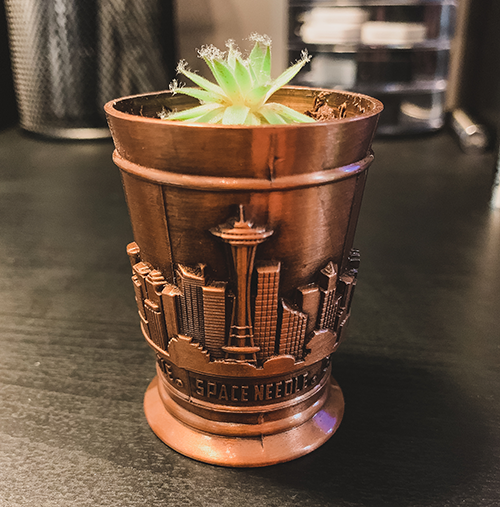
- Ground-level retail featuring Space Needle–themed items
These facilities are integrated without detracting from the primary viewing experience.
Enduring Civic Role
The Space Needle functions as both landmark and observation instrument.
Despite changes in materials and visitor expectations, its role remains consistent. The tower provides a fixed vantage point from which Seattle can be examined spatially, geographically, and architecturally.
Each visit differs based on light, weather, and season, but the underlying experience remains defined by elevation, visibility, and context. The Space Needle continues to operate as a place where the city can be observed as a whole rather than as isolated parts.
Space Needle Q&A
Why was the Space Needle built for the 1962 World’s Fair?
It was intended to symbolize technological optimism and civic ambition during a period focused on science and future-oriented design.
How tall is the Space Needle?
The structure stands approximately 605 feet tall.
What makes dusk a distinct time to visit?
Dusk highlights the transition from natural to artificial lighting, emphasizing urban structure and depth.
Are the glass observation areas safe?
Yes. All glass elements are engineered and tested to meet stringent safety and structural standards.
Can Mount Rainier be seen from the tower?
Yes, visibility depends on weather conditions and atmospheric clarity.
Were the glass floors always part of the Space Needle?
No. These elements were introduced during major renovations completed in the late 2010s.