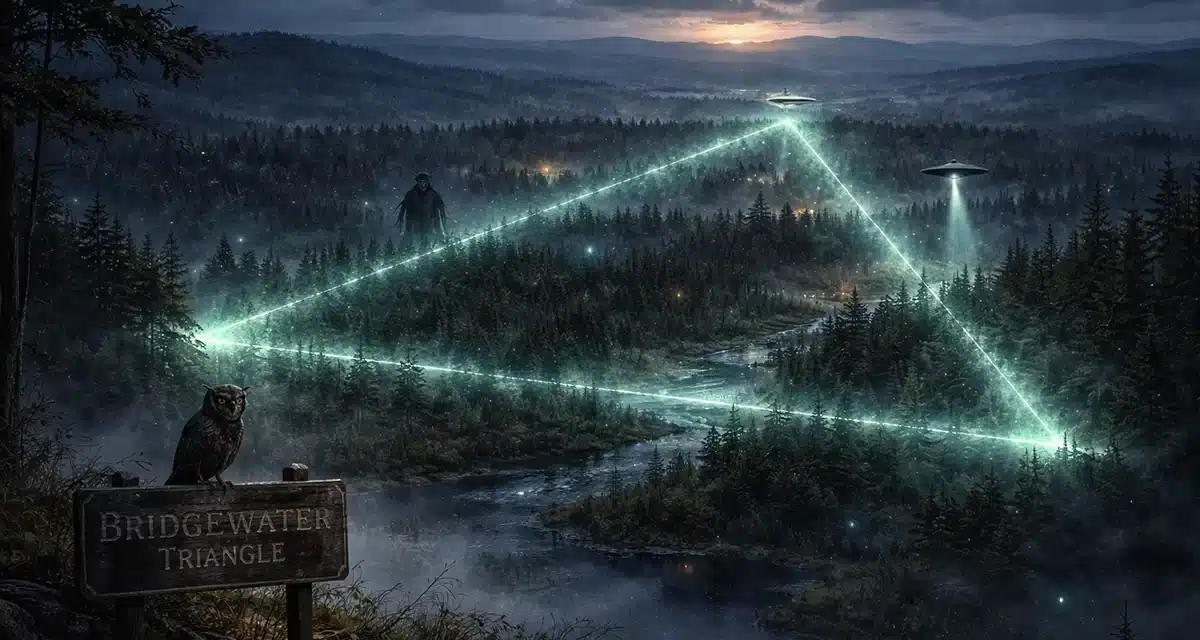
The Bridgewater Triangle refers to a loosely defined area of southeastern Massachusetts associated with recurrent reports of unusual phenomena.
The term “Bridgewater Triangle” was popularized in the late twentieth century to describe a region encompassing parts of Bristol and Plymouth counties in Massachusetts. The area is typically outlined by three reference points: Abington, Rehoboth, and Freetown. These points form an approximate triangular shape rather than a formally surveyed boundary.
The region includes forests, wetlands, rivers, and historically isolated settlements.
Much of the terrain has remained undeveloped due to poor drainage and difficult soil conditions.
These environmental factors shaped how the land was settled, used, and perceived over time.
Unlike formally designated historical or cultural regions, the Bridgewater Triangle has no official boundaries or administrative recognition.
Its definition varies slightly across sources, but the core area consistently includes long-standing tracts of undeveloped land and historically marginalized communities.
The label functions as a modern organizing term rather than an Indigenous designation. Earlier accounts of unusual activity existed long before the triangle concept emerged.
Table of Contents
Indigenous History and Pre-Colonial Context
The land within the Bridgewater Triangle was historically occupied by Algonquian-speaking peoples who regarded certain areas as dangerous or restricted.
Prior to European settlement, the region was inhabited by peoples including the Wampanoag. Indigenous oral traditions referenced specific locations associated with danger, spiritual imbalance, or taboo.
These narratives were tied to practical rules governing travel, hunting, and habitation rather than abstract mythology.
Swamps and dense forests were often described as places to avoid unless necessary.
These environments presented real risks, including predators, unstable ground, and difficulty navigating without established trails.
Oral traditions reinforced caution through narrative rather than mapping.
Colonial records occasionally reference Indigenous warnings about particular tracts of land.
These warnings were often dismissed or misunderstood, later reinterpreted through European religious frameworks that emphasized moral judgment rather than environmental knowledge.
This reinterpretation introduced a shift. Locations once framed as hazardous became framed as cursed or evil, altering how later generations contextualized the area.
Colonial Settlement and Early Anomalous Reports
Early colonial accounts document fear, isolation, and violence in the region, laying groundwork for later interpretations.
European settlement in southeastern Massachusetts lagged behind coastal areas. Poor agricultural conditions and difficult terrain made the region unattractive for large-scale farming.
Settlements were sparse, and travel between them was limited.
Historical records from the seventeenth and eighteenth centuries document:
- Conflicts between settlers and Indigenous communities
- Accusations of witchcraft
- Reports of outlaw hideouts and bandit activity
- Isolated homesteads subject to crime and disappearance
These events were not interpreted as paranormal at the time.
They reflected frontier instability rather than supernatural intervention. Over time, later retellings reframed these events within a mystery-based narrative.
The region’s association with the nearby Salem witch trials reinforced retrospective connections, despite limited direct overlap.
The Emergence of the “Bridgewater Triangle” Concept
The modern concept of the Bridgewater Triangle emerged in the 1970s through synthesis rather than discovery.
The term was popularized by writer and researcher Loren Coleman, who compiled decades of reports involving sightings, disappearances, and unexplained events within the region.
Rather than focusing on a single phenomenon, the concept grouped diverse accounts under a geographic umbrella.
This synthesis included reports of:
- Cryptid sightings
- UFO encounters
- Poltergeist activity
- Cult activity allegations
- Unexplained animal mutilations
The unifying element was location rather than mechanism. This approach increased public visibility but introduced analytical challenges.
Events with no clear causal relationship were presented as part of a shared pattern.
The triangle label provided narrative coherence but risked conflation. As a result, critical evaluation requires separating claims by type and context.
Cryptid and Creature Reports
Cryptid claims within the Bridgewater Triangle vary widely and lack a single defining figure.
Unlike regions associated with a specific legendary creature, the Bridgewater Triangle features multiple reported entities.
These include Bigfoot-like figures, large serpents, and smaller humanoid beings.
Frequently cited cryptid reports include:
- Tall, bipedal figures seen in forested areas
- Large, snake-like animals reported near waterways
- Small humanoid entities associated with wooded terrain
One commonly referenced location is Hockomock Swamp, a vast wetland historically avoided due to its size and inaccessibility.
Limited visibility and difficult navigation contribute to the potential for misidentification.
No physical evidence has been recovered. Reports tend to be brief, low-visibility encounters that resist verification.
UFO Sightings and Aerial Phenomena
UFO reports are among the most frequently cited modern claims associated with the area.
Reports of unusual aerial phenomena increased in the mid-twentieth century, coinciding with broader national interest in UFO sightings.
Witnesses described lights, silent objects, and structured craft performing rapid movements.
Common characteristics of reported sightings include:
- Erratic motion inconsistent with known aircraft
- Silent or near-silent operation
- Low-altitude hovering over wooded areas
- Abrupt directional changes
The region lies beneath civilian and military flight paths, complicating interpretation.
Experimental aircraft testing during the Cold War era introduced additional variables.
As with other categories, sightings are reported unevenly and lack corroborating physical evidence.
Cult Activity Allegations and Criminal History
The area has been repeatedly associated with allegations of cult activity, often without substantiation.
From the 1970s through the 1990s, rumors circulated involving satanic rituals, animal sacrifice, and secret gatherings.
Investigations by law enforcement failed to substantiate organized cult activity at the scale described.
Contributing factors include:
- Isolated terrain suitable for secrecy
- A history of unsolved crimes
- Moral panic during the late twentieth century
- Media amplification without evidentiary grounding
Criminal activity did occur, but available records suggest conventional explanations rather than coordinated occult practice. The persistence of these narratives reflects social anxiety more than documented behavior.
Environmental and Psychological Interpretations
Environmental conditions within the region plausibly contribute to misperception and narrative reinforcement.
The area’s geography includes dense forests, wetlands, uneven ground, and limited sightlines. These features increase disorientation and amplify ambiguous stimuli.
Sound travels unpredictably, and visual depth cues are often distorted.
Psychological factors also play a role:
- Expectation bias shaped by regional reputation
- Heightened alertness in isolated environments
- Stress responses during unfamiliar conditions
These interpretations do not dismiss reported experiences but contextualize how they may arise without extraordinary causes.
Cultural Persistence and Modern Reputation
The Bridgewater Triangle functions as a modern folklore region shaped by media, geography, and continuity of claim.
The region’s reputation persists because the environmental conditions that produced early isolation remain partially intact. Development has increased, but large tracts remain undeveloped and sparsely populated.
Unlike tourist-driven mystery locations, the Bridgewater Triangle exists primarily in regional consciousness rather than promotional infrastructure.
Its identity is maintained through books, documentaries, and localized storytelling.
Bridgewater Triangle Q&A
Is the Bridgewater Triangle an officially recognized region?
No. It is an informal term used to group reports geographically.
What types of phenomena are associated with the area?
Reports include cryptids, UFOs, alleged hauntings, and criminal activity.
Is there physical evidence supporting these claims?
No verified physical evidence has been produced.
Why is Hockomock Swamp frequently mentioned?
Its size, isolation, and historical avoidance contribute to sightings and speculation.
Did Indigenous peoples describe the area as supernatural?
They described certain locations as dangerous or restricted rather than supernatural.
Is the reputation declining or increasing today?
Public interest fluctuates, but regional awareness remains stable.