
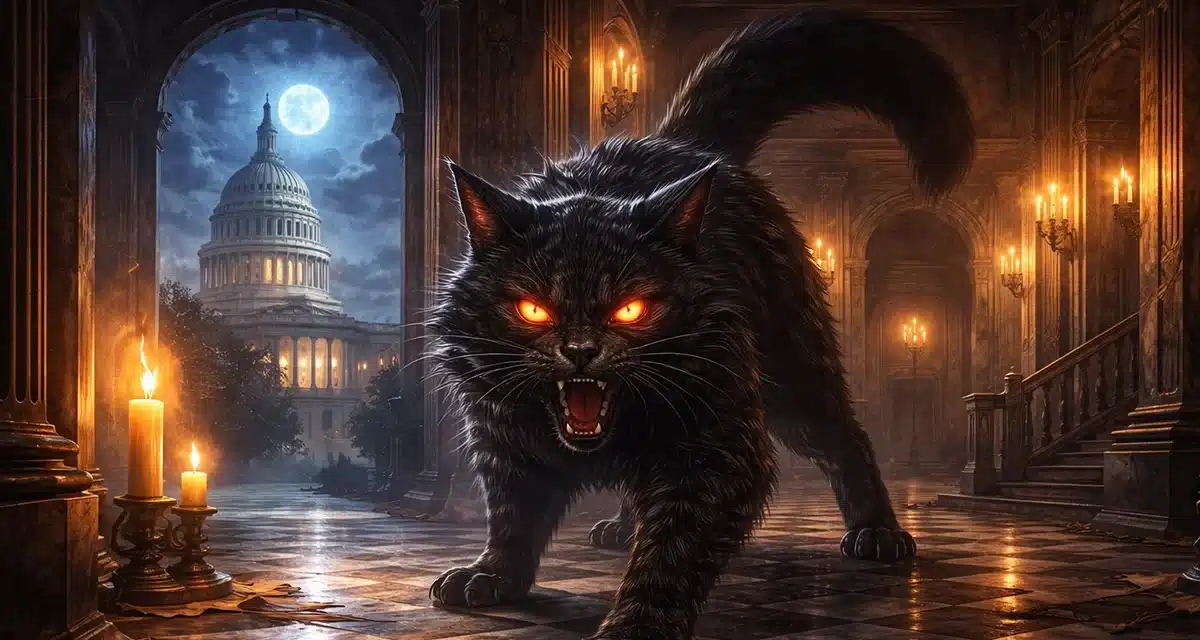
Washington, D.C. maintains a long tradition of folklore that exists alongside formal governance and constitutional ritual.
Among the city’s most persistent legends is the Demon Cat, a spectral figure said to appear within the corridors of federal power at moments of institutional stress.
Unlike rural folklore rooted in wilderness, the Demon Cat legend is inseparable from state buildings, political authority, and the symbolic weight of the American presidency.
Table of Contents
Origins of the Demon Cat Legend
The Demon Cat legend emerged in the nineteenth century within federal government buildings.
The earliest reported sightings date to the mid-1800s, a period marked by rapid expansion of federal institutions and repeated national crises.
Accounts consistently place the apparition inside government structures rather than private homes or public streets.
Descriptions portray a black cat that appears ordinary at first, then grows to unnatural size before vanishing.
The escalation from mundane to threatening mirrors the anxieties of a capital city designed to project order while managing instability.
These narratives developed in an environment saturated with ceremony, secrecy, and symbolic power.
The U.S. Capitol as a Liminal Political Space
The Demon Cat is most closely associated with the United States Capitol as both a workplace and a national symbol.
The Capitol has never functioned solely as an administrative building. It operates simultaneously as a theater of governance, a historical archive, and a symbol of state continuity.
Legends rooted within the Capitol reflect this dual role.
Sightings are often linked to basements, crypts, and transitional corridors rather than visible chambers.
These spaces sit beneath formal democracy, both literally and symbolically.
The Demon Cat occupies the unseen infrastructure of power rather than its public face.
Civil War Washington and Institutional Anxiety
The legend gained prominence during the Civil War era when federal stability was uncertain.
Washington, D.C. transformed into a militarized capital during the Civil War.
Troops occupied federal buildings, hospitals filled public spaces, and the presidency itself became a focal point of national survival.
Reports of the Demon Cat increased during this period, particularly around moments of military uncertainty or political tension.
The apparition was said to appear before calamity rather than after it.
Folklore functioned as a psychological outlet for fear when official narratives demanded confidence and resolve.
Government Employees and Oral Transmission
The Demon Cat legend spread primarily through government staff rather than through popular literature.
Unlike folktales transmitted through families or villages, this legend circulated among guards, clerks, and night workers responsible for maintaining federal buildings after hours.
These individuals occupied a unique position.
They were close to power but excluded from decision-making.
Their vantage point made them witnesses to institutional routine rather than political speech.
The story persisted because it belonged to the workplace culture of the state itself.
Symbolism of the Black Cat in Political Context
Black cats historically represent uncertainty, omen, and marginal presence rather than direct threat.
In Western symbolism, black cats rarely act as aggressors.
They signify warning, transition, or reversal.
This symbolism aligns closely with the Demon Cat’s reported behavior.
The apparition does not attack.
It appears, expands, and disappears. The threat lies in implication rather than action.
Within a political context, this mirrors how crises often arrive not as sudden collapse, but as slow, visible escalation ignored until unavoidable.
Presidential Transitions and Crisis Moments
The Demon Cat is frequently associated with moments of political transition or national stress.
According to legend, sightings have occurred before assassinations, economic collapses, or major political upheaval.
These claims are anecdotal and unverifiable, but the pattern remains consistent within the mythology.
Presidential transitions concentrate uncertainty. Power changes hands, policies shift, and continuity is tested.
Folklore fills the interpretive gap between ceremony and consequence.
The Demon Cat becomes a symbolic monitor of institutional tension.
Relationship to Other American Political Legends
The Demon Cat belongs to a distinct category of government-centered folklore.
Unlike ghost stories tied to individual figures or locations of violence, the Demon Cat is impersonal.
It represents process rather than personality.
Comparable legends include:
- Omens associated with presidential residences
- Haunted corridors in state buildings
- Apparitions tied to legislative chambers
These stories do not focus on tragedy alone. They reflect anxiety around governance, responsibility, and historical weight.
Skepticism and Rational Interpretation
Modern interpretations often frame the Demon Cat as psychological or environmental.
Proposed explanations include misidentified animals, lighting distortions, or stress-induced perception.
Government buildings are expansive, poorly lit in some areas, and active around the clock.
Yet rational explanations do not erase the legend.
They coexist with it. Folklore does not require empirical confirmation to remain functional.
The story persists because it expresses institutional unease rather than physical danger.
The Demon Cat in Contemporary Washington
The legend continues to circulate despite technological surveillance and security modernization.
Cameras, sensors, and constant monitoring have not eliminated stories of the Demon Cat.
This persistence suggests that the legend has moved fully into symbolic territory.
Today, it appears primarily in oral retellings, historical accounts, and cultural discussions of Washington’s psychological landscape.
The Demon Cat no longer predicts catastrophe. It reflects awareness of power’s fragility.
Political Folklore as Historical Record
Legends like the Demon Cat reveal how institutions perceive themselves.
Formal histories document decisions and outcomes.
Folklore records emotion, fear, and anticipation.
In a city defined by abstraction and authority, such stories provide a parallel narrative.
The Demon Cat reflects:
- Unease beneath institutional permanence
- Awareness of historical cycles
- Anxiety surrounding concentrated power
Its endurance is not accidental.
Demon Cat of D.C. Q&A
Is the Demon Cat considered an official historical event?
No. It exists within folklore and oral tradition rather than verified historical record.
Why is the legend tied to government buildings?
The story reflects institutional anxiety rather than domestic or personal fear.
Has any physical evidence ever been documented?
No credible physical evidence has been established.
Why do such legends persist in political capitals?
They express collective uncertainty around power, transition, and responsibility.
Is the Demon Cat still referenced today?
Yes. It remains part of Washington’s unofficial historical culture.