
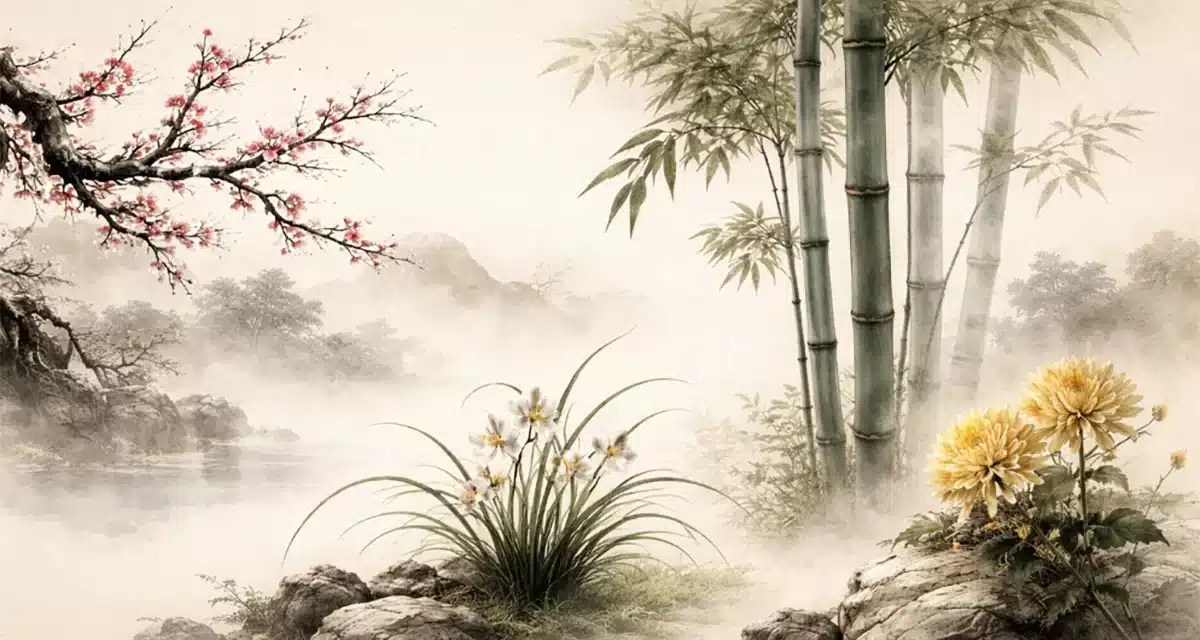
Across centuries of Chinese thought, four plants came to represent not decoration, wealth, or status—but character.
Known as the Four Gentlemen or Four Noble Plants, they function as moral symbols rather than botanical curiosities.
Each plant reflects a way of behaving under pressure, a posture toward life, and a standard for conduct when circumstances are less than ideal.
The Four Gentlemen are:
- Plum Blossom
- Orchid
- Bamboo
- Chrysanthemum
They correspond to winter, spring, summer, and autumn.
More importantly, they correspond to endurance, integrity, balance, and withdrawal. Together, they form a quiet ethical system—one that values inner structure over outward success.
Table of Contents
Cultural Context: Why Plants Became Moral Teachers
In classical Chinese culture, nature was not separate from ethics.
The natural world was observed as a living text, one that revealed how order, restraint, and principle functioned without human interference.
Scholar-artists did not paint plants to show technical skill alone. They painted them to communicate values. A single branch or stalk could suggest an entire worldview.
These four plants were chosen because they:
- Survive difficult conditions
- Display restraint rather than excess
- Possess strength without dominance
- Reveal character over time
Each plant behaves correctly within its environment.
None seeks attention. None relies on force. This restraint made them ideal metaphors for cultivated human character.
Taken together, the Four Gentlemen describe how to live well without needing to win.
Plum Blossom — Endurance Before Reward (Winter)
The plum blossom flowers in the dead of winter, often before snow has melted and before leaves appear.
It does not wait for warmth. It does not require ideal conditions. It blooms anyway.
In Chinese symbolism, this makes the plum blossom a lesson in endurance. Not survival alone, but purposeful endurance.
The plum blossom represents:
- Strength developed in isolation
- Resolve formed before recognition
- Renewal that begins before evidence appears
Unlike flowers that rely on abundance, the plum blossom appears when life seems paused. Its beauty is restrained. Its fragrance is faint. Its presence feels intentional rather than ornamental.
This plant taught scholars that integrity is forged early, long before success becomes visible. If character does not exist in hardship, it will not suddenly appear during comfort.
The winter season reinforces this idea. Winter strips life down to essentials. The plum blossom answers with commitment rather than complaint.
In practical terms, the plum blossom argues for patience that works quietly while others wait for permission.
Orchid — Integrity Without Witness (Spring)
Orchids grow in secluded places—between rocks, along shaded forest paths, far from display.
Their fragrance exists whether or not anyone is there to notice it.
For this reason, the orchid became a symbol of moral consistency. It behaves the same when unseen as it would if admired.
The orchid represents:
- Character maintained in solitude
- Principles that do not adjust to audience
- Worth that does not require validation
Confucian thinkers often used orchids as metaphors for ethical people living under unjust rulers or within corrupt systems. The orchid does not change its nature simply because the environment is indifferent.
Spring is associated with renewal and growth, yet the orchid remains understated. It does not dominate the season. It participates quietly.
The lesson here is subtle but firm: integrity loses meaning when it depends on recognition. What one does when unnoticed defines the whole.
Orchids remind readers and viewers that consistency matters more than visibility.
Bamboo — Discipline That Bends (Summer)
Bamboo grows tall and fast, yet remains hollow at its center.
It bends in strong wind rather than snapping. It breaks only when it refuses flexibility.
Bamboo symbolizes balance between strength and humility.
Its traits include:
- Structural strength without rigidity
- Growth governed by segments, not chaos
- Resilience through adaptability
The hollow center carries special meaning. It represents openness, restraint, and the absence of arrogance.
A person full of ego cannot bend. Bamboo bends because it is not overfilled.
Summer is associated with energy, expansion, and activity. Bamboo thrives during this season but does not lose discipline. Its growth remains ordered. Its height never compromises its roots.
For scholars and officials, bamboo served as a reminder that authority must remain flexible to remain effective. Power without restraint leads to collapse.
Bamboo teaches that stability comes from knowing when to yield and when to hold.
Chrysanthemum — Withdrawal Without Defeat (Autumn)
Chrysanthemums bloom in autumn, when other flowers fade.
Their season marks decline, cooling, and preparation for dormancy.
Rather than resisting this shift, the chrysanthemum accepts it.
This plant represents:
- Dignified withdrawal
- Choosing simplicity over ambition
- Peace found in restraint
In Chinese tradition, the chrysanthemum became associated with reclusion—particularly scholars who chose distance from political life. Withdrawal was not framed as failure, but as discernment.
Autumn is a time of harvesting and release. The chrysanthemum does not chase spring. It completes its cycle gracefully and steps back.
This idea carries weight. Not every season requires visibility. Not every stage of life rewards striving. Knowing when to step away preserves integrity.
The chrysanthemum teaches that disengagement can be an act of strength.
The Four Together: A Complete Ethical Cycle
Each plant represents a season, but together they represent a full human life.
Endurance, integrity, discipline, and release form a complete arc.
Consider the progression:
- Winter teaches endurance before reward
- Spring reinforces integrity during renewal
- Summer demands strength with restraint
- Autumn permits withdrawal with dignity
This cycle rejects constant productivity. It allows for rest, preparation, effort, and release. It resists the idea that worth must be proven endlessly.
For scholars, artists, and thinkers, the Four Gentlemen offered a way to measure success internally rather than socially.
They still do.
Why the Four Gentlemen Still Matter
Modern life rewards speed, exposure, and constant output.
The Four Gentlemen argue for something quieter.
They suggest:
- Growth does not need an audience
- Strength does not require dominance
- Withdrawal can preserve clarity
- Integrity is built before it is tested
These ideas feel increasingly rare, which makes them more useful—not less.
The Four Gentlemen are not nostalgic symbols. They are correctives.
They remind readers that life is seasonal, character is cumulative, and restraint is not weakness.
The Four Noble Plants Q&A
What are the Four Noble Plants?
The Four Noble Plants—also called the Four Gentlemen—are the plum blossom, orchid, bamboo, and chrysanthemum.
They symbolize ethical virtues rather than decorative beauty.
Why are they associated with seasons?
Each plant thrives during a specific season, reflecting how different virtues emerge under different conditions.
Together, they mirror a complete cycle of growth, effort, and withdrawal.
Are these symbols tied to religion?
They are influenced by Confucian, Daoist, and scholarly traditions rather than formal religious doctrine.
Their focus is ethical conduct and personal discipline.
Why were these plants painted so often?
Scholar-artists used them to express values indirectly.
A single plant could communicate restraint, integrity, or resilience without explanation.
Do these ideas still apply today?
Yes.
The Four Gentlemen offer an alternative to constant performance and competition. They prioritize internal structure over external approval.
Is withdrawal seen as failure in this system?
No.
Withdrawal, represented by the chrysanthemum, is viewed as discernment. Stepping back can preserve integrity and clarity.
What unites all four plants?
Each demonstrates strength without excess.
None relies on spectacle. All endure through correct alignment with their environment.