
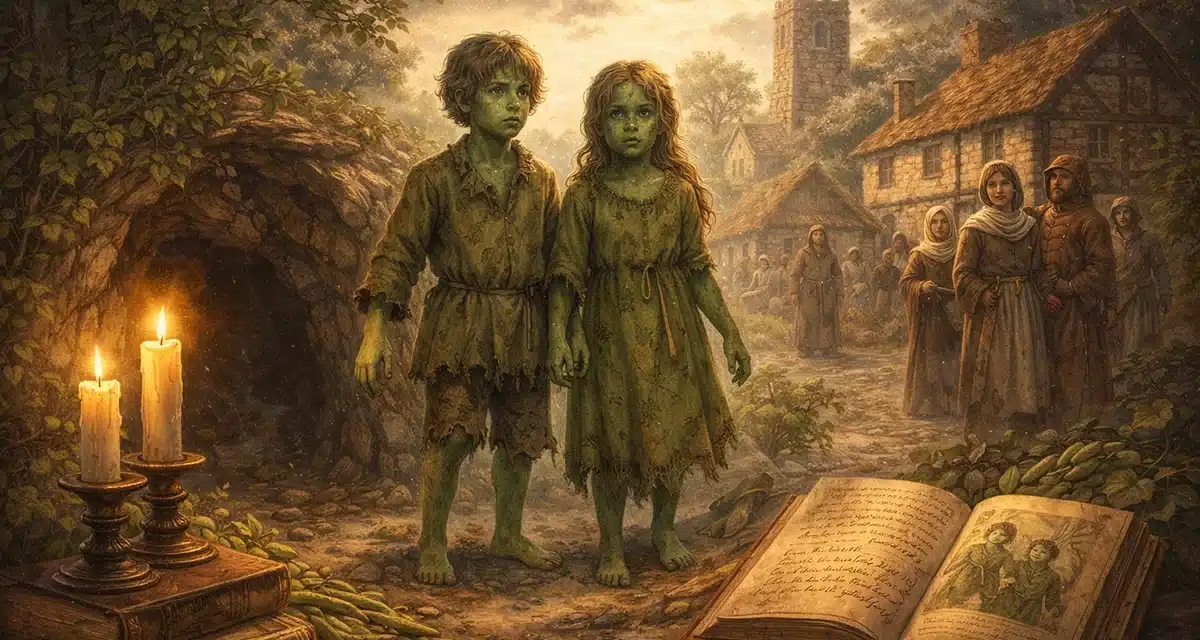
In the twelfth century, a brief and strange account entered English historical writing describing two children of unusual appearance discovered near a rural village.
Known today as the Green Children of Woolpit, the episode sits at the intersection of medieval record-keeping, folklore transmission, and social anxiety during a period of political instability.
Unlike later legends preserved orally, this story survives because it was written down by contemporaries who believed it noteworthy, even if they could not explain it.
Table of Contents
The Medieval Accounts and Their Sources
The Green Children story survives in two near-contemporary Latin chronicles.
The episode is recorded by William of Newburgh and Ralph of Coggeshall, both clerics writing within a generation of the reported events.
Neither author presents the account as allegory or fiction.
Each frames it as an unusual occurrence relayed through local testimony.
Their agreement on core details—the children’s green skin, unfamiliar speech, strange diet, and eventual assimilation—suggests reliance on a shared oral report rather than later embellishment.
Differences appear in interpretation, not description.
This places the narrative unusually close to the historical record compared to most medieval marvel tales.
Woolpit and Its Historical Setting
The incident is located near the village of Woolpit during a period of local disruption.
Woolpit was a small agrarian settlement whose name derives from wolf traps dug to protect livestock. The surrounding region was shaped by feudal landholding, seasonal labor, and limited mobility.
The alleged appearance of the children occurred during the reign of King Stephen, a time marked by civil conflict, food scarcity, and population displacement.
Villagers were accustomed to outsiders passing through, but rarely to children without guardians or recognizable origin.
The setting matters because medieval communities interpreted anomalies through social rather than scientific frameworks.
Description of the Children
Contemporary accounts emphasize physical difference and behavioral unfamiliarity.
The children were described as a boy and a girl, both with green-tinged skin and clothing of unfamiliar style.
They spoke a language no one could identify and refused most food offered to them.
Eventually, they accepted raw beans as nourishment.
Over time, as they adopted local food, the green coloration reportedly faded.
The boy died within months. The girl survived, learned English, was baptized, and later married, integrating into local society.
Medieval Worldviews and Interpretation
Medieval chroniclers recorded marvels alongside political and religious events.
In twelfth-century England, history writing did not strictly separate natural phenomena from divine sign or moral curiosity.
Miracles, monsters, and portents were included if they conveyed meaning about the world’s order.
The Green Children were not framed as demons or angels.
They were treated as human, albeit altered.
This distinction is important. The chroniclers expressed curiosity and restraint rather than fear or condemnation.
Their tone suggests uncertainty rather than assertion.
Proposed Historical Explanations
Later interpretations attempt to contextualize the account without dismissing its origins.
Modern historians and folklorists have proposed explanations grounded in social and environmental realities of medieval England.
Common interpretations include:
- Displaced children from a neighboring region with distinct language and dress
- Effects of malnutrition or anemia causing unusual skin coloration
- Survivors of localized famine or conflict unfamiliar with local customs
These theories do not claim certainty. They aim to reconcile recorded detail with plausible historical conditions.
Symbolism and Folkloric Elements
The narrative reflects recurring medieval themes of otherness and assimilation.
Green coloration appears in medieval literature as a marker of liminality—neither fully natural nor supernatural.
The children emerge from an underground or hidden realm, reinforcing the idea of borders between worlds.
Their gradual loss of green skin parallels integration.
The story resolves not through revelation, but through absorption into social order.
This structure mirrors broader medieval concerns about outsiders, language, and belonging.
Relationship to Other European Wonder Tales
The Green Children belong to a wider medieval tradition of recorded marvels.
European chronicles include accounts of people with unusual features, lands of perpetual twilight, and encounters at the edge of the known world.
These stories often functioned as boundary markers for cultural understanding.
What distinguishes the Green Children is specificity.
Names, places, durations, and outcomes are recorded. The story is anchored rather than abstract.
This grounding contributes to its persistence.
Modern Reception and Cultural Afterlife
The story endures because it resists definitive explanation.
Later centuries reframed the Green Children through lenses of folklore, science fiction, and speculative history.
Each reinterpretation reflects contemporary concerns more than medieval ones.
The original account remains compelling because it does not insist on meaning.
It presents a puzzle and moves on.
Ambiguity sustains interest where certainty would end it.
Historical Value Beyond Belief
The Green Children illuminate how medieval societies processed uncertainty.
Whether interpreted literally or symbolically, the episode demonstrates how communities encountered difference and resolved it through care rather than exclusion.
The surviving girl was not expelled or punished.
She was fed, baptized, taught, and married. Integration, not fear, concludes the account.
This social response is as historically significant as the mystery itself.
Green Children of Woolpit Q&A
Were the Green Children considered supernatural at the time?
No. Chroniclers treated them as human but unexplained.
How many original sources describe the event?
Two independent medieval chroniclers recorded similar accounts.
Did the green skin have symbolic meaning?
Likely yes. Green often marked liminality or otherness in medieval thought.
Is there a confirmed modern explanation?
No. All modern theories remain speculative.
Why does the story persist today?
Its ambiguity and detailed recording invite ongoing interpretation.