
Atlantic City in Atlantic County exists because it was built deliberately, marketed aggressively, and reinvented repeatedly.
Unlike older New Jersey towns that developed gradually through farming, trade, or industry, Atlantic City was conceived as a destination.
From its origins as a health resort to its rise as an entertainment capital and its ongoing struggle with reinvention, the city’s history follows cycles of promotion, decline, intervention, and recalibration.
This is not a story of organic growth. It is a story of intent.
Table of Contents
Before Atlantic City: Barrier Island and Indigenous Use
Long before Atlantic City existed, the barrier island was used seasonally by the Lenape.
The Lenape harvested shellfish, fished coastal waters, and traveled along the shoreline. The land itself was unsuitable for permanent agriculture.
Sandy soil, exposure to storms, and shifting dunes limited long-term settlement.
European colonists largely avoided the barrier island for the same reasons. Until the 19th century, the area that would become Atlantic City was sparsely populated and economically marginal.
Its value would come later, not from production, but from perception.
The Railroad and the Creation of a Resort
Atlantic City began as a railroad project.
In 1854, the Camden and Atlantic Railroad completed a line connecting Philadelphia to the barrier island. The goal was explicit: create a seaside resort accessible to urban residents.
That same year in 1854, Atlantic City was incorporated.
Early development focused on:
- Hotels and boarding houses
- Bathing pavilions
- Promenades
- Transportation infrastructure
The city’s economy was tourism from the outset.
There was no prior agricultural or industrial base to fall back on.
Health, Leisure, and Victorian Morality
In the late 19th century, Atlantic City marketed itself as a health destination.
Seaside air, saltwater bathing, and controlled leisure were promoted as therapeutic. This framing mattered. It made beachgoing respectable for middle-class families.
Hotels enforced social norms. Public behavior was regulated. Leisure was structured.
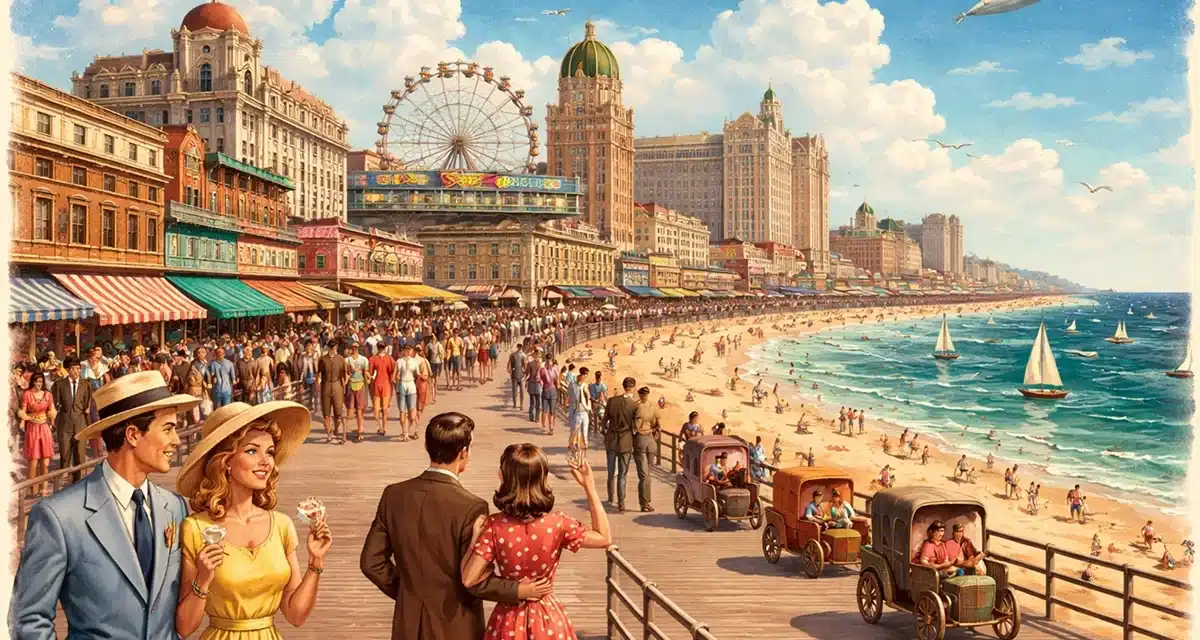
The Boardwalk, first built in 1870, reinforced these values. It allowed visitors to enjoy the beach without walking directly on sand, preserving clothing and decorum.
The city’s early success came from balancing pleasure with order.
The Boardwalk as an Economic Engine
The Boardwalk became Atlantic City’s defining feature.
Rebuilt multiple times due to storms and fires, it evolved into a commercial corridor lined with hotels, theaters, shops, and amusements.
By the early 20th century, the Boardwalk supported:
- Large resort hotels
- Entertainment venues
- Retail and concessions
- Seasonal employment
This concentration of activity created high revenue density but also dependence on continuous visitor flow.
Atlantic City prospered as long as it remained fashionable.
Prohibition and the City’s Reputation
Prohibition altered Atlantic City’s image but did not halt its economy.
The city gained a reputation for lax enforcement, backroom drinking, and political corruption.
Nucky Johnson, the city’s political boss, oversaw an era where:
- Alcohol was widely available
- Gambling operated unofficially
- Law enforcement was selective
For visitors, this permissiveness added appeal. For the city, it entrenched a dual identity: outward respectability and inward tolerance for vice.
This reputation would later be formalized rather than erased.
Decline After World War II
Atlantic City’s decline began after World War II.
Several factors converged:
- The rise of automobile travel
- Competition from other resort destinations
- Growth of suburban leisure options
- Aging hotel infrastructure
Middle-class families increasingly chose other destinations.
The city’s hotel stock deteriorated. Investment slowed.
By the 1960s, Atlantic City faced shrinking tourism, rising poverty, and urban decay.
Casino Gambling and Reinvention
Legalized casino gambling was introduced in 1976 as an economic intervention.
Voters approved gambling with the expectation that it would revive tourism and provide employment.
Casinos opened beginning in 1978.
The new economy brought:
- Large-scale construction
- Employment opportunities
- Increased tax revenue
However, it also concentrated wealth within casino properties rather than spreading it throughout the city.
Casinos functioned as self-contained environments. Visitors often had little reason to leave them.
Limits of the Casino Model
While casinos revived Atlantic City temporarily, they introduced structural vulnerabilities.
The city became dependent on a single industry subject to competition and regulation.
Challenges included:
- Competition from casinos in neighboring states
- Reduced exclusivity
- Declining visitation
- Financial instability among operators
Casino closures in the 2010s exposed the city’s fragility.
The promise that gambling alone would solve Atlantic City’s problems proved overstated.
Social and Economic Inequality
Economic activity in Atlantic City has long been unevenly distributed.
Wealth generated along the Boardwalk contrasts sharply with conditions in residential neighborhoods.
Persistent issues include:
- High poverty rates
- Housing instability
- Limited economic mobility
Redevelopment efforts often prioritized tourism infrastructure over local quality of life. This imbalance remains a central challenge.
Diversification Efforts
Recent decades have focused on diversification beyond gambling. Efforts include:
- Convention and event hosting
- Entertainment and dining
- Sports and esports venues
- Heritage and cultural tourism
These strategies aim to reduce dependence on casino revenue, though results have been mixed.
Atlantic City continues to search for a stable economic identity beyond novelty.
The Built Environment
Atlantic City’s physical landscape reflects its cycles of ambition and abandonment.
Large structures rise quickly and are sometimes removed just as fast.
The city contains:
- Preserved historic buildings
- Empty lots from demolished properties
- Active casino complexes
- Underutilized public spaces
This unevenness is not accidental. It follows investment cycles rather than community continuity.
Atlantic City Today
Today, Atlantic City remains an active but unstable tourism city.
It draws millions of visitors annually while struggling with long-term structural issues.
Its defining characteristics include:
- Continued reliance on tourism
- Limited economic diversification
- Strong state involvement
- Ongoing redevelopment pressure
Atlantic City persists because it adapts, even imperfectly.
What Atlantic City Represents
Atlantic City is not a failed city, but it is not a resolved one.
It exists at the intersection of entertainment, regulation, and expectation.
It demonstrates:
- The risks of single-industry dependence
- The power of branding
- The limits of reinvention without structural change
Its history is not linear. It is cyclical.
Atlantic City, New Jersey Q&A
When was Atlantic City founded?
Atlantic City was incorporated in 1854 following completion of a railroad from Philadelphia.
Why was the city created?
It was intentionally developed as a seaside resort for urban visitors.
What made the Boardwalk important?
It concentrated tourism, commerce, and entertainment in a single linear space.
How did Prohibition affect Atlantic City?
The city became known for lax enforcement and political corruption, boosting its nightlife appeal.
Why did Atlantic City decline after WWII?
Changing travel habits, competition, and aging infrastructure reduced its appeal.
Did casinos solve Atlantic City’s problems?
They provided temporary revival but created long-term dependence and inequality.
What defines Atlantic City today?
A tourism-focused economy balancing casinos, entertainment, and redevelopment efforts.