
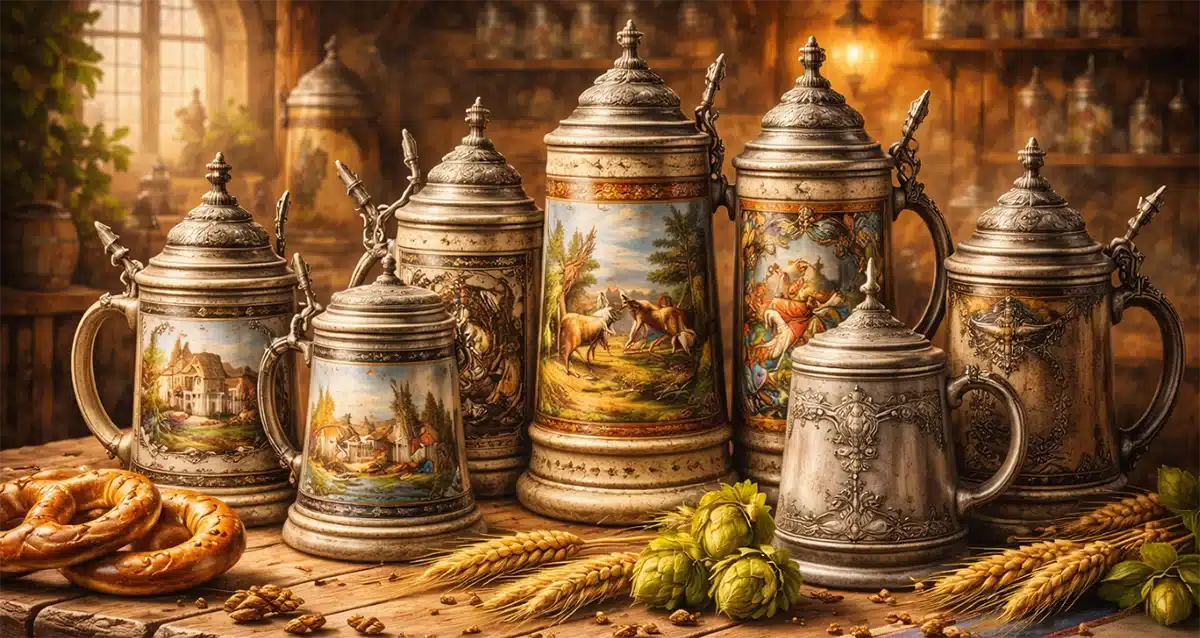
Beer steins are practical objects that accumulated meaning after their usefulness was established.
They were not designed as decorative souvenirs, heirlooms, or symbols of heritage. They exist because beer needed a durable, repeatable container in a public setting, and because law, disease, and manufacturing constraints pushed drinkware in specific directions over centuries.
Table of Contents
What a Beer Stein Is—and Is Not
A beer stein is a drinking vessel traditionally associated with Central Europe, most often made from stoneware and sometimes fitted with a hinged lid.
The term comes from Steinkrug, meaning stone mug or stone jug.
Not all beer mugs are steins.
Glass tankards, pewter cups, wooden vessels, and modern barware are distinct categories.
Historically accurate steins tend to share several characteristics.
- Thick walls
- Fired ceramic or stoneware bodies
- A single handle
- Functional lids in some regions
The lid is the most misunderstood feature.
It was not universal, and it did not originate as decoration.
Early Beer Drinking Before Steins
Before steins existed, beer was consumed from whatever container could be made locally.
In medieval Europe, this included wood, leather, clay, and shared communal bowls.
These early vessels created recurring problems.
- Porosity trapped residue and bacteria
- Wood and leather altered flavor
- Containers wore out quickly
- Cleaning standards were inconsistent
As beer moved from household production to taverns and public houses, inconsistency became a liability.
Reusable, standardized vessels became necessary.
Regulation, Disease, and the Lid
The hinged lid developed in response to public health concerns, not ritual.
During outbreaks of plague and other communicable diseases in the late medieval period, authorities in parts of the Holy Roman Empire required food and drink to be protected from contamination.
This is where the beer stein lid appears.
Why Lids Were Mandated
Lids addressed specific, observable problems.
- Insects landing in beer
- Debris falling into open vessels
- Unsanitary conditions in dense taverns
A hinged lid allowed drinkers to open the vessel with one hand and close it quickly. It was a compliance tool.
Over time, this requirement became regional custom, particularly in German-speaking areas.
Materials Follow Function
The evolution of beer stein materials followed manufacturing capability rather than aesthetic preference.
Early clay vessels were replaced by stoneware as kiln technology improved.
Stoneware offered clear advantages.
- Higher firing temperatures
- Lower porosity
- Greater durability
- Easier cleaning
This material shift reduced health risks and extended vessel lifespan
Common Materials by Period
Different materials appeared as technology allowed.
- Earthenware in early medieval periods
- Salt-glazed stoneware in the late medieval and early modern periods
- Pewter for lids and fittings
- Glass during later industrial periods
- Porcelain during export and decorative phases
Material choice reflected cost, regulation, and availability.
When Decoration Appears
Decoration became common only after the functional problems had been solved.
Early steins were plain. Markings were rare and utilitarian.
As production stabilized, workshops began adding surface detail.
What Decoration Communicated
Decorative features served identification and affiliation.
- Ownership marks
- Guild symbols
- Regional crests
- Trade motifs
Decoration did not imply luxury. It implied belonging.
A stein identified where someone drank, worked, or held status.
Taverns, Guilds, and Personal Steins
In many regions, frequent tavern patrons owned personal steins kept on-site.
This practice reduced disputes, theft, and hygiene concerns.
Personal stein storage reinforced loyalty to a specific tavern and created predictable customer behavior.
Guild and Trade Steins
Trade organizations commissioned steins to mark professional milestones.
- Completion of apprenticeship
- Guild membership
- Retirement or service
These steins were functional objects first, commemorative objects second.
Industrialization Changes the Object
The 19th century altered beer steins permanently.
Industrial kilns, mold casting, and rail transport enabled mass production.
At the same time, beer consumption expanded and tourism increased.
This combination shifted steins from durable tools to export goods.
Export-Oriented Steins
Steins made for export emphasized appearance.
- Thinner walls
- Heavier decoration
- Painted scenes
- National symbolism
These steins were not designed for tavern abuse. They were designed to travel.
Beer Steins in the United States
Beer steins entered American culture primarily through German immigration in the 19th century.
Breweries, beer halls, and social clubs adopted steins initially as functional objects.
Over time, American drinking culture moved toward glassware.
The Shift Away From Use
Several factors accelerated this transition.
- Bar standardization
- Health codes favoring glass
- Industrial cleaning systems
- Changing aesthetics
Steins increasingly moved out of use and into cabinets.
Prohibition and Preservation
Prohibition removed steins from daily use but preserved them as symbols.
Without legal public drinking, steins became inert objects tied to memory rather than habit.
After Prohibition ended, bars did not fully return to steins.
Glassware dominated. Steins became decorative.
This was a permanent shift.
Collectibility and the 20th Century Boom
By the mid-20th century, beer steins were produced explicitly as collectibles.
Manufacturers released limited editions, commemorative runs, and themed series.
Common themes included:
- Military service
- Oktoberfest
- City landmarks
- Historical scenes
These steins were never intended for daily use.
Function was secondary from the start.
Authenticity Versus Imitation
Most beer steins in circulation today are modern reproductions.
Authentic historical steins exist, but they are outnumbered by mass-produced decorative items.
Indicators of age and authenticity include:
- Manufacturing marks
- Glaze wear consistent with handling
- Construction method
- Material density
Value depends on provenance, not sentiment.
Why Beer Steins Persist
Beer steins endure because they compress regulation, habit, labor, and memory into a single object.
They were shaped by necessity first and meaning later.
They demonstrate several broader truths.
- Objects outlast the conditions that created them
- Regulation influences design more than taste
- Nostalgia follows utility, not the other way around
Beer steins were solutions before they were symbols.
History of Beer Steins Q&A
When did beer steins first appear?
They emerged in medieval Central Europe as reusable drinking vessels for beer.
Why do some steins have lids?
Lids were introduced due to public health regulations during disease outbreaks.
Were steins always decorative?
No. Decoration followed functional standardization.
Are beer steins still used today?
Rarely, outside of traditional settings. Most modern steins are decorative.
What materials were most common historically?
Stoneware was the most durable and widely used material.
Why did steins lose practical use?
Glassware became cheaper, easier to sanitize, and easier to standardize.
Do beer steins have historical value?
Some do. Most derive value from symbolism rather than age.