
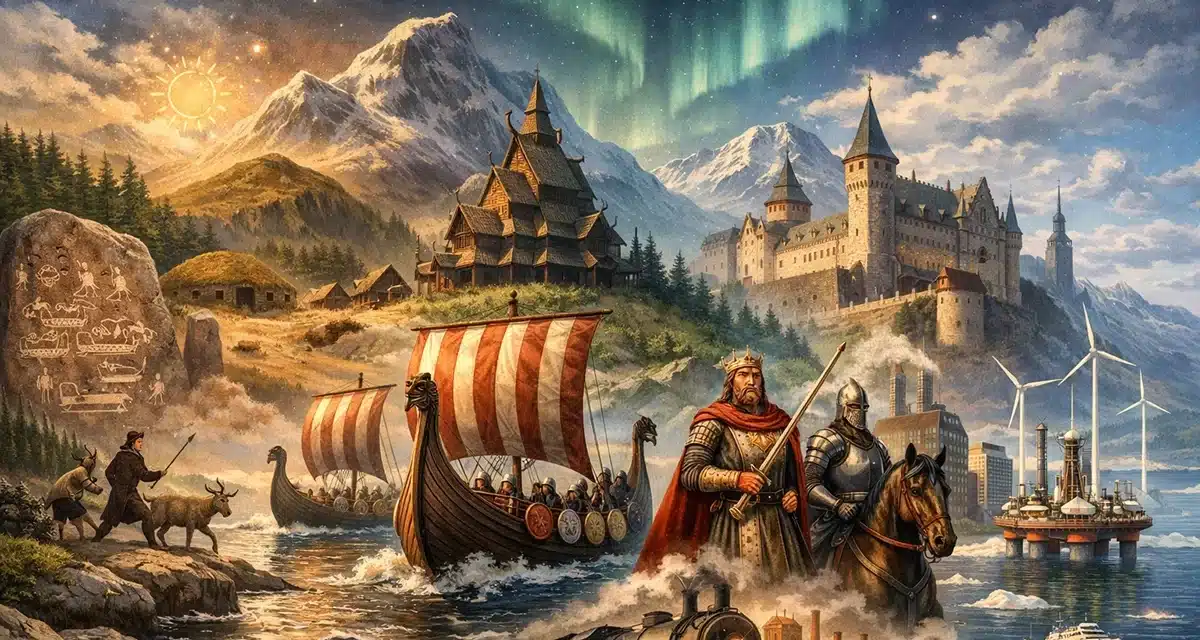
Scandinavia occupies the northernmost region of Europe and has shaped continental politics, maritime trade, religious development, and constitutional governance for more than a millennium.
The term traditionally refers to Norway, Sweden, and Denmark, though historical analysis frequently includes Finland and Iceland due to prolonged political unions and shared institutional evolution.
From prehistoric settlements to modern welfare states, Scandinavia’s development reflects adaptation to geography, maritime orientation, and shifting power balances within Europe.
Table of Contents
Prehistoric and Early Nordic Foundations
Human settlement in Scandinavia began after the last Ice Age, with early communities adapting to glacial retreat and coastal migration routes.
Archaeological evidence shows human habitation in southern Scandinavia as early as 12,000 years ago. As glaciers receded, hunter-gatherer societies moved northward, following animal migrations and establishing coastal fishing and trapping settlements.
Over time, Neolithic agricultural practices spread from continental Europe, introducing permanent farming communities.
Bronze Age societies in the region engaged in trade networks reaching Central Europe and the Mediterranean. Rock carvings, burial mounds, and metalwork reveal maritime symbolism and hierarchical structures.
During the Iron Age, tribal groups formed regional power centers, setting foundations for later kingdoms.
Runic inscriptions from the first centuries A.D. reflect linguistic continuity that developed into Old Norse.
By the late Iron Age, organized chieftaincies controlled trade hubs and defensive sites across Denmark, southern Sweden, and Norway.
The Viking Age Expansion
Between the late eighth and mid-eleventh centuries, Scandinavian seafaring societies expanded across Europe, the North Atlantic, and parts of Eurasia.
The period commonly known as the Viking Age began around 793 A.D. with recorded raids on monastic settlements in Britain.
Scandinavian fleets later reached Ireland, northern France, the Mediterranean, and river systems deep into Eastern Europe.
Expansion took multiple forms:
- Raiding expeditions targeting coastal settlements
- Establishment of trade cities such as Hedeby and Birka
- Founding of settlements in Iceland, Greenland, and briefly North America
- Integration into Byzantine and Islamic trade routes through the Varangian networks
- Formation of political entities such as the Danelaw in England and Normandy in France
While popular narratives emphasize raiding, trade and state formation were equally significant.
Kings consolidated internal authority as external ventures increased wealth and military prestige.
By the eleventh century, Christianization accelerated across Scandinavia, linking Nordic polities more formally to continental Europe and reshaping governance structures.
Christian Kingdoms and Medieval Consolidation
From the eleventh to the fourteenth centuries, Denmark, Norway, and Sweden emerged as consolidated Christian monarchies integrated into European diplomacy.
The introduction of Christianity facilitated centralized rule, the codification of law, and the establishment of bishoprics aligned with Rome. Monarchs strengthened authority through administrative reforms and church alliances.
Denmark developed early royal consolidation under figures such as Cnut the Great, who briefly ruled England.
Norway solidified control over Atlantic territories including Iceland and Greenland.
Sweden gradually unified competing regional rulers under a centralized crown.
In 1397, the Kalmar Union united Denmark, Norway, and Sweden under a single monarch.
Though designed to strengthen Nordic resistance to German and Hanseatic influence, the union faced internal resistance and eventually dissolved in the sixteenth century after Swedish revolt led by Gustav Vasa.
Reformation and Early Modern Rivalries
The sixteenth and seventeenth centuries marked religious transformation and intensified regional warfare among Scandinavian powers.
The Protestant Reformation reshaped governance.
Denmark-Norway and Sweden adopted Lutheranism, transferring church lands to royal authority and strengthening centralized states.
Sweden rose as a major Baltic power during the seventeenth century, participating extensively in the Thirty Years’ War and controlling territories around the Baltic Sea.
This era elevated Sweden to great-power status in European politics.
Denmark, while territorially reduced after conflicts with Sweden, retained control of Norway and maintained influence over maritime trade through the Øresund Strait.
Key structural developments of this period included:
- Lutheran state churches integrated into national administration
- Expansion of royal taxation systems
- Professional standing armies
- Codified national legal frameworks
- Maritime trade regulation
By the early eighteenth century, Sweden’s defeat in the Great Northern War ended its period of regional dominance, shifting balance once again.
Nineteenth-Century National Transformations
The nineteenth century reshaped Scandinavia through constitutional reform, union realignments, and industrial development.
The Napoleonic Wars altered territorial arrangements.
Denmark lost Norway to Sweden in 1814, leading to a Swedish-Norwegian union that lasted until 1905. Norway eventually achieved peaceful independence through referendum.
Finland, separated from Sweden in 1809, became a Grand Duchy under the Russian Empire before declaring independence in 1917 amid the Russian Revolution.
Denmark transitioned toward constitutional monarchy in 1849. Sweden adopted parliamentary reforms over time, expanding representation and limiting royal authority.
Industrialization advanced gradually compared to continental Europe, yet railways, timber exports, shipping industries, and later manufacturing transformed economic structures.
Twentieth-Century Neutrality and Welfare States
The twentieth century defined Scandinavia through democratic consolidation, social reform, and strategic neutrality.
World War I affected Scandinavia economically but not militarily.
During World War II, Denmark and Norway were occupied by Nazi Germany, while Sweden maintained armed neutrality. Finland fought conflicts with the Soviet Union yet preserved sovereignty.
Postwar reconstruction emphasized democratic governance and social policy.
Scandinavian countries became known for comprehensive welfare systems, public healthcare frameworks, labor cooperation models, and mixed-market economies.
Core institutional traits developed during this period include:
- Strong parliamentary democracies
- Universal healthcare systems
- Extensive public education networks
- Structured labor union negotiations
- High taxation supporting social services
These frameworks contributed to stable governance and consistent global rankings in economic performance and quality-of-life measurements.
Scandinavia in the Contemporary Era
Modern Scandinavia balances regional integration, economic competitiveness, and strategic positioning within Europe and the Arctic.
Denmark, Sweden, and Finland are members of the European Union, while Norway participates through the European Economic Area.
All maintain advanced industrial and technological sectors alongside energy development and maritime industries.
Sweden joined NATO in 2024, joining Norway and Denmark, while Finland also became a member in 2023.
These developments reflect evolving security calculations in northern Europe.
Scandinavia’s global presence is shaped by:
- High levels of political transparency
- Active engagement in climate and environmental policy
- Arctic governance participation
- Advanced renewable energy development
- Leadership in humanitarian diplomacy
Though often grouped together culturally, each country retains distinct historical experiences and institutional paths.
History of Scandinavia Q&A
What countries are traditionally considered part of Scandinavia?
Scandinavia traditionally refers to Denmark, Norway, and Sweden, though Finland and Iceland are often included in broader Nordic discussions.
Why did the Viking Age end?
The Viking Age declined as Scandinavian kingdoms consolidated power, adopted Christianity, and integrated into established European political and trade systems.
What was the Kalmar Union?
The Kalmar Union was a political union formed in 1397 that united Denmark, Norway, and Sweden under one monarch until its dissolution in the sixteenth century.
Why are Scandinavian countries known for welfare systems?
Twentieth-century political reforms produced tax-funded social systems emphasizing healthcare, education, and labor cooperation within democratic frameworks.
Are all Scandinavian countries members of the European Union?
Denmark, Sweden, and Finland are EU members; Norway is not but participates in the European Economic Area.