
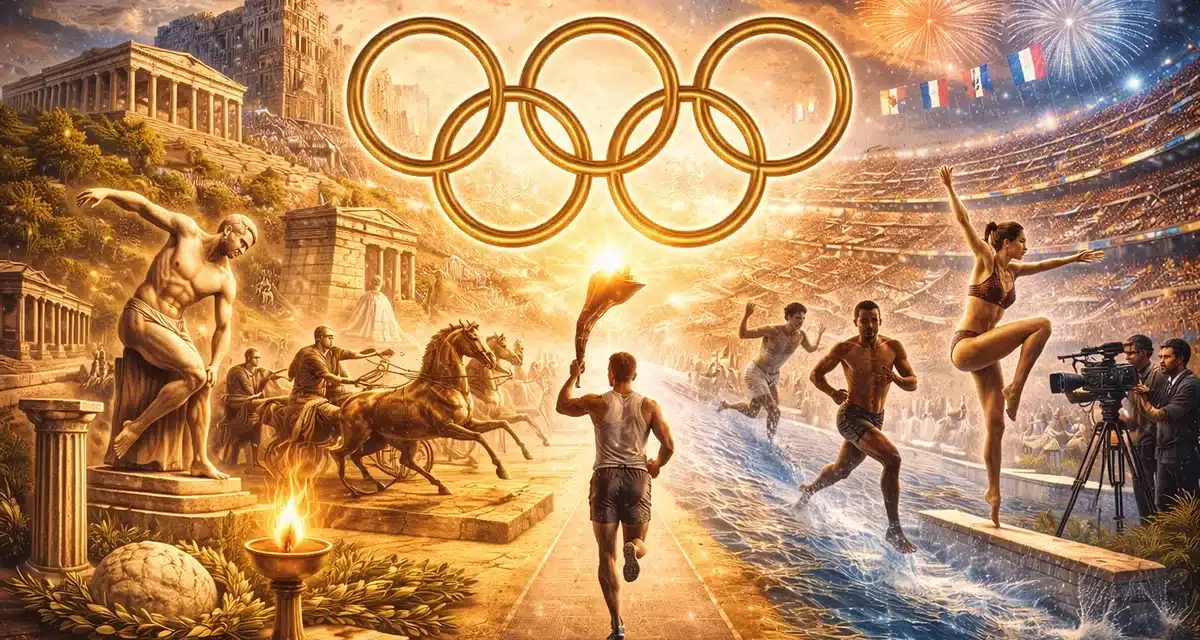
The Olympic Games are one of the few institutions in human history to survive radical political change, religious upheaval, global war, and technological transformation while maintaining recognizable continuity across millennia.
From their origins as a localized religious festival in ancient Greece to their present role as a global system of sport, diplomacy, media, and capital, the Olympics have never been just about athletic competition.
They functioned—and continue to function—as a way for societies to define excellence, regulate conflict, project power, and narrate identity at scale.
Understanding the history of the Olympics requires examining how sport interacts with religion, politics, economics, and culture across different historical periods rather than treating the Games as a timeless or purely celebratory tradition.
Table of Contents
Ancient Origins of the Olympic Games
The Olympic Games began as a sacred festival embedded within the religious and political life of ancient Greece rather than as a neutral athletic competition.
The earliest recorded Olympic Games took place in 776 BCE at Olympia, a sanctuary site dedicated to Zeus in the region of Elis.
These Games were one of several Panhellenic festivals, but they became the most prestigious due to their regularity, religious authority, and geographic neutrality among Greek city-states.
Competition was inseparable from ritual.
Athletic events occurred alongside sacrifices, processions, and communal worship. Participation carried religious meaning as much as physical achievement.
Why Olympia Mattered
Olympia was not a city and held no permanent population.
Its power came from its status as sacred ground, which allowed rival city-states to compete without formally ceding political authority.
Several structural features defined the early Games:
- Events tied closely to military readiness and physical utility
- Competition between city-states rather than individuals
- Victory framed as divine favor rather than personal success
- Public honor replacing financial reward
Athletes trained for years, often with state support, and winners received lifelong privileges at home, including stipends, tax exemptions, and public commemoration.
Social Limits of Ancient Competition
Despite later romanticization, the ancient Olympics were highly exclusive.
Only freeborn Greek men could compete. Women were barred not only from participation but also from attendance, with severe penalties for violation.
This exclusion reinforced broader Greek social hierarchies and civic norms rather than challenging them.
Structure and Governance in Antiquity
The ancient Olympics developed an early regulatory framework that balanced religious authority, civic law, and competitive integrity.
Judges known as Hellanodikai oversaw events, enforced rules, and imposed penalties.
Cheating, bribery, and false claims of citizenship were not uncommon, prompting fines used to erect warning statues near the stadium.
The Games also created one of the earliest systems of standardized timekeeping and record-keeping through the use of Olympiads as a dating method across the Greek world.
A key institutional feature was the ekecheiria, or Olympic truce.
While often overstated as universal peace, it formally prohibited interference with travel to Olympia and underscored the Games’ role in managing inter-state relations.
Decline and Suppression of the Ancient Games
The end of the ancient Olympics reflected long-term cultural and religious transformation rather than sudden collapse.
As Greece came under Roman rule, the Games continued but gradually shifted in tone.
Athletic ideals tied to civic virtue gave way to spectacle and patronage. Wealthy sponsors and emperors reshaped events to suit Roman tastes.
The decisive break occurred in the late fourth century CE, when Christian emperors moved to suppress pagan festivals.
In 393 CE, imperial decrees banning pagan worship effectively ended Olympic competition.
Environmental damage, neglect, and shifting trade routes then erased Olympia as a functioning site.
The Games faded into historical record rather than evolving organically.
The Modern Revival of the Olympics
The modern Olympics emerged from nineteenth-century anxieties about education, nationalism, and industrial society rather than from pure admiration of antiquity.
The revival was led by Pierre de Coubertin, a French educator concerned that industrial life and rigid schooling systems were weakening physical development and civic character.
Coubertin viewed sport as a civilizing force that could instill discipline, international understanding, and moral order while avoiding militarized conflict.
Founding Principles of the Modern Games
The modern Olympic movement reframed ancient symbolism within a new institutional structure:
- Secular rather than religious authority
- International governance through the IOC
- Standardized rules enforced by federations
- Emphasis on peaceful competition between nations
The first modern Olympic Games were held in Athens in 1896, deliberately linking the revival to Greek antiquity while signaling a new global orientation.
Expansion and Institutional Growth
Twentieth-century expansion transformed the Olympics from a modest competition into a permanent global system.
Participation grew rapidly as national committees formed, rules solidified, and new sports were added.
Women gradually gained inclusion, though unevenly and often through contested reform.
The introduction of the Winter Olympics in 1924 reflected geographic realities and the need to separate ice and snow disciplines from summer competition.
This period also established the Games as a site of political symbolism.
Medal counts became expressions of national strength, particularly during periods of global tension.
Media, Money, and Professionalization
The modern Olympics became inseparable from mass media and commercial capital in the second half of the twentieth century.
Television transformed the Games into a global spectacle, shifting economic dependence away from ticket sales and toward broadcasting rights.
Corporate sponsorship followed, reshaping branding, scheduling, and venue design.
Key changes followed:
- The gradual abandonment of strict amateurism
- Acceptance of professional athletes
- Centralization of revenue under the IOC
- Escalation of host city costs and infrastructure demands
These developments increased reach and visibility but also introduced structural tensions between public good and private profit.
The Olympics as a Political Stage
Despite claims of neutrality, the Olympics repeatedly functioned as a theater for global politics.
Wars led to cancellations. Cold War rivalries shaped training systems, funding models, and medal priorities.
Boycotts in 1980 and 1984 demonstrated the vulnerability of the Games to diplomatic conflict.
At the same time, the Olympics offered rare moments of symbolic reconciliation, shared visibility, and soft power projection that few other institutions could replicate.
Why the Olympics Still Matter Today
The modern Olympic Games persist because they provide a structured, legible framework for global competition in an increasingly fragmented world.
They offer:
- A standardized measure of athletic excellence
- A recurring global media event with shared narratives
- A platform for emerging nations to gain visibility
- A test case for sustainability, governance, and reform
Current challenges—including climate change, athlete health, technological enhancement, and economic inequality—are not external threats but extensions of long-standing structural tensions within the Olympic system.
The Olympics endure not because they are static or flawless, but because they continue to adapt while maintaining recognizable continuity across time.
History of the Olympics Q&A
When did the ancient Olympic Games begin?
The earliest recorded Games took place in 776 BCE at Olympia in ancient Greece.
Why were the ancient Olympics discontinued?
They were suppressed as pagan festivals during the Christianization of the Roman Empire in the late fourth century CE.
Who founded the modern Olympic movement?
Pierre de Coubertin led the revival and helped establish the International Olympic Committee in 1894.
When were the first modern Olympic Games held?
The first modern Games took place in Athens in 1896.
Why are the Olympics still significant today?
They remain one of the few global institutions capable of organizing large-scale international competition while reflecting broader political, cultural, and economic conditions.