
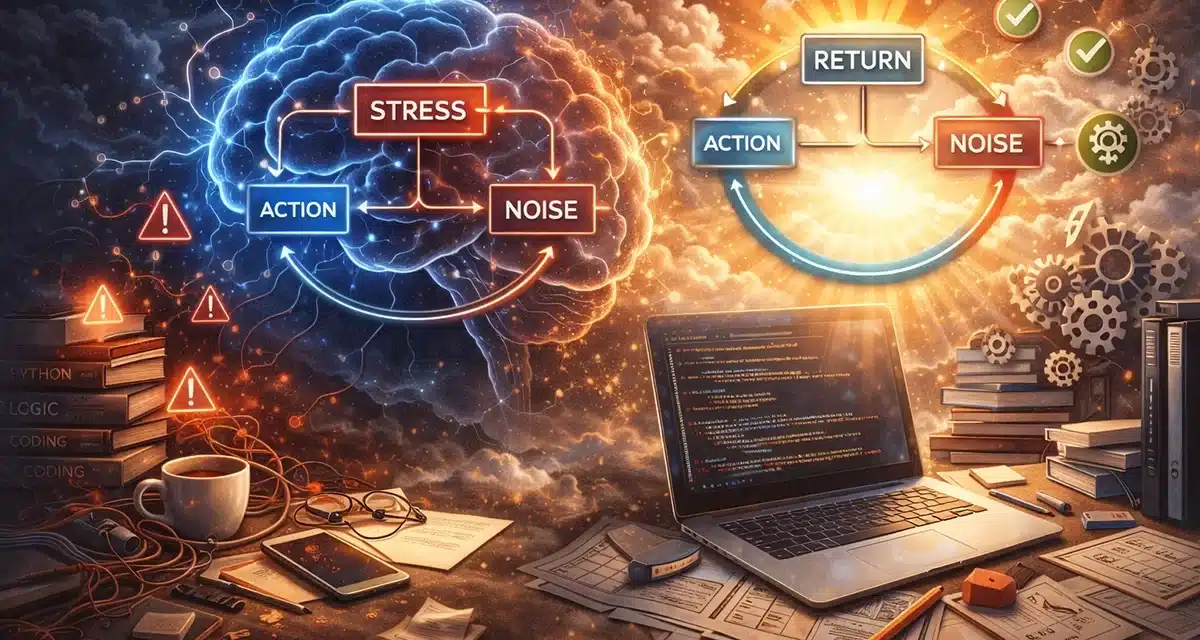
Modern anxiety is not emotional fragility. It is a systems problem.
Most people experiencing persistent rumination are not overwhelmed because their problems are uniquely severe.
They are overwhelmed because their minds lack a stopping condition. Thoughts continue executing long after their usefulness ends.
The result feels personal, but the cause is structural.
Programming offers a useful parallel.
In code, a function without a return statement does not conclude cleanly.
It keeps running, consuming resources, stacking calls, and degrading performance. The system slows. Eventually, it crashes.
The same thing happens in the human mind.
A thought without a return becomes rumination.
This article examines anxiety through the lens of logic and control flow. It explains why rumination feels unstoppable, why reassurance rarely works, and why applying simple programming principles can restore cognitive stability during periods of personal reassessment.
Table of Contents
Rumination Is Not Reflection
Reflection has direction. Rumination does not.
Reflection evaluates inputs, produces insight, and exits. Rumination repeats the same evaluation endlessly without yielding new output. The mind remains active, but progress stalls.
This distinction matters. Many people mistake rumination for productive thinking. They believe that continuing to think will eventually resolve discomfort. In practice, the opposite occurs.
The longer a thought runs without closure, the more authority it appears to gain.
The brain interprets persistence as importance.
That misinterpretation creates a feedback loop.
The thought feels urgent because it keeps appearing. It keeps appearing because it feels urgent.
Without a termination condition, the loop sustains itself.
In programming terms, this is an infinite loop caused by missing control logic.
How the Mind Loses Control Flow
The human brain excels at pattern recognition and threat simulation.
These traits evolved to support survival. They are less suited to abstract, long-term uncertainty.
Modern stressors often lack immediate resolution. Future outcomes, imagined failures, aging, mortality, financial trajectories, and identity shifts cannot be solved in the present moment. Yet the brain treats them as active threats.
The result is constant background processing.
In software, background processes must be managed carefully.
Unchecked execution depletes memory and attention.
Good systems limit scope, isolate tasks, and return control to the main program.
Most people never learn to do this mentally.
Instead, they attempt emotional fixes. They seek reassurance, distraction, or suppression. These approaches sometimes mute symptoms, but they do not address structure. The thought continues running.
Stress as an Input, Not a Command
The first correction is reframing stress as data rather than instruction.
Stress is an alert. It signals a discrepancy between current state and desired state. It does not automatically require prolonged attention.
In logic systems, inputs are evaluated before execution. They are not allowed to run unexamined.
The same rule applies here.
When stress appears, it should trigger a simple evaluation rather than a full mental takeover.
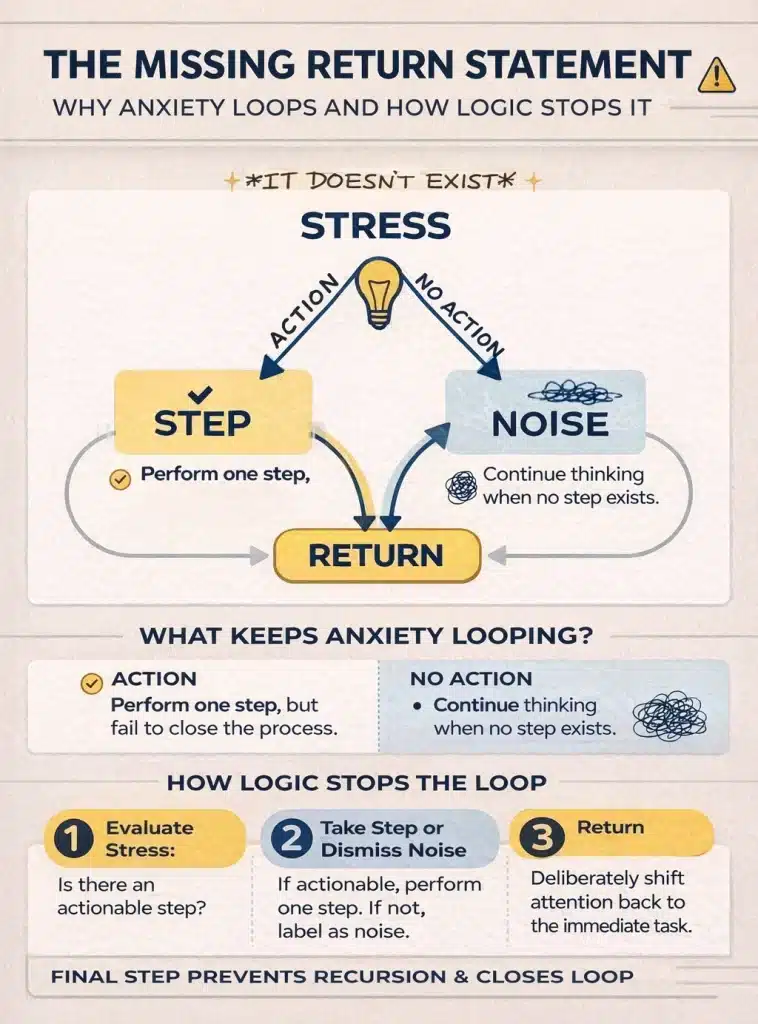
Does this stress point to a concrete action available right now?
This single question divides stress into two categories.
Actionable Stress and Non-Actionable Stress
Not all stress is equal. Treating it as such guarantees overload.
Actionable stress refers to concerns with a clear, immediate step attached. Health maintenance, household tasks, work deliverables, scheduling, communication, and financial planning often fall into this category.
Non-actionable stress refers to concerns without a present-day intervention.
Mortality, long-range outcomes, imagined future regret, and abstract identity fears belong here.
These two categories require opposite responses.
Actionable stress converts to execution
When an action exists, the correct response is to perform one bounded step.
Not a plan. Not a full solution. One step that moves the state forward.
Once that step is taken, the process concludes.
The emotional signal has been honored through execution. There is nothing left to analyze.
Non-actionable stress converts to noise
When no action exists, continued thought provides no value.
The stress cannot be resolved today. Processing it repeatedly does not create preparedness. It creates fatigue.
In systems terms, this input should not be executed. It should be discarded.
Labeling it as noise is not denial. It is correct classification.
The Critical Missing Step: Return
Most frameworks stop too early.
They identify action versus inaction but fail to restore control.
This is where programming logic offers its most valuable insight.
After execution or discard, a function must return.
Without a return statement, even correct logic keeps running.
In mental terms, return means deliberately redirecting attention back to the immediate task, environment, or bodily state that existed before the stress appeared.
Not checking how one feels afterward.
Not verifying relief.
Not reviewing the thought again.
Just returning.
This return completes the loop.
Stress enters.
It is evaluated.
Action is taken or noise is dismissed.
Attention returns to the present.
That final step prevents recursion. It stops stack buildup. It preserves bandwidth.
Why Emotional Reassurance Fails
Reassurance attempts to override anxiety at the feeling level.
It often relies on future-oriented promises or generalized comfort.
The brain does not treat reassurance as a return. It treats it as additional processing.
That is why reassurance must be repeated. It does not resolve the loop. It feeds it.
Logic works differently. Logic closes processes.
When attention is redirected without seeking emotional confirmation, the mind does not interpret that as avoidance.
It interprets it as resolution.
The system quiets because execution ended.
Applying the Framework During Life Transitions
Periods of reassessment amplify rumination.
Milestone ages, career plateaus, shifting priorities, and identity changes increase ambiguity.
Ambiguity strains emotional systems. Logical systems tolerate it better.
Applying simple control flow rules during these periods preserves mental clarity without forcing premature decisions. Questions about music, creativity, career direction, or long-term meaning do not require constant processing to remain valid.
They require scheduling, not rumination.
Once a decision is placed on a timeline, it exits the anxiety loop.
It becomes a future task, not a current threat.
The mind stops shouting because it has been heard.
Efficiency Is Not Coldness
Some mistake logical frameworks for emotional detachment.
This misreads the goal.
The purpose of structure is not to eliminate feeling. It is to prevent misallocation.
Emotions belong in lived experience, relationships, creativity, and presence.
They do not belong in infinite evaluation loops.
By formalizing how stress is handled, emotional energy is preserved for places where it matters.
That trade is not avoidance. It is stewardship.
A Simple Mental Control Flow
The system can be summarized cleanly.
Stress appears.
Determine whether it exists in the present.
If action exists:
Take one bounded step.
If no action exists:
Label the thought as noise.
In both cases:
Return attention to the present task or environment.
This loop requires no motivation and no positive thinking. It relies on structure, not willpower.
It works because it respects limits.
Why This Works Long Term
Systems endure because they prevent failure modes, not because they eliminate input.
Stress will continue appearing. Life will remain uncertain. Thoughts will arise without invitation.
The difference lies in what happens next.
When every mental process has a termination condition, the system remains stable under load.
When it does not, even minor inputs create cascading effects.
Adding a return statement changes everything.
Anxiety Logic Q&A
Is labeling thoughts as noise the same as suppressing them?
No. Suppression attempts to block awareness. Labeling classifies the thought and allows attention to move on without resistance.
What if the same non-actionable stress keeps returning?
Repetition does not make it actionable. Each appearance receives the same evaluation and the same return.
Does this reduce creativity or emotional insight?
No. It preserves them by preventing cognitive exhaustion.
Can this be applied to grief or loss?
Active grief involves emotion, not problem-solving. This framework applies to analytical rumination, not lived feeling.
What if the mind refuses to return?
Return can be physical. Shift posture, change rooms, engage hands. Movement is a valid control transfer.
Is this just over-intellectualizing anxiety?
No. It is correcting a structural flaw. Feelings stabilize when systems do.