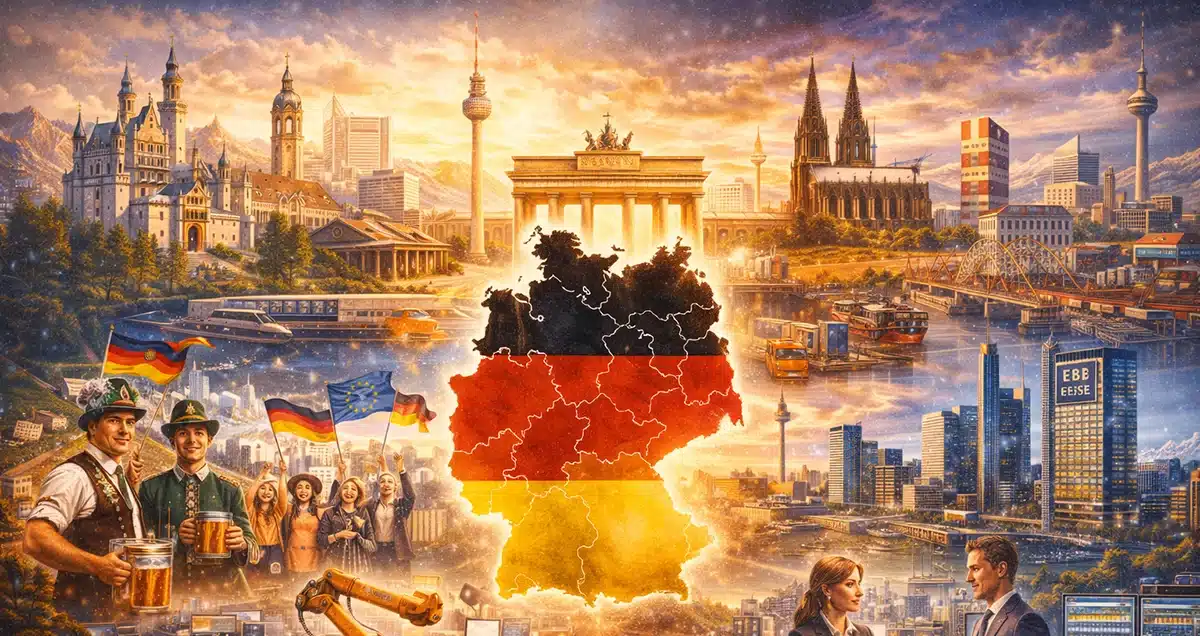
Germany is not a single cultural or economic organism.
It is a federal system built from historically independent regions, each shaped by different empires, religions, industries, and postwar trajectories.
Modern German stability comes from how these regions were preserved rather than flattened after unification.
Understanding Germany means understanding its regions, because power, identity, and influence remain distributed across them.
Table of Contents
Bavaria (Bayern) & Munich
Bavaria is Germany’s most self-contained and economically powerful region, combining cultural distinctiveness with modern industrial strength.
Historically, Bavaria functioned as a Catholic kingdom with its own aristocracy, church alignment, and legal traditions. It resisted Prussian dominance longer than most German territories and retained a strong regional identity after unification in 1871.
Today, Bavaria is Germany’s wealth engine.
Munich anchors finance, technology, media, and high-end manufacturing.
Global firms such as BMW and Siemens grew out of Bavaria’s emphasis on precision, engineering, and export-oriented industry.
Culturally, Bavaria preserves local traditions more visibly than other regions, including dialect, festivals, and regional governance pride.
This creates an internal balance: deeply traditional in identity, aggressively modern in economics.
Bavaria’s influence lies in proving that regional identity and global competitiveness are not mutually exclusive.
Baden-Württemberg
Baden-Württemberg functions as Germany’s technical brain trust, built on decentralized engineering and export specialization.
This region emerged from smaller states rather than a single kingdom, producing a culture of local autonomy, cooperatives, and technical guilds. Protestant ethics and early industrialization shaped its work culture.
Cities such as Stuttgart, Karlsruhe, and Mannheim anchor an ecosystem of medium-sized industrial firms, often family-owned, globally dominant in narrow technical niches.
Mercedes-Benz and Porsche represent the visible surface of a much deeper manufacturing base.
Socially, Baden-Württemberg is pragmatic, orderly, and systems-focused. Innovation tends to be incremental rather than disruptive, driven by reliability rather than scale.
This region defines what outsiders often think of as “German engineering” in its purest form.
North Rhine-Westphalia (NRW)
North Rhine-Westphalia is Germany’s population and corporate density core, shaped by heavy industry and post-industrial reinvention.
The Ruhr region once fueled Europe through coal and steel. Massive urbanization created a polycentric zone with multiple cities rather than a single dominant capital.
As heavy industry declined, NRW transitioned into logistics, legal services, media, and corporate management.
Cologne became a broadcasting center; Düsseldorf emerged as a legal and business services hub.
Culturally, NRW is more informal and socially open than southern Germany.
Dialects soften, attitudes loosen, and public discourse feels less hierarchical.
This region’s power lies in scale, connectivity, and institutional continuity rather than cultural symbolism.
Berlin and Brandenburg
Berlin operates as Germany’s political center and cultural laboratory rather than its economic engine.
Historically, Berlin was Prussia’s administrative heart, built for governance rather than commerce.
The division of the city during the Cold War arrested economic development while amplifying political symbolism.
After reunification, Berlin became the seat of federal government but remained economically weaker than western cities.
This allowed it to develop a cultural identity centered on experimentation, politics, and creative industries rather than corporate dominance.
Berlin influences Germany through ideology, social movements, art, and policy debate rather than manufacturing or finance.
It is Germany’s loudest city, but not its richest or most efficient.
Brandenburg, surrounding Berlin, reflects eastern Germany’s slower economic convergence, with lower population density and deeper post-socialist restructuring.
Saxony and Eastern Germany
Eastern German regions reflect the long shadow of socialist planning and abrupt reunification.
Saxony was historically one of Germany’s most advanced industrial regions, particularly in machinery and textiles.
The German Democratic Republic disrupted this continuity through centralized planning, followed by rapid post-1990 privatization and industrial collapse.
Cities such as Dresden and Leipzig have since reemerged as cultural and technology centers, though economic gaps persist compared to western states.
Eastern Germany’s political culture differs noticeably, with stronger protest voting patterns and skepticism toward centralized authority.
The region’s influence today lies in its role as a stress test for German federalism and social cohesion rather than economic leadership.
Hamburg and Northern Germany
Northern Germany reflects maritime trade culture, Protestant restraint, and international orientation.
Hamburg functions as Germany’s primary port and logistics gateway. Its identity is shaped by centuries of trade independence and membership in the Hanseatic League.
Northern regions emphasize commerce, shipping, and global connectivity.
Culturally, they are less expressive, more reserved, and more outward-looking than southern counterparts.
The north’s power is quiet but enduring, tied to infrastructure, trade law, and global supply chains rather than domestic politics.
Hesse and Central Germany
Hesse anchors Germany’s financial system and regulatory authority.
Frankfurt hosts the European Central Bank, Germany’s central banking institutions, and major financial firms.
This concentration gives Hesse outsized influence relative to its population size.
The region’s culture is transactional and international, oriented toward finance, law, and regulation rather than regional tradition.
Hesse’s influence is structural. Decisions made there ripple outward across European markets.
Germany as a Federal Mosaic
Germany’s regional structure is intentional.
Power was dispersed after World War II to prevent central domination, authoritarian capture, or personality-driven politics.
Each region contributes a distinct capability:
- Bavaria supplies economic mass and export power
- Baden-Württemberg supplies engineering depth
- NRW supplies scale and corporate infrastructure
- Berlin supplies political discourse and cultural experimentation
- The north supplies trade and logistics
- Hesse supplies financial governance
Germany’s global influence emerges from how these regions interlock rather than compete.
Regions of Germany Q&A
Why doesn’t Germany have one dominant city like Paris or London?
Postwar federal design intentionally spread power across regions to prevent centralization and political abuse.
Which region most defines Germany internationally?
Bavaria and Baden-Württemberg shape international perceptions due to industrial exports and engineering reputation.
Why does Berlin feel different from other German cities?
Its economic weakness allowed politics, culture, and experimentation to dominate over corporate interests.
Is eastern Germany still economically behind?
Yes, though the gap is narrowing unevenly, with select cities outperforming surrounding regions.
How does regionalism strengthen Germany overall?
It creates redundancy, resilience, and specialization, reducing systemic risk and political concentration.