
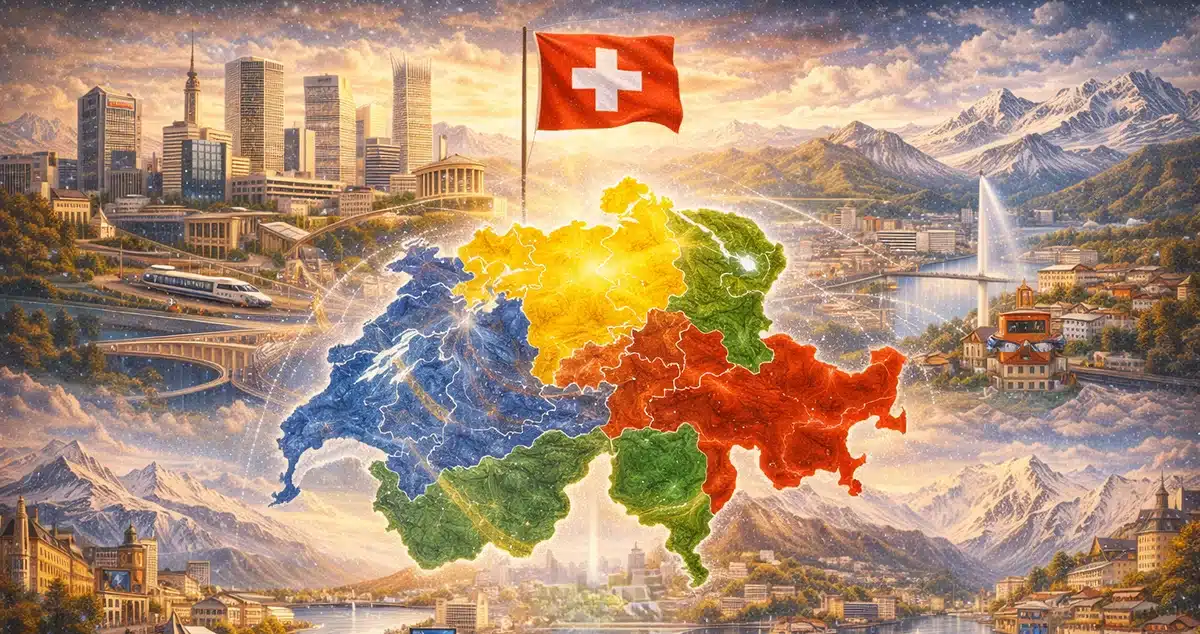
Switzerland is not a small country with a single national character.
It is a tightly organized federation of distinct linguistic, religious, and economic regions, bound together by deliberate political design rather than cultural uniformity.
Swiss stability comes from managing differences, not erasing them.
Modern Swiss power flows through finance, diplomacy, infrastructure, and trust. Each region contributes a specific function to that system.
Table of Contents
German-Speaking Switzerland (Deutschschweiz)
German-speaking Switzerland forms the demographic and economic core of the country, but not its symbolic center.
This region includes Zurich, Basel, Bern, and much of central and eastern Switzerland.
It accounts for roughly two-thirds of the population and the majority of economic output.
Historically, these cantons developed through merchant trade, guild structures, and early Protestant governance.
Civic participation, fiscal discipline, and local autonomy became deeply embedded.
Zurich anchors Switzerland’s role in global finance, banking, and insurance.
Basel functions as a pharmaceutical and life sciences hub.
Bern serves as the federal capital, chosen for administrative balance rather than dominance.
Culturally, the region values discretion, procedural correctness, and institutional continuity. Power is exercised quietly, through systems rather than spectacle.
This region provides Switzerland’s economic backbone and regulatory credibility.
French-Speaking Switzerland (Romandie)
Romandie connects Switzerland to global diplomacy, humanitarianism, and cultural exchange.
Centered on Geneva and Lausanne, western Switzerland developed under stronger French cultural and intellectual influence.
Catholic–Protestant balance and cross-border exchange shaped its civic life.
Geneva hosts a dense cluster of international organizations, NGOs, and diplomatic missions.
Its influence is global rather than national, projecting Swiss neutrality outward into international governance.
Romandie tends to be more outward-facing, rhetorical, and culturally expressive than German-speaking regions.
Political debates emphasize social coordination and international cooperation.
This region supplies Switzerland’s moral and diplomatic capital rather than its industrial force.
Italian-Speaking Switzerland (Ticino)
Ticino represents Switzerland’s southern face and its Mediterranean interface.
Italian-speaking Switzerland remained geographically isolated for centuries, developing a hybrid identity shaped by alpine constraints and Italian cultural flows.
Catholic traditions dominate, alongside family-based social structures.
Modern Ticino functions as a financial, tourism, and cultural bridge between northern and southern Europe.
Lugano is a secondary financial center with strong cross-border ties.
Culturally, the region values aesthetics, social warmth, and local continuity more than administrative minimalism.
Ticino contributes lifestyle influence and cross-border flexibility rather than institutional control.
Romansh-Speaking Alpine Switzerland
Romansh Switzerland represents historical depth rather than demographic power.
Located primarily in Graubünden, this region preserves one of Europe’s oldest living languages. The terrain is mountainous, decentralized, and sparsely populated.
Although economically small, the region plays an outsized symbolic role in Swiss identity.
It embodies continuity, protection of minorities, and local sovereignty.
Its influence is cultural and constitutional. Switzerland’s political structure exists partly to prevent regions like this from being absorbed or overridden.
Urban vs Cantonal Power
Swiss cities do not dominate their surrounding regions in the way global capitals often do.
Cantons retain substantial legal, fiscal, and political autonomy.
Education, policing, taxation, and healthcare vary by region. This prevents urban centers from consolidating power over rural areas.
Zurich may be economically dominant, but it does not politically command the federation.
Geneva’s international influence does not override cantonal sovereignty.
Bern governs administratively without overshadowing economic centers.
This balance is intentional and foundational.
Religion and Cultural Fault Lines
Switzerland’s religious divisions shaped its political architecture.
Catholic and Protestant cantons fought wars in the early modern period.
The federal system evolved specifically to avoid sectarian domination.
Regional religious traditions still influence voting behavior, civic norms, and education policy, but coexistence is institutionalized rather than negotiated ad hoc.
Switzerland’s Functional Power Model
Switzerland does not project power through ideology, military force, or cultural dominance.
Its influence operates through reliability:
- Financial infrastructure that prioritizes stability
- Legal environments trusted by international institutions
- Diplomatic neutrality that facilitates negotiation
- Federal design that manages linguistic and regional diversity
Each region contributes a capability rather than an identity narrative.
Switzerland as a System of Regions
Swiss cohesion does not come from shared culture.
It comes from shared process:
- German-speaking regions supply economic mass and regulatory credibility
- Romandie supplies diplomacy and global coordination
- Ticino supplies cross-cultural linkage and lifestyle influence
- Romansh regions supply historical legitimacy and minority protection
Switzerland persists because no region can dominate the others, and no region can function alone.
Regions of Switzerland Q&A
Why does Switzerland work despite major linguistic differences?
The federal system protects regional autonomy while aligning incentives through shared institutions.
Which region is most powerful economically?
German-speaking Switzerland, particularly Zurich and Basel.
Why is Geneva so influential globally?
Its neutrality, institutional density, and international legitimacy attract diplomacy and governance functions.
Does Switzerland feel culturally unified?
No. It feels politically unified while remaining culturally plural.
What gives Switzerland global influence beyond its size?
Trust, procedural consistency, and a reputation for neutrality embedded in its regional structure.