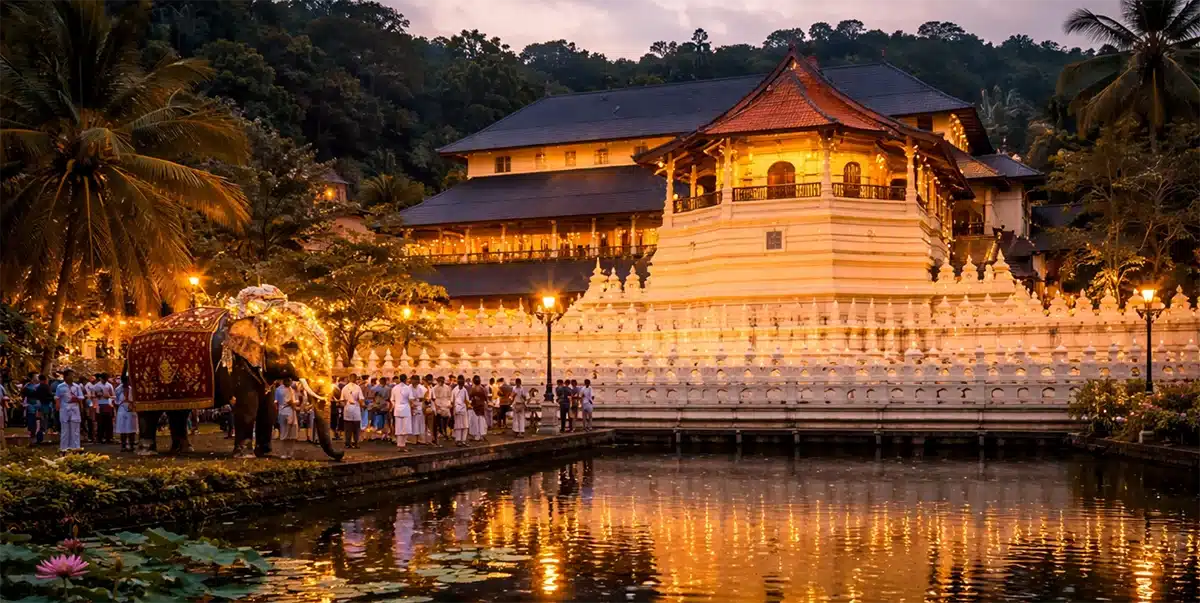
In the hill city of Kandy, Sri Lanka, a single object anchors centuries of ritual, political authority, pilgrimage, and belief: a tooth said to belong to the Buddha.
Housed within the Temple of the Sacred Tooth Relic—known locally as Sri Dalada Maligawa—the artifact is treated not as a historical curiosity, but as a living center of religious devotion.
Worshippers believe it carries protective and healing properties, and its presence has shaped Sri Lanka’s history in ways few physical objects ever have.
This account approaches the relic from a skeptical standpoint, without ridicule or dismissal—examining what people believe, why those beliefs persist, and what the relic represents culturally, psychologically, and politically.
Table of Contents
What the Relic Is Claimed to Be
According to tradition, the relic is a tooth taken from the Buddha after his cremation in the 5th century BCE.
Early Buddhist texts describe the distribution of the Buddha’s remains among kingdoms, with relics serving as focal points for worship and legitimacy.
Sri Lankan tradition holds that one tooth was rescued from the funeral pyre and smuggled to the island centuries later.
From that point forward, it became inseparable from sovereignty. Whoever controlled the relic was considered the rightful ruler of the land.
This claim—that a single tooth survived intact, was authenticated, and has been preserved for over two thousand years—sits at the center of both belief and skepticism.
The Journey to Sri Lanka
The most widely accepted legend recounts that the tooth arrived in Sri Lanka in the 4th century CE.
It was allegedly carried by Princess Hemamala and Prince Dantha from India, hidden in the princess’s hair to avoid detection.
Once in Sri Lanka, the relic was placed under royal protection.
Over time, it moved with the capital—from Anuradhapura to Polonnaruwa to Kandy—each relocation reinforcing the idea that political authority flowed from guardianship of the relic.
Historically verifiable records confirm that rulers publicly associated themselves with the relic, built temples to house it, and staged ceremonies to display proximity to it. Whether the relic was authentic mattered less than what it symbolized.
The Temple in Kandy
The current temple complex in Kandy dates primarily to the 17th and 18th centuries.
The structure is fortified, layered, and deliberately inaccessible. The relic itself is not openly displayed. It is enclosed within a series of nested caskets—reportedly six or seven—made of gold, jeweled metal, and protective coverings.
Visitors never see the tooth directly.
They see the chamber where it is believed to reside.
This separation plays a key role in sustaining belief. The relic’s invisibility protects it from scrutiny while amplifying its mystique. What cannot be examined cannot be disproven.
Daily Ritual and Pilgrimage
Every day, rituals are performed before the sealed chamber.
Monks chant, drums are played, and offerings of flowers are made. Thousands of visitors pass through annually, many traveling long distances to be near the relic.
For devotees, presence matters more than proximity. Being in the same space as the relic is believed to bring blessings, protection, and sometimes healing.
Beliefs associated with the relic include:
- Protection from illness or misfortune
- Healing properties for physical ailments
- Spiritual purification
- Good fortune for families or communities
These beliefs persist even though the relic is never seen, touched, or tested.
The Claim of Healing Power
Belief in the relic’s healing ability is common, though rarely formalized.
Stories circulate of illnesses improving after prayer or pilgrimage. There are no controlled studies, medical documentation, or standardized claims—but personal testimony is powerful within communal settings.
From a skeptical perspective, several explanations are more plausible than supernatural intervention:
- Placebo effects
- Stress reduction through ritual
- Psychological comfort
- Confirmation bias
None of these negate lived experience. They explain it without invoking metaphysical causation.
People often feel better after participating in deeply meaningful rituals. That improvement is real, even if the cause is not supernatural.
Why Skeptics Question the Relic
There is no scientific verification that the relic is a human tooth, let alone the Buddha’s.
The tooth has never been subjected to DNA analysis, radiocarbon dating, or independent examination.
Skeptical concerns include:
- Multiple Buddhist sites across Asia claim possession of Buddha relics
- Teeth, bones, and ashes attributed to the Buddha exceed plausible quantities
- Medieval authentication relied on religious authority, not evidence
- Political incentives existed to fabricate or embellish relic claims
From a historical standpoint, relic multiplication is common in religious traditions. Christianity, Buddhism, and Islam all contain examples where sacred objects proliferated across regions.
That does not make belief foolish. It makes it human.
Politics and Power
The Tooth Relic functioned as a political instrument for centuries.
Control over it justified kingship. Losing it meant loss of legitimacy.
Even in modern Sri Lanka, the relic retains symbolic political weight.
Major ceremonies are attended by government officials. Security around the temple is intense, a reminder that the relic remains a national symbol.
This political role complicates claims of pure spiritual significance. The relic has always served multiple purposes at once.
The Esala Perahera
Each year, the relic is honored during the Esala Perahera, one of Sri Lanka’s largest public festivals.
The relic itself remains sealed, but a ceremonial casket is paraded through the streets on the back of a decorated elephant.
The procession includes dancers, drummers, torchbearers, and guards.
The spectacle reinforces continuity. It tells participants that this object—and what it represents—has endured war, colonization, and cultural change.
Whether or not the relic is authentic becomes secondary to what it organizes socially
Why the Relic Endures
Skeptically speaking, the relic does not need to be real to be effective.
Its power lies in collective belief, ritual repetition, and symbolic inheritance.
People do not travel to Kandy for forensic certainty. They travel for meaning.
Relics function as anchors in abstract systems. They turn philosophy into place. They give form to ideas too large to hold otherwise.
In that sense, the tooth functions as a psychological artifact rather than a biological one.
Respect Without Belief
It is possible to reject supernatural claims while acknowledging cultural significance.
Questioning the relic’s authenticity does not require dismissing the people who venerate it.
What matters is understanding:
- Why belief persists
- How ritual affects behavior
- What role symbols play in cohesion
The Temple of the Sacred Tooth Relic offers insight into how humans construct shared meaning, not proof of metaphysical truth.
That alone makes it worth attention.
The Buddha’s Sacred Tooth Q&A
What is the Buddha’s Tooth Relic?
It is an object in Sri Lanka claimed to be a tooth of the Buddha, preserved as a sacred relic.
Can visitors see the tooth?
No. The relic is sealed within multiple containers and is never publicly displayed.
Is there scientific proof it is the Buddha’s tooth?
No. There has been no independent scientific analysis.
Why do people believe it has healing powers?
Belief is shaped by religious tradition, personal testimony, and ritual reinforcement rather than evidence.
Is skepticism disrespectful?
Not inherently. Skepticism examines claims; disrespect targets people.
Why is the relic politically important?
Historically, possession of the relic legitimized kingship in Sri Lanka.
Does the relic still matter today?
Yes. It remains a major religious, cultural, and national symbol.
The Sri Lankan Buddha’s Tooth Relic does not ask to be proven. It asks to be honored. For believers, that is enough. For skeptics, its value lies not in its origin, but in what it reveals about belief itself.