
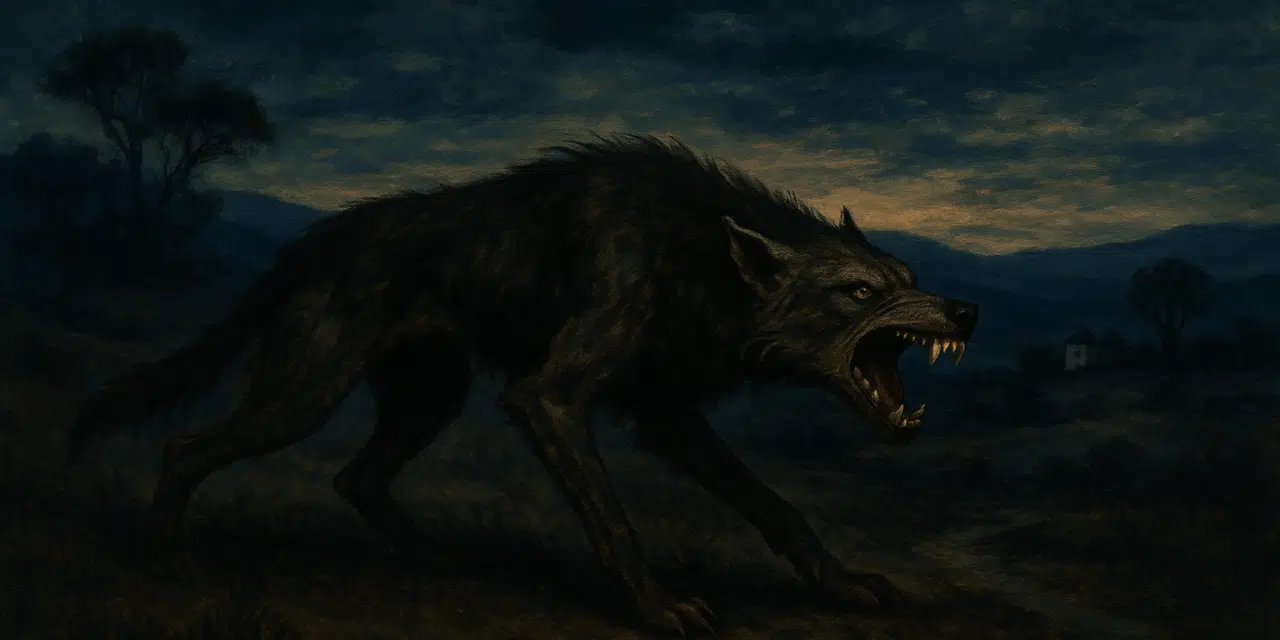
Few mysteries balance fact, folklore, fear, and history quite like the Beast of Gévaudan—a creature blamed for terrorizing rural France between 1764 and 1767.
For three years, something killed more than 100 people in the remote, mountainous region of Gévaudan (modern-day Lozère). The attacks were brutal, often targeting women and children, and word spread quickly across France that a monstrous beast was on the loose. Reports described it as wolf-like but larger, faster, and more aggressive than any known animal.
Rumors spiraled: Was it a supernatural creature? A lion escaped from a nobleman’s menagerie? A hyena? A werewolf?
This story has lived for centuries because it sits perfectly at the intersection of verified historical documents and the kind of imaginative storytelling humans have always used to explain the unknown.
Below is a deeper, layered exploration—one that respects the facts but also acknowledges the questions that make the Beast of Gévaudan so intriguing.
Table of Contents
A Region on Edge: The Attacks Begin
The first recorded attack occurred in June 1764, when a young shepherdess was killed while tending cattle.
News traveled fast in rural France, and fear grew after more victims followed in the weeks ahead.
Unlike ordinary wolf attacks—which were not uncommon in 18th-century Europe—the Beast’s behavior stood out:
- It attacked in daylight
- It pursued humans intentionally
- Victims were often found mutilated
- It seemed to evade hunters again and again
At a time when communication was slow and rumors spread faster than facts, the idea of a monstrous predator gripping an entire region wasn’t hard to imagine.
Descriptions That Fueled a Legend
Witnesses offered wildly different accounts—yet many shared recurring details.
Reported features included:
- massive size
- reddish or striped fur
- an unnaturally broad chest
- a long tail with a tuft
- a “feline-like” or “hyena-like” stride
- the ability to stand on hind legs
Some accounts described it as a wolf the size of a cow. Others said it resembled a lioness. People who believed in supernatural threats called it a shape-shifter or werewolf.
Folklore grew because the attacks seemed too frequent, too bold, and too brutal to fit a single ordinary animal. But history often hides simpler explanations behind dramatic stories.
France Takes Notice: Royal Hunters Arrive
As attacks continued, King Louis XV became involved—sending professional wolf hunters, soldiers, and even his royal gun-bearer.
Large hunting parties searched the forests for days at a time. Hundreds of wolves were killed, yet the attacks continued. Each failed hunt magnified the Beast’s mystique. The idea that one supernatural creature was evading entire battalions added fuel to the growing panic.
But the truth may be simpler: wolves in 18th-century France were far more numerous, larger, and more aggressive than their modern descendants. It is possible multiple wolves were involved and that locals were attributing every attack to a single creature.
The Brave Teenagers Who Fought the Beast
One of the most remarkable moments in the Gévaudan story involves a group of children who stood their ground.
In 1765, several boys—including famed survivor Jacques Portefaix—were attacked while tending cattle. Instead of scattering, the children formed a defensive line, armed only with sticks and stones. Their coordinated effort drove the beast off long enough for adults to arrive.
Their bravery earned national praise. King Louis XV even rewarded Portefaix and his companions financially, calling them heroes of France. This moment remains one of the rare instances where the “monster story” intersects with true human courage.
The Possible Explanations: What Was the Beast?
Theory 1: A Pack of Wolves
This is the most widely accepted explanation today.
Evidence suggests:
- 18th-century wolves were larger and more aggressive
- wolf packs sometimes acted in coordinated ways
- winter scarcity led to bolder attacks
- fear and miscommunication may have combined multiple wolves into one “Beast”
Historical records frequently reference multiple attacks happening far apart—too distant for one creature to travel in a short time.
Theory 2: A Wolf-Dog Hybrid
These hybrid animals can be larger, bolder, and less afraid of humans. Their appearance often seems “unnatural,” matching descriptions from the time.
Theory 3: An Exotic Animal (Hyena or Lioness)
Some argue it could have been:
- a hyena
- a lioness
- an animal escaped from private ownership
Hyenas, in particular, align with several descriptions. But there’s no documented escape or travel of such animals to the region at that time.
Theory 4: Human Involvement
Conspiracy theories suggest:
- a trained animal used for attacks
- a mentally unstable individual using a beast to terrorize communities
- or bodies misinterpreted due to limited forensic tools
There’s no concrete evidence supporting this—but the theory persists because of inconsistencies in eyewitness reports.
The End of the Beast (or Beasts)
In 1767, a local hunter named Jean Chastel killed a large wolf believed to be the Beast.
After the kill:
- attacks ceased almost immediately
- the carcass was sent to authorities
- villagers celebrated the end of the terror
Though some say Chastel used a silver bullet—fueling the werewolf legend—this detail is almost certainly a later embellishment.
The simplest truth is often the most likely:
the Beast was probably a wolf or group of wolves, exaggerated by fear, folklore, and the hardships of rural 18th-century life.
Yet the myth remains because the story offered something larger than life—something people used to explain tragedy in a time before science, modern communication, or forensics.
Q&A: Common Questions About the Beast of Gévaudan
Was the Beast of Gévaudan a real creature?
Yes—the attacks were real and well-documented, though the “Beast” itself was likely a misidentified wolf or wolves.
Historical records confirm numerous fatalities, but descriptions varied too widely for a single creature to be definitively identified.
Why did people think it was a werewolf?
Because the attacks were unusually aggressive, happened in daylight, and villagers used folklore to interpret the unknown.
In the 1700s, supernatural explanations filled the gaps where science was limited.
Were multiple animals responsible for the attacks?
Most modern historians believe so.
The geographical spread and timing of attacks suggest more than one predator.
What happened to the Beast in the end?
A large wolf killed by Jean Chastel in 1767 is considered the most likely “Beast,” as attacks stopped immediately afterward.
Why does the legend continue today?
Because it blends real tragedy, eyewitness mystery, folklore, and the human tendency to create larger-than-life stories.
The Beast of Gévaudan sits perfectly between fact and myth, making it one of Europe’s most enduring mysteries.