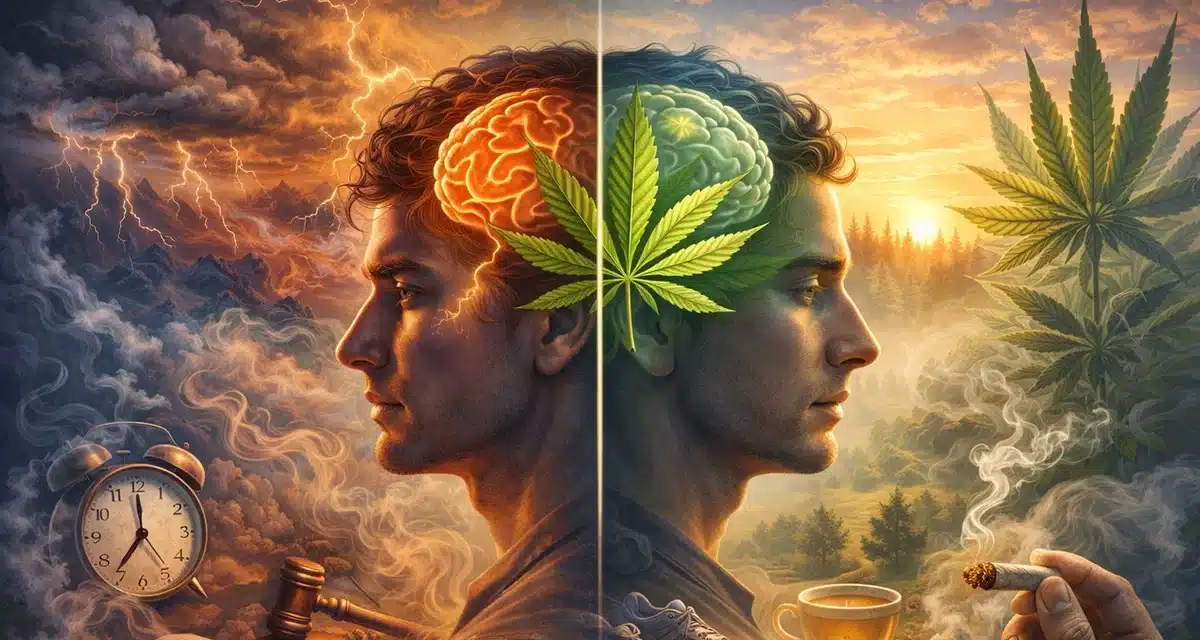
Long-term daily cannabis use is rarely sustained by pleasure alone.
It often functions as a regulatory mechanism for stress, identity disruption, and prolonged nervous-system activation rather than as a simple recreational habit.
Many individuals report remaining in heavy-use patterns for years—even when enjoyment declines—because cannabis serves roles unrelated to intoxication. Understanding those roles explains why use can persist far beyond initial intent.
Regulation Rather Than Escape
Cannabis commonly operates as a form of informal self-regulation.
It lowers perceived threat, softens cognitive load, and reduces baseline vigilance. Over time, this creates a dependence not on euphoria, but on stability.
Persistent use is more strongly associated with:
- Cognitive fatigue
- Chronic background stress
- Prolonged identity strain
- Long-term hypervigilance
- Difficulty accessing rest without stimulation
In these cases, cannabis acts as a tool for maintaining function rather than avoiding responsibility.
Table of Contents
Stimulated Calm and Continuous Motion
A distinguishing feature of modern cannabis concentrates is their tendency to create stimulated calm rather than sedation.
This produces a paradoxical effect: stress decreases, but internal momentum remains high.
Users often describe:
- Continuous internal activity
- Enhanced sensory engagement
- Persistent mental motion
- Resistance to quiet states
- Difficulty tolerating stillness without input
Rather than encouraging rest, this pattern sustains forward motion.
The absence of movement—or “normal baseline awareness”—may feel uncomfortable or unfamiliar.
Identity Stress and Prolonged Adaptation
Long-term psychological stressors can extend the useful life of coping mechanisms well beyond their original purpose.
Major identity transitions, prolonged social displacement, or ideological rupture can produce multi-year states of heightened internal tension.
During extended adaptation periods, cannabis may function as:
- A soft buffer against hypervigilance
- A substitute for lost structure
- A stabilizer during uncertainty
- A bridge through prolonged psychological effort
Even after external stability returns, the habit often remains, having been integrated into the nervous system’s default regulation strategy.
Why Stopping Can Feel Like Acceleration Rather Than Relief
Discontinuation does not always produce immediate calm.
Instead, many individuals experience an unfamiliar sense of exposure.
Common early effects include:
- Heightened awareness without stimulation
- Reduced artificial momentum
- Increased perceptual neutrality
- Emerging fatigue
- Emotional clarity without buffering
This is not withdrawal in the classic sense. It is a recalibration process in which baseline states reassert themselves after years of modulation.
Normalization of the Nervous System
The primary long-term benefit of cessation is the restoration of internal regulation without chemical assistance.
This process occurs gradually and is often uneven.
Documented effects include:
- Improved attention span
- Clearer memory formation
- Normalized sleep architecture
- Reduced respiratory irritation
- More consistent energy patterns
- Increased cognitive sharpness
- Greater emotional continuity
Over time, stimulation-dependent calm is replaced by baseline equilibrium.
Replacement Over Suppression
Sustainable cessation is associated with replacement strategies, not suppression.
Removing a long-standing regulatory aid without providing an alternative often leads to relapse.
Effective substitutions tend to share characteristics with the original function:
- Reading or structured cognitive engagement
- Short, intentional rest periods
- Low-stimulation physical movement
- Predictable evening routines
- Friction-based access reduction
These replacements provide containment without artificial arousal.
Reclaiming Stillness Without Anesthesia
Stillness is not inherently threatening; it becomes so through prolonged avoidance.
When cannabis has been used to maintain motion, silence and neutrality can initially feel unsafe.
With time, these states often shift from discomfort to neutrality, and eventually to rest.
The nervous system adapts to operating without constant stimulation once threat perception recalibrates.
Cessation is best understood not as deprivation, but as a transition from externally induced regulation to internally generated stability.
Cannabis Use Q&A
Why do people stay in daily cannabis habits for years?
Because the substance often regulates stress and cognitive load rather than providing simple enjoyment.
Is long-term use always about avoidance?
No.
In many cases it supports sustained functioning during extended periods of stress or transition.
Why does stopping sometimes feel uncomfortable rather than relieving?
Because baseline mental and physical states return without stimulation, which can feel unfamiliar after long-term modulation.
Does cessation improve cognition over time?
Yes.
Many individuals report sharper focus, improved memory, and clearer mental pacing after adjustment.
Is replacement activity more effective than willpower?
Yes.
Habits maintained for regulation respond better to functional replacement than to suppression alone.
Does the nervous system adapt without cannabis?
Yes.
Regulation capacity typically returns gradually as baseline equilibrium reestablishes.