
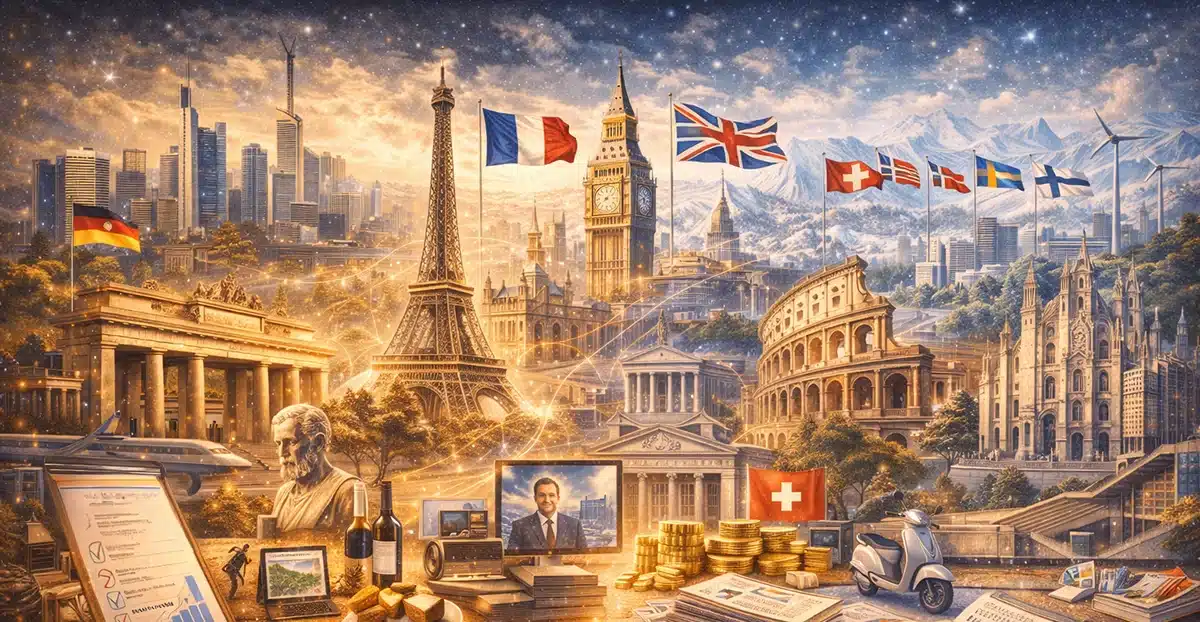
Europe’s influence on global politics, culture, and intellectual life no longer flows from empire or military dominance.
It emerges through institutional design, economic specialization, cultural production, and long-standing social models that continue to shape how the modern world functions.
Each major European country projects influence in a distinct way, reflecting its history, geography, and post-war evolution.
This primer outlines how key European societies exert power today, what forms that power takes, and where their influence is most visible across global systems.
Table of Contents
Germany: Structural Power and Systems Thinking
Germany operates as Europe’s primary structural engine, shaping how systems are built, regulated, and maintained.
Germany’s power is not expressive or rhetorical. It is functional. The country exerts influence through engineering standards, industrial supply chains, regulatory frameworks, and political gravity within continental institutions.
Postwar Germany intentionally decentralized authority.
Political power sits in Berlin, financial power in Frankfurt, industrial expertise in Munich and Baden-Württemberg, logistics in Hamburg, and manufacturing depth across multiple regions.
This prevents domination by any single city while reinforcing redundancy and resilience.
Globally, Germany influences how infrastructure is planned, how manufacturing scales, and how environmental and labor standards are institutionalized.
German engineering principles shape transportation networks, energy systems, industrial machinery, and climate policy mechanisms far beyond Europe.
Culturally, Germany projects seriousness, stability, and competence.
Its restraint functions as a form of credibility. Germany’s influence is strongest where continuity, precision, and long-term reliability matter.
France: Intellectual, Cultural, and Aesthetic Authority
France remains Europe’s dominant source of philosophical framing, cultural theory, and aesthetic leadership.
French influence operates through language, critique, and narrative control. Political theory, social analysis, fashion, gastronomy, and global cultural institutions still draw heavily from French traditions.
Paris functions as a symbolic capital rather than a logistical one.
French power does not require efficiency to be influential.
It relies on legitimacy, historical continuity, and the authority to define taste, meaning, and critique.
In global discourse, French frameworks shape how ideas are debated, categorized, and institutionalized. From academic theory to diplomacy to fashion, France sets terms rather than follows them.
France’s power is often indirect but persistent. It operates best where values, symbolism, and cultural capital determine outcomes.
United Kingdom: Media Reach and Cultural Broadcasting
The United Kingdom’s influence flows through language, media formats, and global cultural distribution.
Despite reduced political leverage after Brexit, the UK remains a central producer of global culture.
Music, television formats, journalism, literature, and entertainment norms continue to originate or consolidate through British institutions.
London remains a global city whose influence exceeds national borders.
British media organizations shape international discourse, while UK pop culture continues to export at scale.
The country’s power lies in framing narratives that travel easily across borders, particularly within Anglophone systems.
This influence is less structural than Germany’s and less philosophical than France’s, but broader in reach.
Switzerland: Financial Stability and Institutional Trust
Switzerland exerts influence primarily in finance, diplomacy, and institutional credibility.
The country projects reliability rather than authority. Its financial sector, regulatory stability, and diplomatic neutrality make it an anchor for international agreements, arbitration, and capital preservation.
Cities like Zurich and Geneva function as global service hubs rather than cultural exporters.
International organizations, humanitarian institutions, and financial mechanisms rely on Switzerland’s predictability and restraint.
Swiss influence is quiet, transactional, and durable. It shapes outcomes through trust rather than visibility.
Italy: Design, Craft, and Cultural Memory
Italy influences the world through physical aesthetics, material culture, and lifestyle ideals.
Italian power expresses itself through fashion, industrial design, architecture, cuisine, and visual culture. Italian cities export a sense of proportion, craftsmanship, and human-scaled beauty that continues to inform global taste.
Italy’s contribution is not institutional dominance but sensory leadership.
It shapes how environments feel, how products appear, and how cultural memory is preserved.
Italian influence persists through replication rather than imitation. Its visual and material standards are absorbed into global norms without overt attribution.
The Nordic Countries: Governance Models and Social Design
Northern Europe influences the world through governance experiments and social trust frameworks.
Countries such as Sweden, Denmark, Norway, and Finland export models rather than narratives. Their influence is visible in urban planning, labor relations, welfare architecture, environmental policy, and public accountability structures.
These societies shape international thinking about scale, balance, and quality of life.
Their relevance lies in practicality rather than ideology.
Nordic power operates through example. Their systems are studied, adapted, and selectively implemented elsewhere.
Central Europe: Transitional Cultural Logic
Austria, Czechia, and neighboring states function as cultural hinge zones between Western and Eastern Europe.
Austria blends Germanic administrative order with Central European social fluidity.
Vienna remains a historical and cultural bridge city connecting Western institutions with Eastern European sensibilities.
Czechia projects a Central European identity expressed through Slavic language but Austro-German civic structure.
Its cultural influence appears in literature, film, and intellectual skepticism rooted in historical experience.
These countries do not dominate global systems, but they inform European cohesion by maintaining continuity across cultural boundaries.
Eastern Europe and Russia: Divergent Trajectories
Eastern Europe transitions from Central European structures into different civilizational frameworks.
As one moves eastward, institutional inheritance shifts.
Orthodox religious traditions, different state relationships, and alternative cultural logics emerge.
Russia represents a distinct civilizational track rather than an incremental extension of European systems.
Its influence operates through geopolitical pressure, energy markets, and alternative cultural narratives rather than shared institutional alignment.
Power in the Contemporary European Context
Europe’s influence today is not centralized.
It is distributed, layered, and specialized.
Different countries shape different dimensions of global life:
- Germany shapes systems and infrastructure
- France shapes thought, critique, and aesthetics
- The UK broadcasts culture at scale
- Switzerland anchors trust and finance
- Italy defines physical and sensory standards
- Nordic countries export governance models
This division of influence explains Europe’s continued relevance despite limited unified political power.
Influence persists because function, credibility, culture, and design remain essential to global systems.
European Power Influences Q&A
Why does Germany feel influential without being culturally dominant?
Germany’s power operates through systems rather than symbolism.
Its influence is embedded in infrastructure, regulation, and industrial organization rather than popular culture.
Why does France still matter culturally despite economic constraints?
France retains authority over cultural framing, intellectual discourse, and aesthetic legitimacy, which do not depend on economic dominance.
Is Switzerland influential beyond finance?
Yes.
Switzerland influences diplomacy, international governance, and conflict mediation by providing neutral and trusted institutional environments.
Why doesn’t Europe have a single dominant cultural capital today?
Postwar political design, economic specialization, and historical experience distributed influence rather than concentrating it in one center.
How does Europe still shape global norms without empire?
Through institutional design, cultural production, regulatory leadership, and social models that are adopted internationally.