
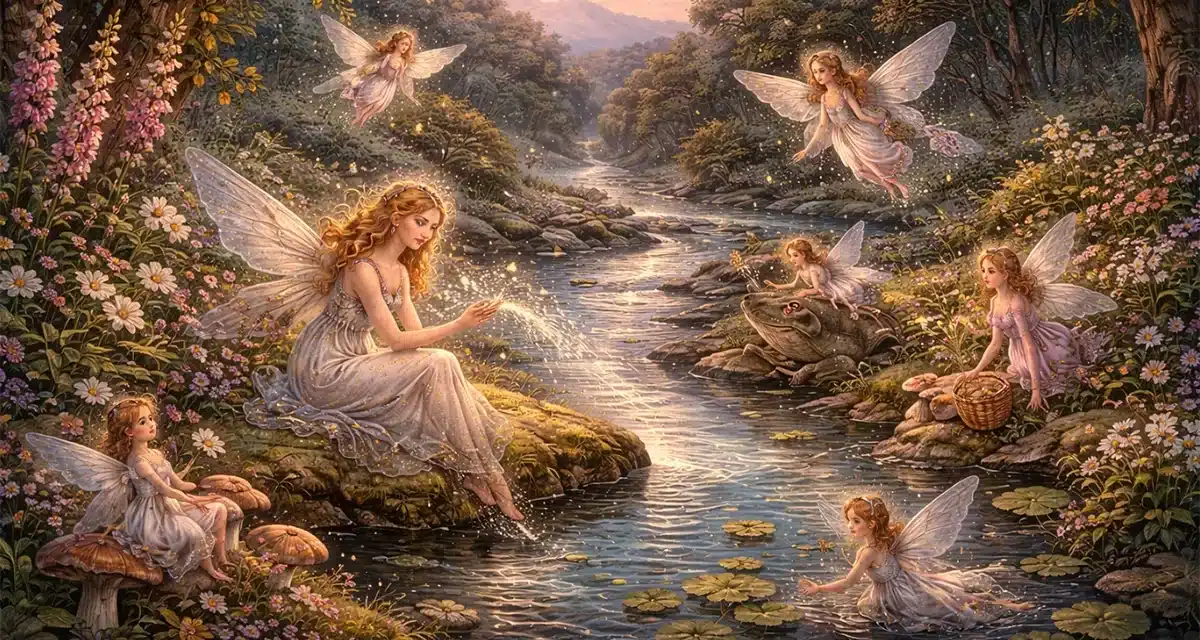
The Catskill Fairies, written and illustrated by The Catskill Fairies by Virginia Wales Johnson, was not an isolated curiosity.
It emerged from a short but intense period in American cultural history when fairies—imported, adapted, and reinterpreted—became fashionable among writers, artists, and middle-class readers in New England, New York, and other cultural centers.
We’ll look at the book itself, the moment that produced it, and why Americans briefly became interested in fairies at all.
The lens here is cultural and skeptical. The goal is not to validate belief, but to understand why belief-adjacent material gained traction when it did.
Table of Contents
The Book Itself
The Catskill Fairies was published in 1910 as a children’s book combining short stories with watercolor illustrations.
Johnson set her fairies in the Catskill Mountains of New York, relocating a traditionally European mythological framework into a distinctly American landscape.
The book presents fairies as:
- Small, humanoid beings
- Associated with nature and rural spaces
- Curious about human behavior
- Mostly benign, with mild mischievous tendencies
There is no claim of literal truth.
The tone is literary and illustrative rather than testimonial. Johnson was not documenting folklore she personally encountered. She was participating in a broader artistic trend.
That distinction matters.
Why the Catskills?
The Catskill Mountains already held a mythic place in American culture by the late 19th century.
Writers like Washington Irving had framed the region as a space where the old world and the new could overlap comfortably.
The Catskills offered wilderness without remoteness, tradition without danger.
They were accessible to:
- New York City artists
- Vacationing middle-class families
- Writers seeking “American” settings with European echoes
Placing fairies in the Catskills allowed Johnson to domesticate Old World mythology without challenging modern sensibilities.
This was folklore without risk.
America’s Fairy Moment
Between roughly 1880 and 1920, fairies appeared frequently in American and British art, children’s literature, and decorative illustration.
This period coincided with industrialization, urban crowding, and anxiety about modern life.
Fairies functioned as:
- Symbols of innocence
- Visual shorthand for nature
- A softened spiritual alternative to organized religion
- Safe fantasy for children
Crucially, this was not a revival of traditional folk belief. It was an aesthetic movement.
In the United States, fairy imagery was rarely tied to rural oral tradition. Instead, it circulated through books, magazines, greeting cards, theater sets, and nursery decoration.
The audience was urban and educated.
Imported Mythology, Reframed
Most American fairy lore of this period was borrowed.
The raw material came from British, Irish, and continental European traditions, already filtered through Victorian literature.
Earlier folklore treated fairies as:
- Morally ambiguous
- Potentially dangerous
- Closely tied to land, borders, and taboo
American adaptations stripped away these elements.
By the time fairies reached books like The Catskill Fairies, they were:
- Non-threatening
- Child-sized and child-safe
- Detached from superstition
- Safe for polite households
Johnson’s fairies fit this pattern exactly.
Why Fairies, Not Ghosts or Spirits?
Fairies offered fantasy without moral consequence.
Ghost stories often implied death. Spiritualism implied metaphysics. Angels implied doctrine.
Fairies implied none of these.
They were:
- Visually appealing
- Narratively flexible
- Morally uncomplicated
- Easily merchandised
This made them especially attractive during a period when Americans were negotiating science, religion, and tradition simultaneously.
Fairies were belief-adjacent but belief-free.
Children’s Literature and the Middle Class
Books like The Catskill Fairies were products of a growing middle-class children’s publishing market.
Childhood itself was being redefined as a protected developmental stage rather than a period of early labor.
Fairy books served several functions:
- Entertainment
- Moral softening without preaching
- Exposure to “imagination” framed as healthy
- Decorative literacy
Johnson’s watercolor illustrations were as important as her text. These books were meant to be owned, displayed, and revisited.
They reinforced taste as much as narrative.
Skepticism and Distance
Even at the height of fairy popularity, most Americans did not believe fairies were real.
Newspapers did not report sightings. Churches did not condemn them. Scientists did not attempt debunking.
That absence is telling.
Fairies occupied a symbolic space. They were never expected to cross into reality.
When later generations look back at this period and ask whether people “believed,” the answer is largely no. People consumed fairy material with the same suspension of disbelief applied to poetry or illustration.
This was controlled imagination.
Why the Trend Faded
By the 1920s, fairy imagery declined sharply in American culture.
Several factors contributed:
- Cultural shifts after World War I
- Changing attitudes toward childhood
- The rise of realism and modernism
- New fantasy forms, including science fiction
Fairies came to feel overly delicate, overly sentimental, and disconnected from contemporary concerns.
They survived mostly in:
- Disney adaptations
- Nursery iconography
- Nostalgic reprints
The Catskill Fairies became a period artifact rather than a living tradition.
What the Book Represents Now
Today, The Catskill Fairies is best read as a cultural document.
It captures a specific moment when Americans experimented with fantasy that was intentionally light, decorative, and non-threatening.
It shows:
- How myth was aestheticized
- How folklore was filtered through illustration
- How nature was romanticized as manageable
- How imagination was compartmentalized
Johnson was not preserving folk belief. She was designing atmosphere.
That distinction explains both the book’s charm and its historical limits.
The Catskill Fairies does not document a hidden world. It documents a moment when Americans briefly enjoyed pretending that the past had left something gentle behind.
Catskill Fairies Q&A
Was The Catskill Fairies based on real sightings?
No.
The book is a work of imaginative fiction inspired by European fairy traditions, not documented encounters.
Did Americans ever seriously believe in fairies?
Outside of isolated spiritual movements, belief was rare.
Fairies were treated as symbolic rather than literal.
Why were fairies popular around 1900?
They provided escapism during industrialization and fit neatly into middle-class children’s culture.
Why set fairies in the Catskills?
The region already had literary cachet and allowed Old World fantasy to feel American without feeling modern.
How is this different from older folklore?
Traditional folklore treated fairies as morally complex and sometimes dangerous.
American versions removed those elements.
Why did fairy stories fall out of fashion?
Cultural priorities changed.
Sentimental fantasy gave way to realism, irony, and new genres.
Why does the book still interest readers?
As an artifact.
It reflects how Americans reshaped myth to match taste rather than belief.