
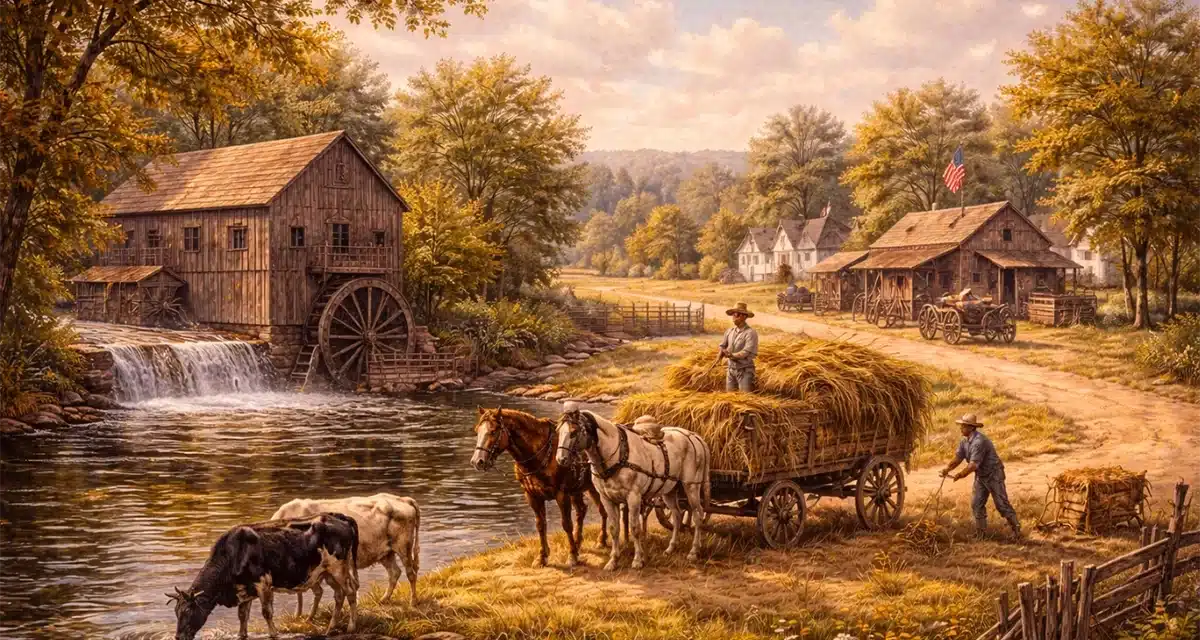
Bridgewater Township developed as an inland agricultural and transportation-centered community whose importance came from land, roads, and regional access rather than ports or industry.
Located in central Somerset County along the Raritan River, Bridgewater’s history follows a steady pattern: Indigenous presence, colonial settlement, long-term agricultural use, gradual population growth, and postwar suburban expansion.
Its development was incremental rather than abrupt, shaped by geography and infrastructure more than by a single defining industry.
Table of Contents
Indigenous Land and Early European Settlement
Before European settlement, the area now known as Bridgewater Township was inhabited by the Lenape.
The Lenape used the Raritan River and its tributaries for fishing, seasonal travel, and trade. Woodland and meadowland supported hunting and small-scale agriculture.
European settlers began arriving in the late 1600s, moving inland from earlier settlements in East Jersey.
Land was acquired through grants and private purchases. Settlement dispersed quickly, with farms spread across fertile river valleys and gently rolling terrain.
There was no early town center. Life organized around individual homesteads, mills, and informal road junctions.
Formation of Bridgewater Township
Bridgewater Township was officially formed in 1749, making it one of the older municipalities in New Jersey.
At the time of its formation, the township included a much larger geographic area than it does today, encompassing land that would later become multiple independent towns.
Early governance addressed practical concerns:
- Road construction and maintenance
- Property boundaries
- Local taxation
- Public order
The township’s identity was rural and administrative rather than commercial.
Agriculture as the Economic Base
For more than two centuries, Bridgewater’s economy was primarily agricultural.
Farms produced grains, livestock, dairy products, and later diversified crops. The township’s soil quality and access to water supported sustained agricultural use without intensive industrial development.
Supporting infrastructure developed gradually:
- Gristmills along streams
- Blacksmith shops
- Small crossroads stores
Agriculture shaped land ownership patterns, road placement, and population density well into the 19th century.
Transportation and the Raritan River
Bridgewater’s location along the Raritan River played an important role in regional connectivity.
The river supported milling operations and allowed goods to move east toward New Brunswick and downstream markets.
Roads connecting western New Jersey to the coast passed through Bridgewater, reinforcing its role as a transit area rather than a destination.
Later transportation improvements included:
- Turnpikes and improved wagon roads
- Rail lines constructed near, but not through, central township areas
These routes facilitated trade while preserving Bridgewater’s agricultural character.
Subdivision and the Creation of Neighboring Towns
During the 18th and 19th centuries, Bridgewater Township gradually lost territory as new municipalities were formed.
Population growth and local governance needs prompted the creation of independent towns within its original boundaries.
Municipalities carved out of Bridgewater included Somerville, Bound Brook, and others.
Each separation reduced Bridgewater’s size while increasing administrative complexity.
By the late 19th century, Bridgewater’s boundaries resembled their modern form.
Nineteenth-Century Stability
The 19th century brought continuity rather than transformation.
While nearby towns developed commercial and industrial activity, Bridgewater remained largely rural.
Key characteristics of this period included:
- Stable population growth
- Continued farm ownership across generations
- Limited village development
Infrastructure improvements were incremental. There was no large-scale industrialization.
Early Twentieth Century Changes
The early 20th century introduced modernization without rapid growth.
Automobiles improved mobility and reduced isolation, but farming remained central to the local economy.
Notable changes included:
- Road paving and bridge improvements
- School consolidation
- Expansion of municipal services
Bridgewater entered World War II as a largely rural township.
World War II Suburban Expansion
Bridgewater changed significantly after World War II.
Population growth in New Jersey, combined with highway construction and suburban demand, altered land use patterns.
Major highways, including Interstate 287 and Route 22, increased accessibility and positioned Bridgewater within regional commuting networks.
This period brought:
- Subdivision of farmland
- Construction of planned residential neighborhoods
- Expansion of schools and public services
The township’s population increased rapidly from the 1950s onward.
Corporate and Commercial Development
Bridgewater also developed a strong corporate and commercial presence.
Proximity to highways attracted office parks, research facilities, and later retail centers.
These developments provided:
- Employment opportunities
- Expanded tax base
- New zoning challenges
Commercial growth was concentrated along major corridors, separating it from residential neighborhoods.
Municipal Planning and Infrastructure
Rapid growth required formal planning and governance adjustments.
Bridgewater expanded municipal departments, invested in school infrastructure, and implemented zoning regulations.
Key planning priorities included:
- Traffic management
- Open space preservation
- Balancing commercial and residential development
Land-use decisions increasingly reflected long-term growth considerations rather than short-term needs.
Bridgewater Today
Today, Bridgewater Township functions as a large suburban municipality with residential, corporate, and retail components.
It serves as both a place to live and a regional employment center within central New Jersey.
Defining characteristics include:
- Extensive highway access
- Diverse residential neighborhoods
- Significant commercial development
- Ongoing emphasis on planning and services
Despite modern growth, Bridgewater’s layout still reflects its origins as a dispersed rural township.
Bridgewater Township, New Jersey Q&A
When was Bridgewater Township established?
Bridgewater Township was established in 1749.
Who lived in the area before European settlement?
The Lenape inhabited the region prior to European arrival.
What defined Bridgewater’s early economy?
Agriculture and milling dominated the local economy for centuries.
Why didn’t Bridgewater industrialize heavily?
Its inland location and land use patterns favored farming rather than factory development.
What caused major population growth?
Post–World War II suburban expansion and highway access.
How did highways affect Bridgewater?
They connected the township to regional job markets and enabled corporate development.
What defines Bridgewater today?
A balance of residential neighborhoods, commercial corridors, and planned suburban growth.