
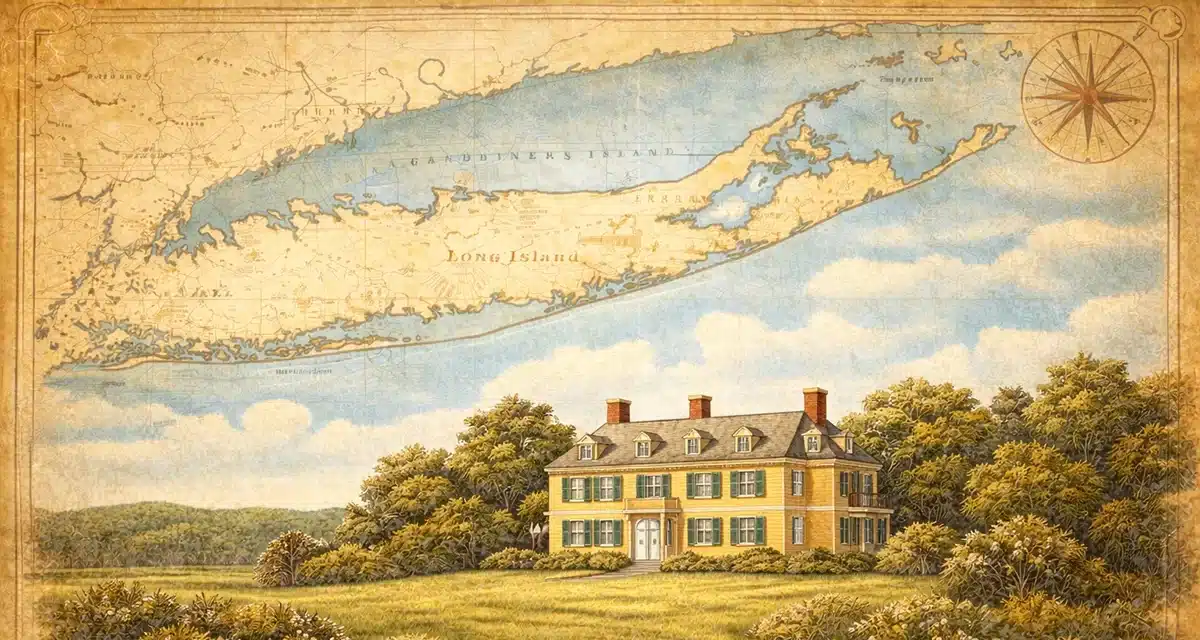
Gardiners Island lies in Gardiners Bay at the eastern end of Long Island, positioned between the North Fork and the South Fork, where Long Island opens toward the Atlantic Ocean.
It spans roughly 3,300 acres and remains privately owned, undeveloped, and largely closed to the public. That status places it among the most unusual historic properties in the United States.
What sets Gardiners Island apart is not scale, scenery, or wealth. Its distinction comes from continuity.
The land has been held by a single family for nearly four centuries.
It has never been sold, subdivided, or absorbed into a town, county, or park system.
Its history offers a rare look at how land ownership, colonial law, and restraint shaped outcomes that feel almost impossible by modern standards.
Table of Contents
Indigenous Use Before European Arrival
The island functioned as a seasonal resource site rather than a permanent settlement.
Before European contact, the waters and shores around Gardiners Island were used by Algonquian-speaking peoples of eastern Long Island, especially the Montaukett.
These communities relied heavily on fishing, shellfish harvesting, and offshore whaling.
The island’s location made it useful for staging and food access rather than year-round residence.
Why the island mattered to Native communities
- Proximity to rich fishing grounds in Gardiners Bay.
- Access to migratory birds and shellfish along the shoreline.
- Shelter for short-term stays tied to hunting and fishing cycles.
- Strategic access to open Atlantic waters.
This pattern of use shaped later land negotiations.
Indigenous leaders viewed the island as shared territory tied to activity rather than fixed ownership. European settlers viewed land as exclusive property.
That mismatch would influence how agreements were later interpreted.
Lion Gardiner and the 1639 Agreement
European settlement began with a single family, not a town.
The island entered written colonial history through Lion Gardiner, an English military engineer hired by the Connecticut Colony. Gardiner arrived in New England in 1635 to oversee construction of Fort Saybrook at the mouth of the Connecticut River.
In 1639, he negotiated with Montaukett leaders to secure control of the island.
The exchange involved goods such as tools, clothing, and weapons rather than currency. From the Native perspective, this resembled conditional use. From the colonial side, it became a permanent purchase.
Key factors that made the purchase durable
- Gardiner settled the island with his family rather than holding it remotely.
- Colonial authorities later recognized the agreement in writing.
- No competing European claims existed on the island at the time.
- The island’s separation reduced disputes with neighboring settlers.
Gardiner did not establish a village. He built a fortified homestead and worked the land directly. His isolation became a long-term asset.
An Island Between Colonies
Political ambiguity protected the island instead of threatening it.
During the mid-seventeenth century, eastern Long Island existed in a gray zone. English colonies in Connecticut and Massachusetts competed for influence. The Dutch controlled New Netherland to the west. Indigenous nations retained authority across much of the region.
Gardiners Island fell into none of these systems cleanly.
Gardiner aligned himself politically with Connecticut while remaining geographically closer to what later became New York. When England seized New Netherland in 1664, this ambiguity forced the Crown to clarify ownership.
The royal patent and its implications
- Confirmed the island as private property under the Gardiner family.
- Granted authority similar to a manor rather than municipal land.
- Limited interference from colonial governments.
- Established inheritance rather than resale as the default transfer method.
Few land grants in colonial America carried this degree of autonomy. Most towns were incorporated. Most farms existed inside counties. Gardiners Island stood outside both.
Daily Life Under Family Rule
For centuries, the island functioned as a self-contained estate.
The Gardiner family managed farming, grazing, fishing, and trade.
Tenant labor existed at times, although population remained small. Governance happened informally through family authority rather than town meetings or courts.
Common economic activities on the island
- Sheep and cattle grazing.
- Limited crop farming for household needs.
- Fishing and coastal harvesting.
- Trade with nearby ports on both forks.
No roads connected to the mainland. No church or school served the island. These absences limited growth and discouraged permanent settlement by outsiders.
The American Revolution
The island survived the war without occupation, but not without loss.
During the American Revolutionary War, Long Island became a major British stronghold. Gardiners Island escaped formal occupation, largely due to its isolation and lack of strategic value.
The greatest damage occurred in 1778, when British-aligned raiders, sometimes described as privateers, stripped the island of livestock and supplies. Thousands of sheep were taken or destroyed. The loss crippled the island’s economy for years.
After independence, New York State reviewed land claims across the region. Many Loyalist estates were seized or divided. Gardiners Island remained intact.
Reasons the claim survived
- Continuous residence by the owning family.
- Documentation dating back to the original purchase.
- No competing private claims.
- Early acknowledgment by colonial governments.
The island carried over from colony to state without interruption.
The Nineteenth Century and Avoided Development
Industrial growth passed the island rather than reshaping it.
The nineteenth century transformed Long Island. Railroads reached the forks. Shipbuilding, commercial fishing, and tourism expanded. Estate development accelerated in coastal areas.
None of this touched Gardiners Island in a permanent way.
Why development did not take hold
- No rail or ferry infrastructure linked the island.
- The family refused subdivision or sale.
- Agricultural use continued at a modest scale.
- Isolation made large projects inefficient.
While neighboring towns grew, the island stayed rural. That separation preserved the land more effectively than any early conservation movement could have.
Twentieth-Century Pressure and Conservation
Modern value created new threats the family chose to limit.
By the twentieth century, the Hamptons had become synonymous with wealth and real estate demand. Gardiners Island gained attention from investors, preservation groups, and government planners.
Proposals included:
- Private resort development.
- State acquisition for parkland.
- Wildlife sanctuary conversion.
- Partial subdivision combined with conservation.
The family declined comprehensive transfer. Instead, they pursued conservation easements that restricted future development while keeping ownership intact.
Effects of conservation agreements
- Permanent limits on construction.
- Protection of shoreline and wetlands.
- Continued private management.
- Reduced speculative pressure.
This approach allowed the island to remain functional rather than frozen. Farming and land management continued at a controlled scale.
Environmental Importance Today
The island serves ecological functions rare in the region.
Gardiners Island supports migratory birds, coastal grasslands, and marine habitats. Its undeveloped shoreline protects water quality in Gardiners Bay and Shelter Island Sound.
Environmental value came late in the island’s history as a formal concept. Preservation occurred first through restraint, then through policy.
Legal Challenges in the Modern Era
Ownership has been questioned, reviewed, and reaffirmed.
New York State has periodically challenged aspects of the island’s ownership, especially submerged lands and tidal boundaries. Courts consistently upheld the Gardiner claim.
The rulings emphasized:
- Unbroken chain of title.
- Recognition under colonial, royal, and state systems.
- Absence of abandonment or sale.
- Continuous use consistent with private ownership.
Few properties can demonstrate this depth of documentation.
Why Gardiners Island Remains Unique
Its survival reflects choices rather than accidents.
Gardiners Island avoided the pressures that reshaped most of coastal America. That outcome required repeated decisions against profit, growth, and convenience.
Characteristics that set the island apart
- Nearly 400 years of family ownership.
- No municipal governance structure.
- No subdivision or public access mandate.
- Conservation driven by owners rather than the state.
The island stands as a working example of how early legal frameworks, reinforced over time, can outlast dramatic regional change.
Gardiners Island Q&A
Is Gardiners Island open to the public?
No. The island is privately owned. Public access is limited and typically restricted to authorized visits.
Who owns Gardiners Island today?
The island remains owned by descendants of Lion Gardiner through direct family inheritance.
Why did the state never take ownership?
Courts consistently upheld the original land grants and documentation, confirming private ownership under New York law.
Was the island ever sold?
No. It has never been sold, subdivided, or transferred outside the family line.
Why is the island still undeveloped?
Isolation, family policy, and conservation agreements prevented large-scale development.
Does anyone live on the island full-time today?
Population remains very small, consisting mainly of caretakers and limited family presence.
What makes Gardiners Island historically significant?
Its uninterrupted ownership, early legal recognition, and preserved landscape distinguish it from nearly every other coastal property in the region.