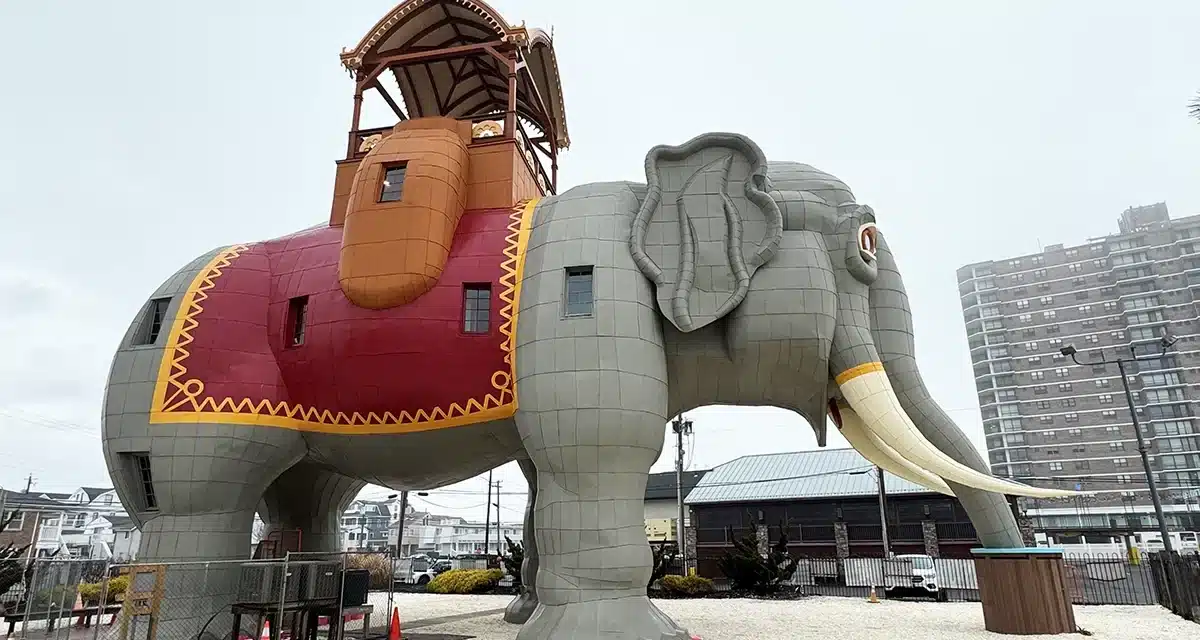
Lucy the Elephant is a six-story elephant-shaped structure built in 1881 and located in Margate City, Atlantic County, New Jersey.
It was constructed decades before automobile tourism and was intended to serve a direct commercial function.
Lucy’s survival is the result of repeated practical decisions related to land use, relocation, and preservation rather than cultural sentiment.
Table of Contents
Pre-Construction Context
Before Lucy was built, the barrier islands south of Atlantic City were lightly developed.
Rail access from Philadelphia made the region attractive to real estate investors, but large tracts of land were difficult to market visually.
Developers sought permanent, recognizable structures that could differentiate their property from competitors and make undeveloped land easier to sell.
Lucy was conceived as one such structure.
Coastal Land Promotion in the Late 19th Century
During the 1870s and 1880s, speculative development along the New Jersey coast relied heavily on novelty, visibility, and access. Permanent landmarks increased buyer interest and provided fixed destinations for excursion traffic arriving by rail.
Construction and Design
Lucy was built in 1881 by James V. Lafferty, a Philadelphia-based real estate developer.
Lafferty experimented with large animal-shaped buildings as advertising devices, but Lucy was the largest and most structurally ambitious of these projects.
The structure was framed in timber and clad in tin sheeting.
At completion, Lucy stood approximately 65 feet tall and included staircases, internal rooms, and exterior viewing access.
Intended Function at Completion
Lucy’s original purpose was commercial, not recreational.
- Real estate sales office
- Elevated observation point
- Landmark visible from rail approaches
The interior was functional and utilitarian, designed to move visitors rather than house them for extended periods.
Early Commercial Reuse
As surrounding development expanded, Lucy’s role shifted.
Once land sales declined in importance, the structure was repurposed multiple times to fit changing economic needs.
Lucy operated at various points as a lodging facility, restaurant, and tavern. These changes involved interior modifications that prioritized short-term use over long-term preservation.
Adaptation to Tourism Patterns
Each reuse reflected broader changes in how visitors interacted with coastal towns. Lucy transitioned from infrastructure for land promotion to stand-alone attraction as the surrounding area matured.
Naming and Public Recognition
Lucy was originally called the “Elephant Bazaar.”
By the early 20th century, the name “Lucy” appeared consistently in printed materials. The naming coincided with a shift in how the structure was marketed.
Shift From Tool to Destination
Once Lucy became known by name, she functioned less as a means to sell property and more as a point of interest in her own right. The name simplified public reference and reinforced her distinctiveness.
Relocation and Preservation Risk
By the mid-20th century, land redevelopment threatened Lucy’s original location.
In 1970, the structure was moved approximately two miles south to her current site in Margate City.
The relocation required structural reinforcement and specialized equipment. While the move prevented immediate demolition, it did not resolve ongoing maintenance challenges.
Structural Vulnerabilities
After relocation, Lucy continued to face deterioration due to:
- Coastal exposure
- Aging materials
- Limited funding
These conditions placed her long-term survival in question.
Historic Designation and Restoration
Lucy was designated a National Historic Landmark in 1969.
This recognition increased visibility but did not provide full financial support. Preservation required organized fundraising and staged restoration.
Restoration work focused on stabilization rather than modernization.
Scope of Restoration Efforts
Key restoration priorities included:
- Structural reinforcement
- Exterior material replacement
- Safety upgrades for limited public access
Cosmetic restoration was secondary to structural integrity.
Lucy as an Architectural Category
Lucy is frequently classified as novelty architecture, but this classification is imprecise.
Her construction predates automobile-oriented roadside attractions and was intended for rail and pedestrian audiences.
Distinction From Later Novelty Structures
Unlike mid-20th-century novelty buildings, Lucy was not designed as entertainment. She was a permanent commercial structure tied to land development strategy.
Lucy is the only surviving large-scale example of her type.
Present-Day Function
Today, Lucy operates as a historic landmark and educational site.
She is managed by a preservation organization and is open to the public through guided access only.
Her current role excludes commercial hospitality functions.
Operational Constraints
Lucy’s continued operation depends on:
- Controlled visitor numbers
- Ongoing maintenance
- Preservation funding
Use is intentionally limited to reduce structural stress.
Lucy the Elephant Q&A
When was Lucy the Elephant built?
Lucy was built in 1881.
Why was Lucy constructed?
She was built as a real estate marketing structure to attract buyers to undeveloped coastal land.
Is Lucy made of metal?
No. The structure is primarily timber-framed with metal exterior elements.
Has Lucy always been in Margate City?
No. She was relocated in 1970 to prevent demolition.
Is Lucy used commercially today?
No. She functions as a historic site with guided tours.
Is Lucy unique?
Yes. She is the only surviving large-scale elephant-shaped structure of her kind.
Why is Lucy historically significant?
She represents early advertising architecture, large-scale wooden construction, and sustained preservation efforts.