
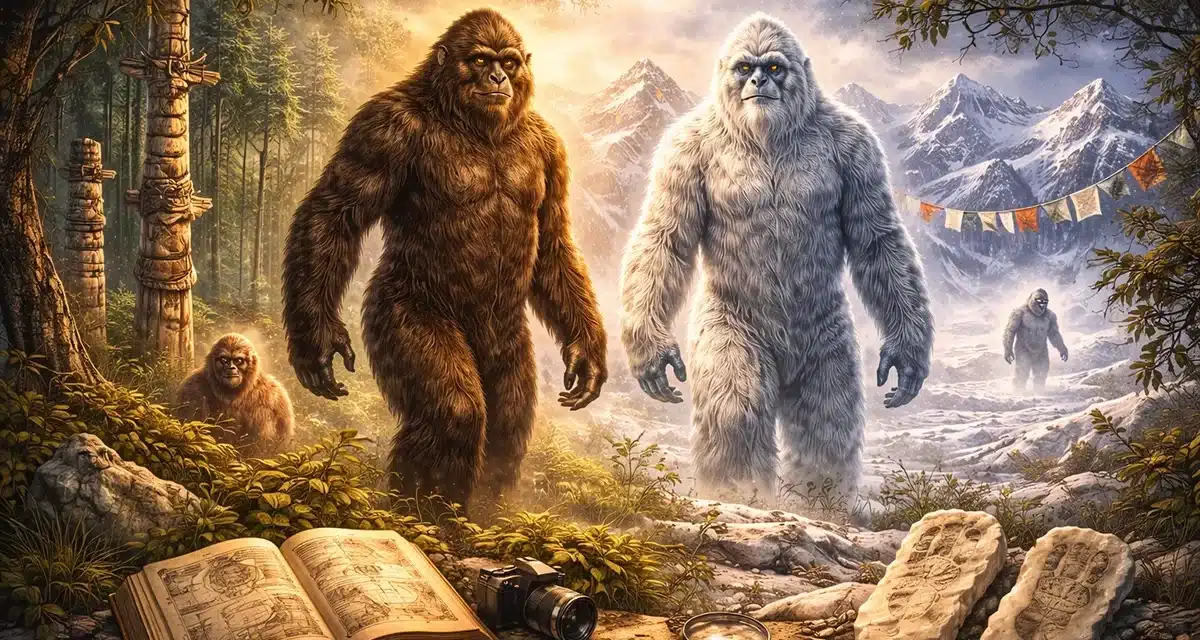
Legends of large, upright, humanlike beings appear in folklore across multiple continents, cultures, and historical periods.
Among the most enduring of these traditions are those commonly referred to today as Sasquatch and Yeti, figures that occupy a complex space between myth, cultural memory, and modern popular imagination.
These traditions did not originate as a single global myth.
They emerged independently within specific ecological, spiritual, and social contexts, long before modern media unified their imagery.
Table of Contents
Defining Sasquatch and Yeti as Cultural Constructs
Sasquatch and Yeti traditions are best understood as regional folklore systems rather than as singular global creatures.
Neither figure originated as a scientific hypothesis. Early references framed them as forest beings, spiritual guardians, or liminal entities associated with wilderness rather than as zoological specimens.
Over time, colonial contact, exploration narratives, and later mass media reduced these traditions into simplified figures described as “cryptids.”
This reframing detached them from their original cultural roles.
The distinction matters.
Folklore preserved meaning long before it invited proof.
Indigenous Traditions of North America
North American Sasquatch stories originate primarily within Indigenous oral traditions.
Long before the term “Sasquatch” entered English usage, numerous Indigenous nations across the Pacific Northwest and interior regions described forest-dwelling beings with humanlike characteristics.
These beings were not uniformly described or interpreted.
In many traditions, they were neither animals nor monsters, but nonhuman persons occupying moral and territorial roles within the natural world.
Common thematic elements included:
- Association with remote forests and mountains
- Physical strength paired with intelligence
- Boundary enforcement between human settlements and wilderness
These stories functioned as cultural instruction, not entertainment.
Regional Variations in Indigenous Accounts
Distinct nations described distinct beings, with names, behaviors, and meanings shaped by local environment and belief systems.
Some traditions emphasized avoidance rather than fear.
Others framed encounters as warnings against disrespecting land or community norms. Importantly, these narratives did not center on discovery or capture.
They assumed coexistence.
Colonial Encounter and Reinterpretation
European colonization reframed Indigenous accounts through a zoological lens.
As settlers encountered Indigenous narratives, they reinterpreted them through unfamiliar frameworks. Oral traditions were filtered through exploration journals, newspapers, and early anthropology.
This process altered meaning. Spiritual or moral figures became potential undiscovered animals.
Encounters became sightings. Warnings became evidence.
By the late nineteenth century, descriptions increasingly emphasized height, hair coverage, and footprint size, laying the groundwork for modern Sasquatch imagery.
Himalayan Yeti Traditions
Yeti traditions emerged within Himalayan cultures as symbolic and spiritual figures tied to extreme environments.
In regions of Tibet, Nepal, Bhutan, and surrounding areas, stories of the Yeti described beings adapted to high-altitude wilderness.
These environments were already considered sacred, dangerous, and liminal.
Yeti narratives often emphasized:
- Isolation rather than aggression
- Superhuman endurance
- Spiritual ambiguity rather than physical dominance
The Yeti was not a creature to pursue. It was a presence to respect.
Religious and Monastic Interpretations
In some traditions, Yetis were associated with spiritual testing or karmic consequence.
Monastic communities recorded references that framed encounters as moral experiences, not empirical observations.
As with North American accounts, these stories existed independently of any desire to prove biological existence.
Western Exploration and Media Transformation
Twentieth-century exploration transformed regional folklore into global mystery.
Western expeditions to the Himalayas and North American wilderness during the early twentieth century carried cameras, newspapers, and international audiences.
Photographs of footprints, secondhand testimony, and speculative reports circulated widely.
Media outlets emphasized mystery and discovery, reframing traditional stories as unsolved problems.
This period standardized imagery:
- Large, bipedal, hair-covered forms
- Remote mountain or forest habitats
- Elusive behavior resistant to documentation
Cultural nuance was replaced with spectacle.
Cryptozoology and the Search for Physical Evidence
Mid-century cryptozoology attempted to formalize folkloric beings into undiscovered species.
Cryptozoology positioned Sasquatch and Yeti as biological candidates rather than cultural symbols. Researchers focused on footprint casts, hair samples, and anecdotal consistency.
This effort borrowed scientific language without institutional support.
Evidence standards were inconsistent, and findings were rarely reproducible.
Despite this, the framework endured. It offered a bridge between folklore and modern skepticism, even as it satisfied neither discipline fully.
Ecological and Psychological Interpretations
Alternative explanations emerged as scientific literacy expanded.
Scholars proposed that reported encounters could stem from environmental misidentification, cognitive pattern recognition, or cultural reinforcement.
Common interpretations included:
- Misidentified wildlife under low-visibility conditions
- Anthropological memory of extinct hominins
- Psychological projection shaped by expectation and folklore
These explanations addressed mechanism but not meaning. They explained how stories might persist, not why they mattered.
Sasquatch and Yeti in Contemporary Culture
Modern representations prioritize identity and entertainment over tradition.
Today, Sasquatch and Yeti appear in film, advertising, tourism, and consumer branding.
These depictions often emphasize humor, mystery, or nostalgia.
Contemporary usage reflects:
- Detachment from Indigenous and regional origins
- Simplified visual tropes
- Commercial rather than cultural function
The figures persist not because they are believed, but because they are recognizable.
Cultural Persistence and Structural Similarities
Sasquatch and Yeti traditions endure because they occupy a shared symbolic role.
Across cultures, these figures represent the boundary between human society and untamed nature.
They personify environments that resist domestication and full comprehension.
Their persistence reflects:
- Human fascination with the unknown
- Anxiety about wilderness and isolation
- Cultural memory embedded in landscape
They survive because they answer questions science does not ask.
Sasquatch & Yeti Q&A
Are Sasquatch and Yeti the same figure?
No. They arise from distinct cultural traditions shaped by different environments and beliefs.
Did Indigenous cultures describe Sasquatch as animals?
Generally no. Many traditions framed these beings as nonhuman persons or spiritual figures.
Is there scientific evidence for Sasquatch or Yeti existence?
No conclusive, reproducible evidence has been established.
Why do similar legends appear worldwide?
They often emerge from shared human relationships with wilderness and isolation.
Why do these traditions persist today?
They continue to function symbolically within modern culture, independent of belief in physical existence.