
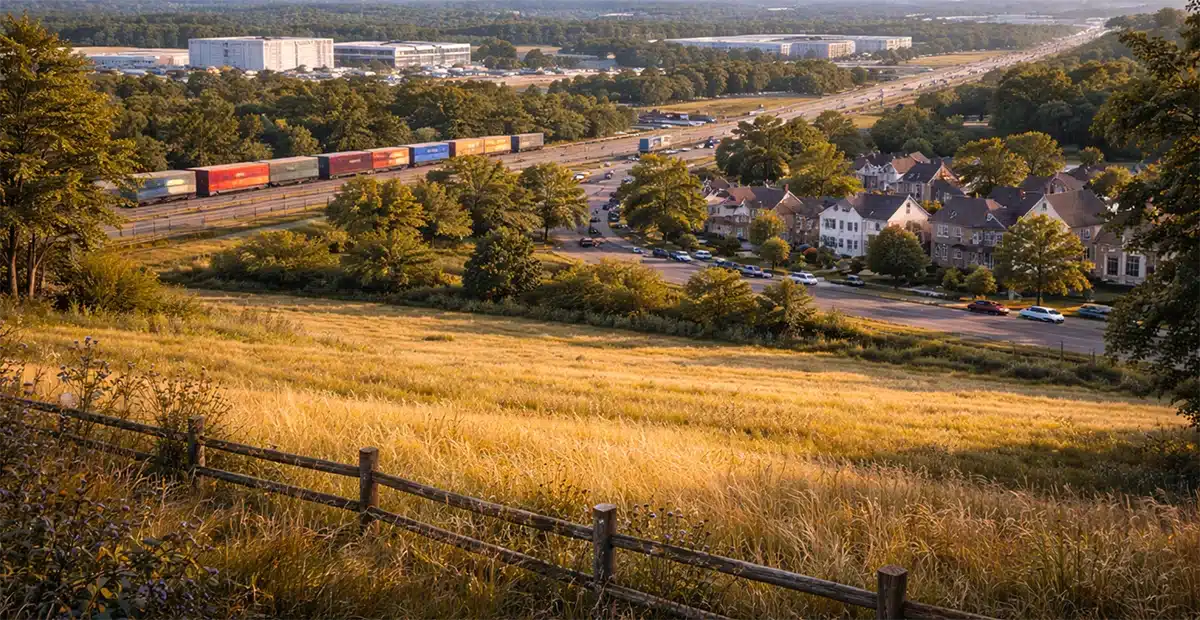
South Brunswick Township, located in Middlesex County, developed as a transportation corridor and agricultural region long before it became a large residential community.
Its history is defined less by a single industry or landmark and more by steady, practical use of land—first by Indigenous peoples, then by farmers, mill operators, and later by commuters and developers responding to New Jersey’s central position between New York and Philadelphia.
South Brunswick’s evolution reflects regional patterns common to central New Jersey: early rural settlement, reliance on roads and waterways, slow population growth for centuries, and rapid suburban expansion in the second half of the twentieth century.
Table of Contents
Indigenous Land and Early European Presence
Before European settlement, the area that became South Brunswick was occupied by the Lenape.
The Lenape used the region’s forests, streams, and wetlands for hunting, fishing, and seasonal movement.
The nearby Raritan River and its tributaries supported trade and travel throughout central New Jersey.
European settlers began arriving in the late 1600s, primarily as part of westward expansion from older settlements along the Raritan and in East Jersey. Early land acquisition followed proprietary land grants rather than village-centered planning.
Settlement remained dispersed. There was no central town and no immediate incentive for dense development.
Formation of South Brunswick Township
South Brunswick Township was officially formed in 1798, when New Jersey reorganized its municipal governments.
Prior to that, the area existed as part of larger administrative divisions, with governance handled through county and regional structures.
At formation, South Brunswick covered a wide rural area made up of farms, mills, and small crossroads communities.
Governance focused on basic needs:
- Road maintenance
- Property boundaries
- Local taxation
- Public order
The township’s boundaries and responsibilities reflected land use rather than population centers.
Agriculture and Early Economy
For much of its early history, South Brunswick was agricultural.
The township’s relatively flat terrain and fertile soil supported grain farming, livestock, and later mixed agriculture.
Farms were typically family-operated and modest in scale. Production focused on supplying nearby towns rather than distant markets.
Supporting infrastructure included:
- Gristmills along streams
- Blacksmith shops
- Small general stores
There was little industrial development, and no major urban center emerged within the township.
Roads, Canals, and Transportation Corridors
Transportation shaped South Brunswick more than any single economic activity.
Its location placed it along key overland routes connecting New Brunswick, Princeton, Trenton, and points west.
Early roads evolved into major corridors, carrying farm goods, travelers, and mail. The construction of the Delaware and Raritan Canal in the 1830s further strengthened regional connectivity, though the canal ran just outside parts of the township.
Later transportation developments included:
- Improved turnpikes
- Rail lines passing nearby rather than through the township
- Expansion of state highways in the 20th century
South Brunswick functioned as a pass-through landscape—important for movement but slow to urbanize.
Small Communities Within the Township
Rather than developing a single downtown, South Brunswick evolved through several unincorporated communities.
Places such as Dayton, Kingston, Kendall Park, and Monmouth Junction developed as service points or residential clusters.
Each community formed around:
- Road intersections
- Rail access (where available)
- Local schools or churches
These settlements remained small and largely independent in character, reinforcing the township’s decentralized structure.
Nineteenth-Century Stability
The 19th century brought continuity rather than transformation.
South Brunswick did not experience the factory growth seen in northern New Jersey or along major rivers.
During this period:
- Population growth remained slow
- Farming remained dominant
- Infrastructure improvements were incremental
The township’s rural identity persisted well into the early 20th century.
Early Twentieth Century Changes
The early 20th century introduced gradual modernization.
Automobiles improved mobility, reducing isolation between farms and nearby towns.
Key changes included:
- Road paving
- School consolidation
- Expansion of local services
Even so, South Brunswick remained largely agricultural through World War II.
Post–World War II Suburban Expansion
South Brunswick changed most dramatically after World War II.
Population growth in central New Jersey, combined with highway construction and automobile ownership, transformed the township.
The construction of Route 1, Route 130, and later Route 27 increased accessibility. Former farmland was subdivided into residential developments.
This period saw:
- Rapid population growth
- Construction of planned housing developments
- Expansion of public schools and municipal services
Neighborhoods such as Kendall Park and Monmouth Junction grew quickly, shifting the township’s identity.
Education and Municipal Infrastructure
As population increased, public institutions expanded.
South Brunswick invested heavily in schools, recreation facilities, and municipal services to accommodate growth.
School construction became one of the township’s largest expenditures. Public education emerged as a defining feature of community identity.
Municipal governance adapted to:
- Zoning regulation
- Traffic management
- Environmental protection
Planning became more formalized as growth accelerated.
Economic Development and Corporate Presence
Unlike some suburban towns, South Brunswick attracted significant corporate and warehouse development.
Proximity to major highways made the township appealing for logistics, research, and office facilities.
Business parks and distribution centers developed primarily along major corridors, separating commercial activity from residential neighborhoods.
This diversification:
- Expanded the tax base
- Reduced reliance on residential property taxes
- Introduced new land-use challenges
Balancing economic growth with quality of life became an ongoing concern.
Preservation and Environmental Considerations
As development increased, South Brunswick placed greater emphasis on open space and environmental protection.
Wetlands, preserved farmland, and greenways were incorporated into planning decisions.
Efforts focused on:
- Protecting waterways
- Managing stormwater
- Preserving remaining farmland and wooded areas
These measures reflected lessons learned from earlier suburban development elsewhere in the state.
South Brunswick Today
Today, South Brunswick is a large, diverse suburban township with strong regional connections.
It functions as both a residential community and an employment center within central New Jersey.
Defining characteristics include:
- Decentralized neighborhoods
- Extensive school infrastructure
- Mixed residential and corporate land use
- Strategic highway access
Despite modern growth, its historical layout—multiple small communities rather than a single downtown—remains evident.
South Brunswick’s history is not one of sudden change, but of gradual adaptation. Its transformation from farmland to suburban township followed practical needs—movement, housing, and access—while retaining the imprint of its rural origins.
South Brunswick Township, New Jersey Q&A
When was South Brunswick Township established?
South Brunswick Township was officially established in 1798.
Who lived in the area before European settlement?
The area was inhabited by the Lenape, who used the land for hunting, fishing, and travel.
Why didn’t South Brunswick develop a traditional downtown?
Settlement occurred through farms and crossroads communities rather than centralized planning.
What drove suburban growth after World War II?
Highway construction, automobile ownership, and population growth in central New Jersey.
Is South Brunswick primarily residential?
It is largely residential but also includes significant corporate and logistics development.
What role does transportation play today?
Major highways continue to define land use, commuting patterns, and economic development.
How is South Brunswick defined now?
South Brunswick is defined by its size, decentralized structure, school system, and role as a suburban hub.