
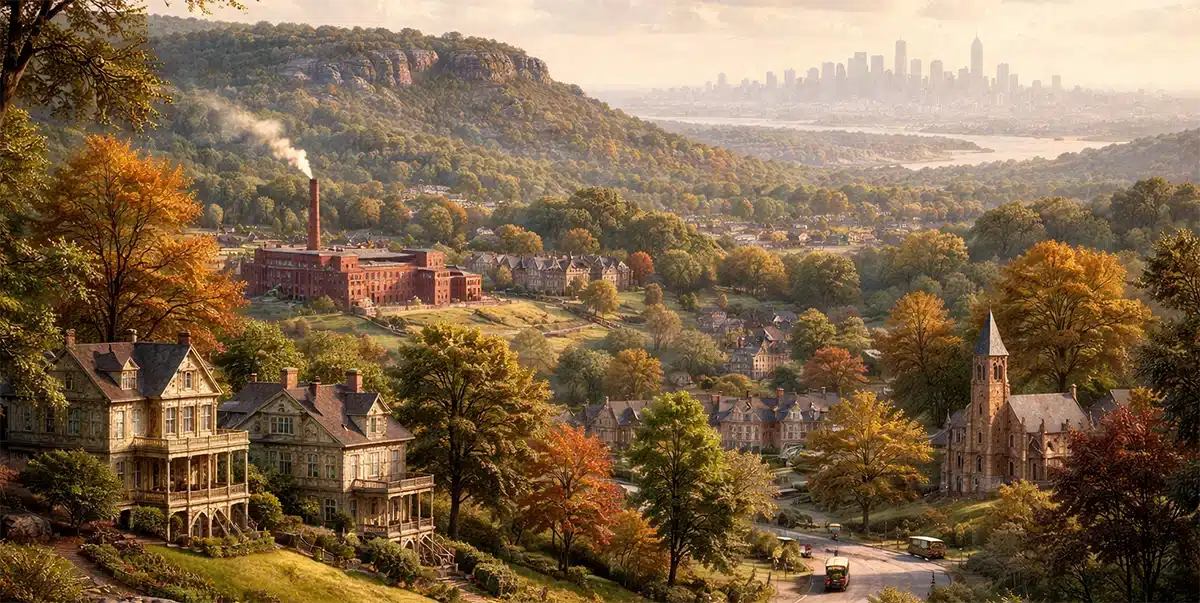
West Orange, New Jersey developed as a hillside township west of Newark, defined early by its terrain and later by its role in industrial research and suburban expansion.
Its history follows a clear sequence: indigenous land use, colonial farming, separation from Orange Township, the arrival of Thomas Edison’s laboratory, and steady residential growth through the twentieth century.
Table of Contents
Indigenous Presence and Early Land Use
Before European settlement, the land that became West Orange was occupied by the Lenape.
The Lenape used the Watchung Mountains and surrounding valleys for hunting, seasonal movement, and trade. Streams flowing east toward the Passaic River supported fishing and travel.
European settlers arrived in the late seventeenth century as Newark expanded westward. The area became known as Newark Mountain, a reference to the First Watchung Mountain ridge. Settlement progressed slowly due to rocky soil and steep grades, which limited large-scale agriculture.
Land use during this period focused on:
- Small farms
- Timber harvesting
- Limited trade with Newark
Population density remained low through the eighteenth century, and the area retained a rural character longer than communities closer to the coast or major rivers.
Orange Township and Early Development
By the early nineteenth century, the region was part of Orange Township, which included modern Orange, East Orange, South Orange, and West Orange.
Growth in Essex County increased demand for land and improved transportation routes.
Roads connecting Newark to western New Jersey passed through the township, encouraging movement of goods and people. Farms expanded where terrain allowed, and estates began to appear as Newark residents sought country properties.
Differences between the eastern and western sections of Orange Township became increasingly clear:
- Eastern villages developed denser housing and commerce
- Western areas retained farmland and estates
- Infrastructure needs diverged
These differences set the stage for political separation.
Incorporation of West Orange (1863)
West Orange became an independent township in 1863.
The decision reflected land use patterns rather than population size. The western section had fewer residents, more open land, and different priorities regarding development and taxation.
At incorporation, West Orange consisted primarily of:
- Farms and large properties
- Scattered residential clusters
- Minimal commercial centers
Township status allowed local control over roads, schools, and land regulation, which proved important as regional industrialization increased.
Thomas Edison and the West Orange Laboratory
In 1887, Thomas Alva Edison established a major research laboratory complex in West Orange.
This facility marked a shift in how invention was organized. Rather than working alone, Edison oversaw teams of machinists, chemists, and engineers conducting coordinated research.
Projects completed or advanced in West Orange included:
- Motion picture technology
- Sound recording improvements
- Electrical equipment
- Storage battery development
The laboratory operated continuously and employed dozens of skilled workers. Housing demand increased as employees relocated to the area.
Edison’s nearby residence, Glenmont, further tied his professional work to the township.
West Orange gained national attention as a center of applied research rather than manufacturing alone.
Transportation and Residential Expansion
By the late nineteenth and early twentieth centuries, transportation improvements supported residential growth.
Rail and streetcar access linked West Orange to Newark and New York City, making daily commuting possible.
Large estates were gradually subdivided, particularly in areas with easier access to transit. Development followed the terrain, resulting in neighborhoods shaped by elevation and road access rather than grid planning.
Key effects included:
- Growth of middle-class housing
- Formation of distinct neighborhoods
- Increased municipal infrastructure
Despite this growth, the Watchung Mountains limited large-scale industrial development and preserved open space.
Parks and Conservation
Preservation efforts played a major role in shaping West Orange’s physical layout.
Portions of the Watchung Mountains were protected as public parkland, preventing overdevelopment and protecting water resources.
Eagle Rock Reservation became one of the township’s most visible landmarks, offering views toward Manhattan and serving recreational and memorial purposes.
These conservation decisions:
- Restricted dense development in sensitive areas
- Maintained public access to green space
- Influenced long-term land values
The balance between development and preservation remains a defining feature of the township.
Demographic Change and Community Institutions
During the twentieth century, West Orange experienced gradual demographic change.
Immigration and internal migration brought new residents, contributing to cultural and religious diversity.
Community development included:
- Construction of houses of worship
- Expansion of public schools
- Growth of local businesses
Neighborhood identity often centered on schools, religious institutions, and civic organizations. Municipal governance remained relatively stable compared to more densely populated Essex County cities.
Postwar Growth and Modern Development
After World War II, West Orange expanded as automobile ownership increased.
Residential development moved farther from transit lines, and commercial corridors developed along major roads.
Former farmland gave way to housing developments, while educational and medical institutions expanded their presence.
By the late twentieth century, West Orange had become:
- Predominantly residential
- Economically mixed
- Regionally connected
Historic preservation efforts reinforced the township’s connection to its past, particularly regarding Edison’s legacy.
West Orange Today
Today, West Orange functions as a suburban township with strong historical ties and regional accessibility.
Its development remains influenced by geography, preserved land, and long-established infrastructure.
The township continues to balance:
- Residential growth
- Historic preservation
- Open space protection
Its history reflects gradual adaptation rather than abrupt change.
West Orange, New Jersey Q&A
When was West Orange established?
West Orange became an independent township in 1863.
Why is West Orange historically important?
Its significance stems largely from Thomas Edison’s research laboratory, which changed how industrial research was organized.
Was West Orange always suburban?
No.
It began as indigenous land, then farmland, later hosting estates and industrial research before transitioning into suburban development.
How did geography influence growth?
The Watchung Mountains limited dense development, guided road placement, and supported early conservation efforts.
What role did transportation play?
Railroads and streetcars connected West Orange to Newark and New York City, supporting residential growth.
Is Edison’s influence still visible?
Yes.
Preserved sites and local institutions continue to reference Edison’s work and its impact.
What defines West Orange today?
West Orange is defined by its residential character, preserved landscape, and historical role in innovation.