
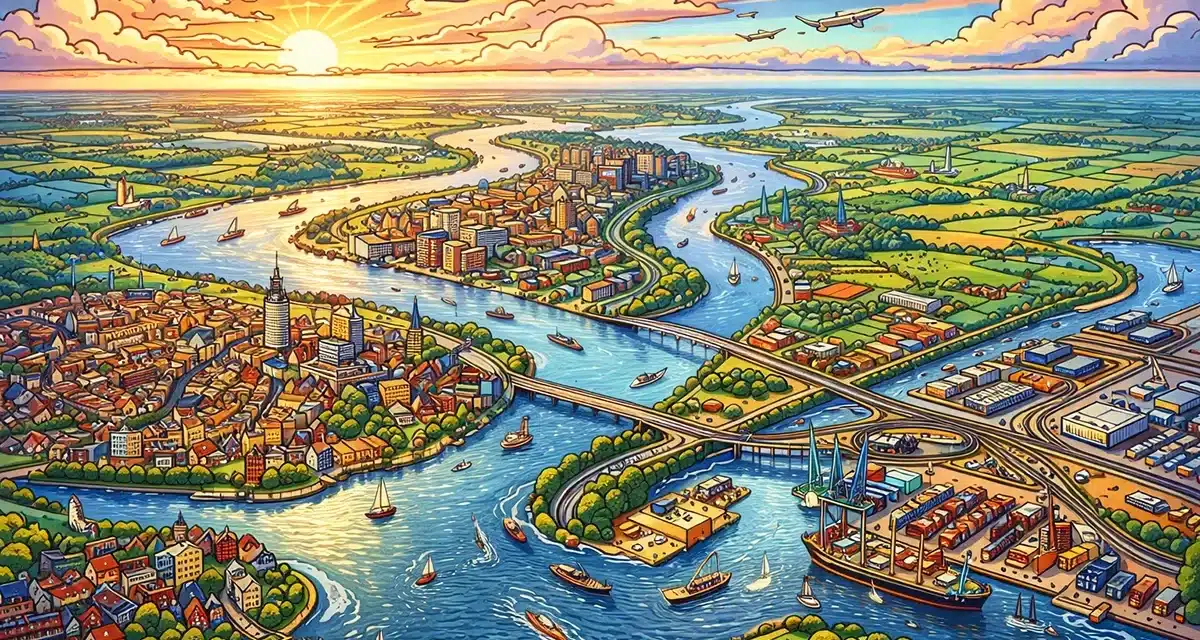
The Netherlands is not organized around a single dominant capital or region.
It functions as a dense, highly coordinated network of cities, ports, institutions, and infrastructure, designed for trade efficiency, governance stability, and outward projection.
Dutch influence flows less from territory and more from connectivity.
Modern Dutch power emerges from logistics, finance, law, urban planning, and cultural mediation.
Each region contributes a specific function to that system.
Table of Contents
Randstad: The Core Network
The Randstad is the Netherlands’ primary power zone, operating as an integrated urban ring rather than a single city.
The Randstad includes Amsterdam, Rotterdam, The Hague, and Utrecht.
Together, they form one of Europe’s most efficient metropolitan systems, linked by rail, waterways, and governance coordination.
Unlike centralized capitals elsewhere, no single Randstad city dominates completely.
Each holds a specialized role, and their proximity allows power to remain distributed but synchronized.
This structure reflects centuries of Dutch political logic: cooperation over hierarchy, function over symbolism.
Amsterdam: Culture, Finance, and Global Visibility
Amsterdam serves as the Netherlands’ cultural and financial gateway.
Historically a mercantile hub, Amsterdam accumulated wealth through trade, finance, and colonial commerce.
That legacy persists in modern banking, fintech, media, and creative industries.
Amsterdam projects soft power.
It exports cultural norms tied to openness, experimentation, and tolerance.
The city strongly influences global conversations around lifestyle, urban living, and social liberalism.
While economically powerful, Amsterdam does not function as the political center of the country. Its influence is expressive rather than directive.
Rotterdam: Logistics, Industry, and Physical Trade Power
Rotterdam is Europe’s most important logistical engine.
Home to the largest port in Europe, Rotterdam anchors the Netherlands’ role as a physical gateway into the continent.
Energy, raw materials, manufactured goods, and food products enter and exit Europe through its infrastructure.
Rotterdam’s culture is pragmatic, industrial, and non-romantic.
Its identity centers on rebuilding, efficiency, and labor rather than heritage aesthetics.
Globally, Rotterdam’s influence is structural. It shapes supply chains, shipping norms, and industrial logistics without relying on cultural visibility.
The Hague: Governance, Law, and Moral Authority
The Hague is the Netherlands’ political and legal center, despite not being the formal capital.
The city hosts national government institutions, international courts, and diplomatic bodies. Its authority is administrative and judicial rather than symbolic.
The Hague anchors the Netherlands’ reputation for rule-based governance, international law, and conflict mediation.
It contributes to global order through legal frameworks rather than force.
This separation of governance from cultural and economic dominance is deliberate and foundational to Dutch political culture.
Utrecht: Coordination and Infrastructure Logic
Utrecht operates as the Netherlands’ internal coordination hub.
Centrally located, Utrecht anchors rail networks, education institutions, and domestic connectivity.
It plays a stabilizing role rather than a directive one.
Historically a religious center, Utrecht transitioned into a knowledge and logistics node.
Its influence is operational, ensuring cohesion among more outward-facing cities.
Northern Netherlands: Agriculture and Energy Transition
The north contributes production, space, and experimentation capacity.
Less urbanized than the Randstad, northern provinces support agriculture, renewable energy infrastructure, and long-term spatial planning.
Wind energy projects, sustainable farming models, and climate adaptation initiatives often locate here.
Culturally, the north is quieter and more locally oriented, but politically significant due to land use and energy strategy.
Southern Netherlands: Manufacturing and Border Integration
The southern regions connect the Netherlands to Belgium and Germany through industry and logistics.
Cities like Eindhoven anchor advanced manufacturing and technology development.
The region benefits from proximity to German industrial networks and Belgian transport corridors.
This area supports export manufacturing, design, and applied engineering rather than finance or governance.
Dutch Federal-Style Balance
While formally a unitary state, the Netherlands behaves functionally like a federal system.
Municipal and regional governance is strong, and consensus-building dominates political culture.
No city monopolizes power.
Economic, political, cultural, and logistical authority are separated and interdependent.
This design reduces risk, encourages cooperation, and reinforces institutional trust.
The Netherlands’ Global Influence Model
Dutch influence is rarely confrontational. It is procedural.
- Trade systems and logistics design
- Legal norms and international arbitration
- Urban planning and water management
- Social policy experimentation
- Cultural openness and mediation
Rather than projecting ideology, the Netherlands exports methods.
The Netherlands as a Power Network
Dutch strength lies in density, trust, and coordination.
- Amsterdam supplies cultural visibility and finance
- Rotterdam supplies trade infrastructure
- The Hague supplies governance and law
- Utrecht supplies internal cohesion
- Peripheral regions supply space, production, and experimentation
This networked design allows a small country to exert outsized influence on global systems without centralizing authority.
Netherlands Q&A
Why doesn’t Amsterdam function like Paris or London?
Power in the Netherlands is intentionally distributed to prevent dominance by any single city.
Why is Rotterdam more important than its cultural profile suggests?
Its port anchors European trade flows, giving it strategic importance beyond visibility.
Why is the government based in The Hague and not Amsterdam?
Separating governance from commerce reinforces neutrality, stability, and institutional balance.
How does the Netherlands maintain global influence without military power?
By shaping trade, law, infrastructure, and governance models used internationally.
What defines Dutch power culturally?
Pragmatism, negotiation, procedural trust, and openness rather than spectacle or ideology.