
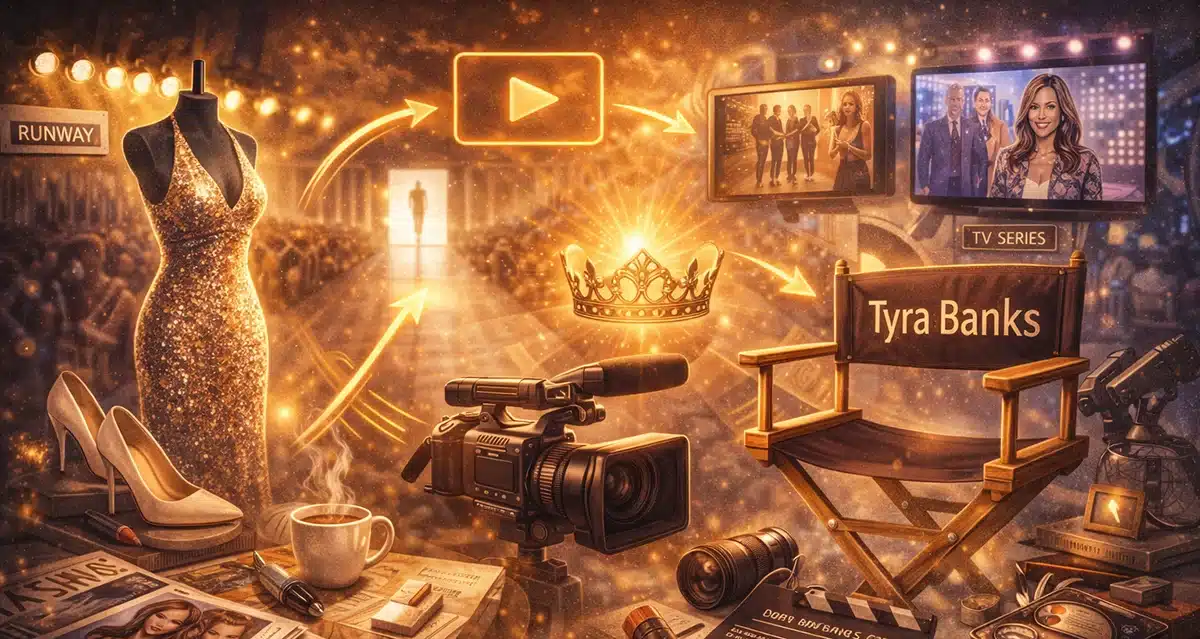
Tyra Banks reshaped the role of the fashion model by extending influence beyond runway and editorial work into mass media, television production, and cultural commentary.
Her career represents a structural shift in how modeling power is accumulated, exercised, and sustained within mainstream culture.
Banks did not rely solely on fashion validation.
She built authority by controlling platforms, narratives, and visibility at a scale that exceeded traditional modeling pathways.
Table of Contents
Modeling as Entry Point Rather Than End State
Banks treated modeling as a foundation rather than a terminal role.
Emerging during a period when runway prestige and editorial exposure defined modeling success, Banks leveraged those credentials while deliberately expanding beyond them.
Fashion functioned as credentials, not confinement.
Her early modeling career established legitimacy within elite fashion systems.
That legitimacy enabled later transitions into television, entrepreneurship, and cultural commentary without severing ties to fashion authority.
Modeling became infrastructure rather than identity.
Television as a Power Multiplier
Mass media exposure expanded Banks’s influence beyond fashion audiences.
Banks recognized television as a mechanism for scale.
Hosting, producing, and appearing in mainstream programming allowed her to reach audiences far larger than fashion publishing alone could provide.
Television altered the model’s role from visual reference to narrative authority.
Banks was no longer merely depicted.
She spoke, framed discussions, and mediated industry access.
This shift repositioned the fashion model as an active participant in cultural production.
Reality Media and Gatekeeping Authority
Banks institutionalized modeling authority through competitive media formats.
By creating and leading modeling-centered television programs, Banks converted industry expertise into gatekeeping power.
These platforms defined standards, evaluated performance, and shaped public understanding of modeling labor.
Key structural effects included:
- Visibility into industry processes
- Expansion of modeling narratives beyond aesthetics
- Public framing of professionalism and discipline
Authority shifted from designers and editors toward media-based arbiters.
Mainstreaming Fashion Industry Language
Banks translated fashion systems into accessible cultural discourse.
Terminology, critique frameworks, and performance standards typically confined to industry contexts were presented to mass audiences.
This translation increased public familiarity with modeling labor and evaluation.
Fashion became legible rather than remote.
Viewers encountered critique, branding logic, and self-presentation as structured skills.
This accessibility broadened engagement while reinforcing Banks’s role as interpreter and mediator.
Representation and Visibility
Banks’s prominence carried representational significance within mainstream media.
Her sustained visibility challenged exclusionary norms in fashion and entertainment spaces that historically limited access.
Representation operated not as symbolism alone but as occupational presence.
Visibility mattered structurally:
- It expanded pathways for aspiring models
- It normalized authority across media roles
- It diversified public images of leadership within fashion-adjacent industries
Representation became embedded in function rather than rhetoric.
Business Ownership and Brand Control
Banks extended influence through ownership rather than endorsement alone.
Beyond appearances, she pursued control over intellectual property, production formats, and brand extensions.
This orientation prioritized durability and autonomy.
Ownership enabled:
- Continuity across media cycles
- Insulation from trend volatility
- Strategic reuse of platform equity
Creative and commercial control reinforced one another.
Modeling as Labor, Not Ornament
Banks reframed modeling as disciplined performance rather than passive display.
Her media narratives emphasized preparation, adaptability, critique, and resilience.
Modeling was presented as work governed by rules rather than by innate traits alone.
This framing altered public perception.
The model appeared as a professional subject to evaluation and skill development.
Fashion labor gained visibility as process.
Cultural Authority Beyond Fashion
Banks’s influence extended into broader cultural conversations.
By operating across fashion, television, and public discourse, Banks occupied a hybrid role. She addressed issues of image, confidence, evaluation, and ambition in contexts unrelated to garments.
Cultural authority followed platform reach rather than industry boundaries.
Fashion became one component within a broader media identity.
Power rested in narrative continuity.
Longevity Through Platform Adaptation
Banks sustained relevance by adapting platforms rather than aesthetics.
Rather than anchoring influence to seasonal trends, she shifted formats as audiences evolved.
Authority migrated across mediums while maintaining thematic consistency.
Longevity emerged from structural agility rather than stylistic reinvention.
Media presence replaced fashion cycles as the unit of endurance.
Structural Impact on the Modeling Industry
Banks altered expectations for what modeling success entails.
Modern modeling careers increasingly incorporate media literacy, personal branding, and cross-platform participation.
These expectations mirror pathways Banks normalized.
Influence now depends on:
- Narrative control
- Platform ownership
- Audience engagement beyond fashion
Her impact persists in the expanded scope of modeling authority.
Tyra Banks Q&A
What distinguishes Tyra Banks from earlier supermodels?
She converted modeling prestige into media ownership and narrative authority.
Did Banks change how modeling is perceived?
Yes. She reframed modeling as skilled labor with visible evaluation processes.
Why was television central to her influence?
Television provided scale, authorship, and sustained audience access.
Was her power limited to fashion?
No. Her authority extended across entertainment and cultural discourse.
Is her influence still visible today?
Yes. Contemporary models increasingly follow media-expanded career paths she normalized.