
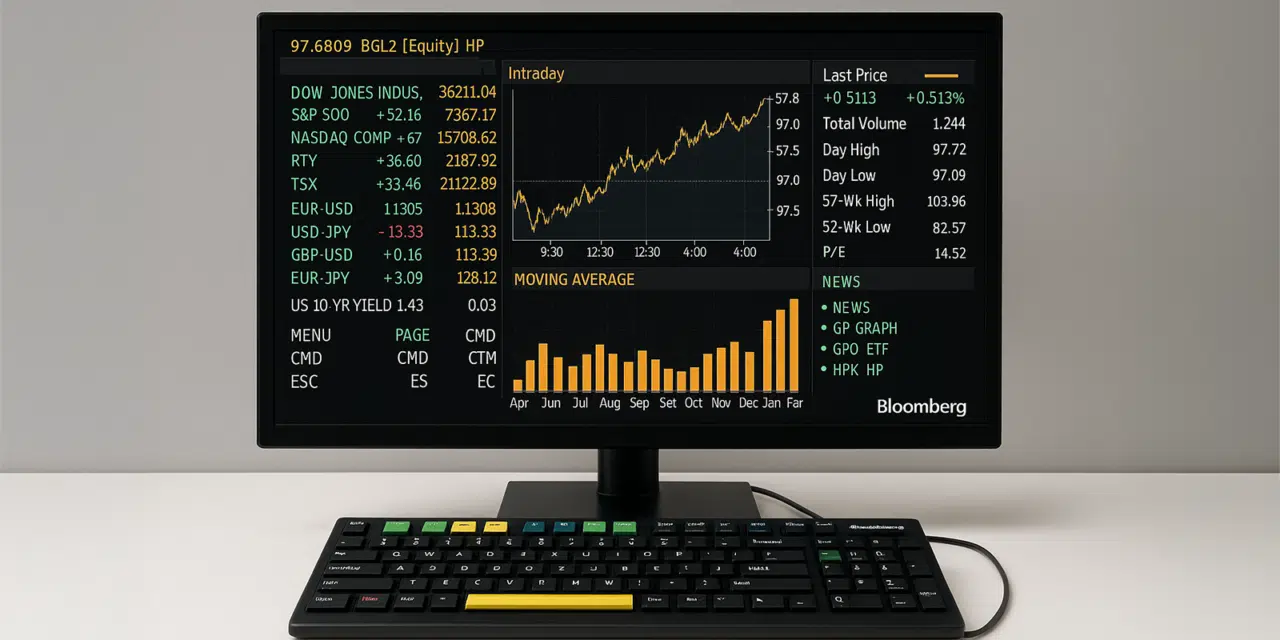
A Bloomberg Terminal is often treated as the ultimate symbol of market intelligence.
Screens packed with charts, flashing headlines, yield curves, and global data feeds suggest an almost unfair advantage.
For traders, that perception is often accurate. For long-term investors, it’s more complicated.
Understanding what Bloomberg actually provides — and who it truly serves — reveals a deeper truth about investing styles, behavioral discipline, and why more information is not always better information.
Table of Contents
What a Bloomberg Terminal Is Really Built For
A Bloomberg Terminal is designed for speed, confirmation, and risk management, not for discovering long-term conviction.
Its real value shows up in moments where seconds matter, assumptions must be tested instantly, and capital must be protected in fast-moving environments.
It excels at helping traders answer questions like:
- Is this move real or thin liquidity?
- Is the news already priced in?
- Is positioning crowded or under-owned?
- Where is risk building before it becomes obvious?
For traders, those answers directly shape entries, exits, sizing, and survival.
Live Market Data: Seeing Liquidity, Not Just Price
Real-time data is the foundation of the Bloomberg ecosystem, and it goes far beyond delayed charts on public websites.
Traders see live bid/ask spreads, depth of book, volume by venue, and second-by-second price behavior.
This matters because:
- Liquidity often tells the real story before price does
- Breakouts can be validated or rejected in real time
- Thin markets and distorted pricing become visible immediately
For short-term decision-making, this is critical. It’s the difference between trading with the market versus trading into it.
News That Arrives Before the Crowd
Bloomberg’s news edge comes from speed, precision, and direct ticker relevance.
Headlines from Bloomberg journalists often hit terminals before they reach mainstream outlets, social media, or news aggregators.
That allows traders to:
- React in seconds rather than minutes
- Understand why price moved instead of guessing later
- Decide whether a move reflects emotion or real repricing
In fast markets, information delays can be expensive. For traders, this speed can be the difference between profit and damage control.
Economic Data and Expectations, Not Just Headlines
Macro trading lives and dies on expectations versus reality, and Bloomberg specializes in showing that gap clearly.
The terminal doesn’t just show CPI or jobs numbers — it shows consensus, prior readings, revisions, and historical reactions.
This enables:
- Scenario planning before releases
- Smarter interpretation of “bad” or “good” numbers
- Reduced emotional reaction after data hits
Macro traders aren’t reacting blindly. They’re trading probability and surprise.
Deep Fundamentals Without the Noise
Bloomberg cleans and standardizes company fundamentals in a way public sites often can’t.
Financials, margins, forward estimates, cash flow, and segment exposure are normalized across companies and regions.
This helps traders and investors:
- Judge whether a price move is justified
- Identify disconnects between earnings reality and price action
- Avoid headline-driven misinterpretation
For swing and position traders, this layer matters. It keeps trades anchored to something real.
Rates, Bonds, and the Cost of Money
Many equity traders ignore rates until they get punished for it — Bloomberg doesn’t let you.
Yield curves, credit spreads, funding stress, and central bank probabilities are all visible in one place.
This allows traders to:
- See risk appetite shift before equities respond
- Understand pressure on growth stocks, banks, and housing
- Trade equities with a macro-aware lens
Ignoring rates often works — until it doesn’t.
Flow, Positioning, and Sentiment
This is where trades move from ideas to probabilities.
Bloomberg tracks fund flows, ETF inflows and outflows, futures positioning, volatility surfaces, and skew.
This data helps traders:
- Avoid crowded trades
- Spot squeeze risk early
- Identify moves lacking real participation
Price alone doesn’t tell you who’s involved. Positioning does.
History as a Guardrail Against Storytelling
Bloomberg’s historical depth keeps traders honest.
Decades of clean data allow for event studies, correlation analysis, and regime comparisons.
This reduces the temptation to assume “this time is different” without evidence and helps traders:
- Size positions based on past drawdowns
- Build rules instead of gut reactions
- Separate pattern from coincidence
Execution and Self-Assessment
The terminal doesn’t just help you trade — it helps you audit yourself.
Execution analysis, slippage review, and performance attribution show whether your edge is real or imagined.
Good traders review ideas.
Great traders review behavior.
The Big Picture: What Bloomberg Actually Does
A Bloomberg Terminal does not make someone a good trader.
It removes information delays, reduces false assumptions, and highlights risk early. Used well, it helps traders avoid bad decisions more than it helps them find brilliant ones.
But that strength is also its weakness — depending on who you are.
Why a Buffett-Style Investor Doesn’t Need Bloomberg
Long-term conviction investing operates on a completely different system.
The edge is not speed. It’s patience.
A buy-and-hold approach assumes:
- You don’t need to be first
- You expect volatility
- You ignore intraday noise
- You let time, not timing, do the work
Bloomberg is optimized for people who must react now.
A conviction investor deliberately does not.
You Already Use the Right Inputs
Long-term investing depends on:
- Business models
- Cash generation
- Balance sheet strength
- Competitive position
- Management behavior
- Structural trends
All of this can be gathered through:
- Annual reports and filings
- Earnings calls
- Investor presentations
- Long-form reading
- Time itself
Bloomberg aggregates faster.
It doesn’t change the conclusion.
The Hidden Risk: Over-Monitoring
For long-term investors, too much information can reduce returns.
Constant price watching creates anxiety, false urgency, and narrative pressure.
One of the most valuable skills in investing is doing nothing — and Bloomberg actively works against that.
Buffett’s advantage has always been behavioral:
- He reads constantly
- He trades rarely
- He ignores most noise
When Bloomberg Might Make Sense (Rarely)
There are limited cases where it could help:
- Evaluating businesses highly sensitive to rates or commodities
- Studying complex capital structures or debt maturity risk
- Understanding sector-wide macro pressure before buying
Even then, it’s a research tool — not a daily companion.
The Quiet Truth
A Bloomberg Terminal gives you more information.
A conviction-based strategy benefits from:
- Better judgment
- Capital inflow discipline
- Emotional restraint
Reading constantly without acting impulsively is not a contradiction. It’s a strength.
High information paired with low activity is rare — and powerful.
In that sense, avoiding the screen isn’t ignorance. It’s discipline.
And yes, it’s funny: the people who would benefit least from a Bloomberg Terminal are often the ones most capable of using it responsibly.
Q&A: Bloomberg Terminals, Trading, and Long-Term Investing
Does a Bloomberg Terminal guarantee better returns?
No.
It improves information quality and timing, but returns still depend on discipline, risk management, and behavior.
Who benefits most from Bloomberg?
Active traders, macro investors, institutions, and anyone whose strategy depends on speed, execution, and positioning.
Can long-term investors use Bloomberg effectively?
Yes — but only sparingly.
Used constantly, it often increases noise and emotional interference.
Is reading a lot of news bad for investors?
Not if reading builds context rather than triggers action.
The danger isn’t information — it’s impulsive response.
Why does “doing nothing” matter so much?
Because time, reinvestment, and staying invested outperform most attempts at cleverness.
What’s the real edge most investors miss?
Behavior.
Tools amplify habits. They don’t replace them.