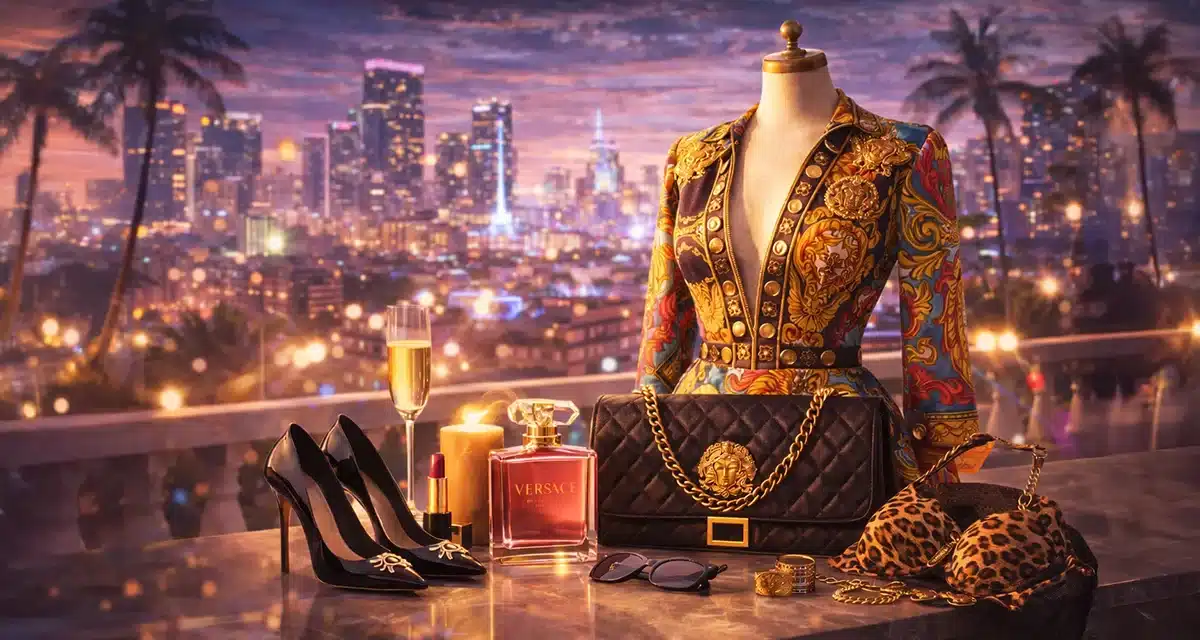
Gianni Versace transformed fashion by relocating its center of gravity from craft authority to visual dominance.
His work did not abandon luxury tradition, but it reoriented luxury toward attention, immediacy, and mass recognition.
Versace treated fashion as performance rather than refinement, making spectacle a structural feature rather than a byproduct.
His influence reshaped how fashion asserted power in the late twentieth century.
Table of Contents
Italian Fashion Before Versace
Italian fashion historically emphasized craftsmanship, restraint, and regional identity over theatrical display.
Prior to Versace’s rise, Italian luxury rested on material excellence and tailoring precision.
Milanese fashion favored quality, proportion, and quiet assurance.
Brands communicated value through workmanship rather than overt imagery.
This system produced credibility but limited cultural reach.
Craft excellence alone did not guarantee recognition outside specialist circles.
Italian fashion possessed authority without mass visibility.
The conditions were set for a different operating model.
Versace’s Entry and the Shift Toward Visibility
Versace entered fashion by prioritizing visual impact as commercial strategy.
From early collections, his work rejected understatement. Color, cut, and surface commanded attention. Sexuality was explicit rather than implied.
Garments emphasized the body directly, often through sharp tailoring, exposed skin, or high-contrast materials.
This approach responded to expanding media ecosystems.
Fashion imagery now circulated rapidly through magazines, television, and advertising. Versace designed for reproduction, not contemplation.
Visibility became currency.
Sexuality as Structural Device
Sex functioned in Versace’s work as operational mechanism rather than personal expression.
Sexuality amplified recognition. It accelerated memorability. It positioned garments within cultural conversation beyond fashion audiences.
Importantly, it remained controlled.
Versace’s use of sex relied on:
- Body-conscious silhouettes
- Strategic exposure rather than abstraction
- High-contrast materials and prints
- Direct alignment with photographic media
Sex did not undermine luxury.
It redefined luxury’s tone.
Celebrity as Distribution Channel
Versace integrated celebrity directly into the fashion system rather than treating it as endorsement.
Celebrities did not simply wear Versace. They embodied it.
Red carpet appearances, concerts, and public events replaced salons and private fittings as primary visibility arenas.
This integration produced measurable effects:
- Fashion reached global audiences instantly
- Designers gained recognition comparable to entertainers
- Clothing became inseparable from public persona
Celebrity became infrastructure for fashion dissemination.
Runway as Performance Space
Versace transformed the runway into a staged spectacle designed for media capture.
Shows prioritized emotional response over technical explanation.
Music, lighting, choreography, and casting reinforced a unified atmosphere.
The presentation itself carried meaning independent of garments.
This format achieved several outcomes:
- Increased press amplification
- Broader audience engagement
- Event status beyond industry function
Runways became cultural events rather than trade showcases.
The Supermodel Alliance
Versace elevated models into integrated components of brand narrative.
Supermodels functioned as repeatable figures across shows, campaigns, and public appearances.
Their presence reinforced recognition and continuity.
This alignment mattered structurally.
Models acted as mobile billboards, connecting body, celebrity, and clothing into singular image units.
The relationship amplified both parties.
Visibility multiplied.
Resistance and Critique
Versace’s approach challenged prevailing definitions of taste and restraint.
Critics characterized the work as excessive or vulgar. These critiques did not hinder success.
They reinforced differentiation. Fashion debate became part of brand visibility.
Spectacle generated division. Division produced attention. Attention converted to influence.
Opposition functioned as reinforcement rather than deterrent.
Legacy and Structural Impact
Versace permanently altered how fashion engages media, celebrity, and desire.
Post-Versace fashion increasingly embraced visibility as necessity.
Brands learned that recognition could outweigh refinement. Spectacle proved scalable.
Contemporary fashion continues to rely on principles Versace normalized:
- Event-driven launches
- Celebrity-centered branding
- Sexuality as visual shorthand
- Media-first design logic
Spectacle became durable system component.
Gianni Versace Q&A
How did Gianni Versace change luxury fashion structurally?
He repositioned visibility and spectacle as central components of luxury authority.
Was sexuality essential to Versace’s success?
Yes. It functioned as controlled mechanism for recognition and memorability.
Why did Versace rely so heavily on celebrity?
Celebrity provided immediate global distribution and cultural relevance.
Did spectacle replace craftsmanship in Versace’s work?
No. Craft remained present, but it served visibility rather than restraint.
Why was Versace controversial within fashion circles?
His work rejected traditional boundaries of taste and understatement.
What defines Versace’s lasting influence?
The normalization of fashion as spectacle operating across media, celebrity, and mass attention systems.