
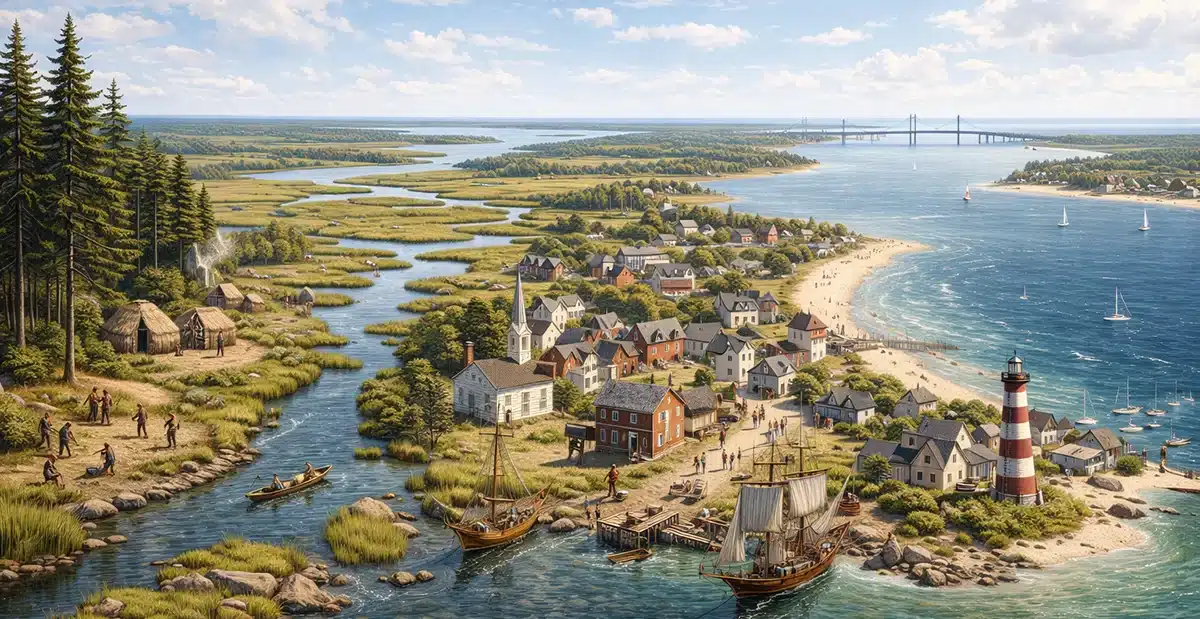
The Delmarva Peninsula is a shared geographic region shaped by water, agriculture, and long-term isolation.
The Delmarva Peninsula occupies a distinctive position along the eastern seaboard of the United States. Bounded by the Chesapeake Bay to the west and the Atlantic Ocean and Delaware Bay to the east, it forms a narrow landmass shared by Delaware, Maryland, and Virginia.
Its name reflects that division, combining elements of each state into a single regional identity.
Rather than developing along state lines, the peninsula evolved as a continuous ecological and economic zone defined by flat terrain, extensive waterways, and proximity to coastal trade routes.
Table of Contents
Geography and Natural Boundaries
The peninsula’s defining feature is its relationship to water.
Bays, rivers, wetlands, and tidal inlets surround and penetrate the landmass, shaping settlement patterns and economic activity.
Key geographic characteristics include:
- Low elevation and flat topography
- Sandy and loamy soils suitable for farming
- Extensive wetlands and estuaries
- Long coastlines with protected bays
These features limited dense urban development while supporting agriculture, fishing, and maritime trade.
Indigenous Presence Before European Contact
Human activity on the Delmarva Peninsula predates European settlement by thousands of years.
Before European arrival, Algonquian-speaking Indigenous groups inhabited the peninsula. Communities were typically located near rivers and bays, allowing easy access to food sources and transportation.
Indigenous Economies and Lifestyles
Indigenous societies relied on a combination of land and water resources.
Primary activities included:
- Fishing and shellfish harvesting
- Seasonal agriculture
- Hunting and foraging
- Canoe-based trade
These communities maintained strong connections to regional trade networks across the Mid-Atlantic, long before colonial borders existed.
Early European Exploration and Settlement
European powers were drawn to Delmarva for its access to waterways rather than its interior land.
Exploration began in the early seventeenth century, with Dutch, Swedish, and English interests competing for control. The English eventually consolidated authority, but settlement progressed slowly.
Colonial Settlement Patterns
Unlike major port cities farther north and south, Delmarva developed through dispersed farming communities and small ports.
Characteristics of early settlement included:
- Scattered rural homesteads
- Small river and bay towns
- Limited urban concentration
Economic activity centered on agriculture and maritime commerce rather than manufacturing or finance.
Agriculture and the Rural Economy
Agriculture became the defining economic force of the Delmarva Peninsula.
The peninsula’s flat terrain and long growing seasons supported sustained farming activity from the colonial period onward.
Crop selection evolved over time as markets shifted.
Agricultural Development Over Time
Major agricultural phases included:
- Tobacco and grain cultivation in the colonial era
- Mixed farming and livestock in the nineteenth century
- Industrial-scale poultry production in the twentieth century
This agricultural focus reinforced rural settlement patterns and limited large-scale industrial growth.
Maritime Trade and Coastal Industries
Water access positioned Delmarva as a regional hub for fishing and bay-based commerce.
Rivers and bays functioned as transportation networks long before roads and railways connected the region to nearby cities.
Water-Based Economic Activity
Key maritime industries included:
- Fishing and crabbing
- Oyster harvesting
- Small-scale shipbuilding
- Coastal trade and transport
These activities tied Delmarva closely to surrounding urban markets while preserving its rural character.
Slavery, Labor, and the Civil War Era
Labor systems on the peninsula reflected its position between North and South.
Slavery existed throughout Delmarva, though at varying levels of intensity.
Maryland and Virginia counties relied more heavily on enslaved labor than Delaware, where gradual emancipation laws took effect earlier.
Civil War Impacts
During the Civil War:
- Delaware and Maryland remained in the Union
- Virginia seceded
- Trade and agriculture were disrupted
- Enslaved and free Black communities experienced major social shifts
After emancipation, Black communities established lasting institutions that remain central to the peninsula’s social history.
Twentieth-Century Change and Modern Development
The twentieth century brought greater connectivity without erasing rural character.
Infrastructure improvements reduced isolation and integrated the peninsula into broader East Coast economies.
Economic and Social Shifts
Major developments included:
- Expansion of highway and bridge networks
- Growth of poultry processing industries
- Rise of coastal tourism economies
Beach towns developed distinct seasonal economies, while inland areas remained agriculturally focused.
Environmental Importance and Risk
The Delmarva Peninsula remains environmentally significant and increasingly vulnerable.
Wetlands and estuaries support wildlife habitats and play a critical role in water filtration and storm protection.
Modern Environmental Challenges
Key concerns include:
- Agricultural runoff
- Habitat loss
- Rising sea levels
- Coastal erosion
Low elevation makes large portions of the peninsula especially sensitive to climate-driven change.
Regional Identity Across State Lines
Delmarva functions as a single cultural and environmental region despite political boundaries.
Shared land use, food traditions, and economic history connect communities across Delaware, Maryland, and Virginia.
The peninsula’s identity is shaped more by geography than governance.
The Delmarva Peninsula Q&A
Why is it called the Delmarva Peninsula?
The name combines Delaware, Maryland, and Virginia, the three states that share the peninsula.
Was the region heavily industrialized?
No. Agriculture and maritime industries dominated, with limited heavy manufacturing.
How did geography shape development?
Flat land and water access favored farming and trade while discouraging dense urban growth.
Why did towns remain small?
Economic activity centered on agriculture and bays rather than industrial concentration.
Is the peninsula environmentally important today?
Yes. Its wetlands and estuaries support biodiversity, water quality, and coastal resilience.